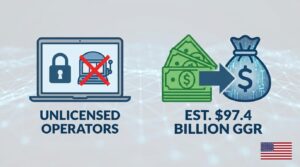
Unlicensed online gambling operators generated an estimated $97.4 billion in gross gaming revenue from US consumers, a figure that dwarfs the regulated market and underscores the scale of offshore activity still draining potential tax revenue from state coffers. The estimate, which has circulated among industry analysts and regulatory advocates, paints a stark picture of how much economic value remains outside the reach of licensed frameworks. For state legislators weighing the costs of inaction on gambling reform, this number is difficult to ignore. And for licensed operators competing on compliance-heavy terms, it represents a competitive distortion that no marketing budget can offset.
What $97.4 Billion in Unregulated GGR Signals for the US Market
Before parsing the strategic implications, it helps to anchor what this figure actually means in context. The entire US regulated online gambling and sports betting market generated a fraction of that total in recent years. The gap between licensed and unlicensed revenue isn’t narrowing fast enough to satisfy regulators or the operators investing heavily in compliance infrastructure.
- The $97.4 billion GGR estimate from unlicensed operators suggests that for every dollar earned by a regulated platform, several more flow to offshore or otherwise unauthorised sites operating without consumer protections.
- State governments are forfeiting billions in potential tax revenue, money that could fund public services, responsible gambling programs, or enforcement itself.
- Licensed operators face an uneven playing field: they absorb the costs of licensing, responsible gambling mandates, and advertising restrictions while unlicensed competitors operate without those constraints.
- Consumer protection gaps widen as players on unlicensed platforms lack recourse for disputes, data breaches, or manipulated odds.
- The sheer volume of unregulated activity complicates federal and state enforcement strategies, which remain fragmented and underfunded relative to the problem’s scale.
Why the Offshore Market Persists at This Scale
Several structural factors sustain the unlicensed gambling ecosystem in the US. The patchwork of state-by-state regulation leaves significant geographic gaps. Only a portion of US states have legalised online casino gambling or sports betting, and even in those that have, the rollout has been uneven. Consumers in states without legal options don’t stop gambling. They migrate to offshore platforms that accept US players with minimal friction.
Payment processing is another enabler. Cryptocurrency adoption among unlicensed platforms has made it harder for traditional banking gatekeepers to intercept transactions. Some platforms use layered payment structures (a distinction regulators have been slow to enforce) that obscure the origin and destination of funds.
There’s also the marketing dimension. Unlicensed operators often advertise through social media channels, affiliate networks, and influencer partnerships that fall outside the advertising standards enforced on licensed operators. The result: a parallel economy that recruits players through channels regulators struggle to monitor.
The Tax Revenue Equation States Cannot Afford to Ignore
If even a modest share of that $97.4 billion were captured within regulated frameworks, the fiscal impact would be substantial. Consider that most US states with legal online gambling impose effective tax rates ranging from 15% to over 50% on operator GGR. Applied to even 10% of the estimated unlicensed total, the revenue implications run into the billions.
| Scenario | Captured GGR (est.) | Tax Rate Range | Potential Tax Revenue |
|---|---|---|---|
| 10% of unlicensed GGR regulated | $9.74 billion | 15%–51% | $1.46B–$4.97B |
| 25% of unlicensed GGR regulated | $24.35 billion | 15%–51% | $3.65B–$12.42B |
| 50% of unlicensed GGR regulated | $48.7 billion | 15%–51% | $7.3B–$24.84B |
These are rough projections, not forecasts. But they illustrate why the conversation around unlicensed gambling is increasingly framed in fiscal terms rather than purely moral or regulatory ones.
How Licensed Operators Are Responding
Major licensed platforms like DraftKings’ regulated sportsbook and casino operations have invested heavily in compliance, responsible gambling tools, and state-level lobbying to expand legal markets. Their argument is straightforward: every state that legalises and regulates online gambling shrinks the addressable market for offshore operators.
Still, the pace of legalisation has frustrated the industry. Some states remain politically resistant to online casino expansion, even where sports betting has been approved. Others impose tax rates so high that operators question the viability of competing with tax-free offshore alternatives on price and promotions.
One underexplored angle is enforcement cooperation. Licensed operators possess data on player behaviour, market trends, and even specific unlicensed competitors that could prove valuable to regulators. Whether that intelligence-sharing becomes formalised remains an open question.
Reframing the Problem: Consumer Behaviour, Not Just Enforcement
Arguably, the most overlooked dimension of this issue is behavioural. Enforcement-first strategies assume that shutting down supply will reduce demand. But consumer psychology tells a different story. Players gravitate toward unlicensed platforms not solely because legal options are unavailable, but because those platforms often offer better odds, higher bonuses, and fewer restrictions on bet sizes.
Addressing this requires regulators to think beyond prohibition. Product competitiveness matters. When legal platforms are constrained to the point where their offerings feel inferior, consumers with even moderate digital literacy will find alternatives. The challenge, then, is designing regulatory frameworks that protect consumers without making the legal product so restrictive it pushes players offshore.
This tension sits at the heart of responsible gambling policy. Overly paternalistic rules can backfire, channelling activity toward environments with zero oversight. At least on paper, a more permissive but well-monitored legal market might achieve better consumer protection outcomes than a restrictive one that drives players underground.
Frequently Asked Questions
How was the $97.4 billion GGR figure estimated?
The estimate draws on analysis of offshore platform activity, payment flow data, and consumer surveys. It represents gross gaming revenue, not total wagering volume, which would be significantly higher.
Are unlicensed gambling operators breaking US law?
Operating without a licence in jurisdictions that require one is unauthorised. Federal laws like the Wire Act and the Unlawful Internet Gambling Enforcement Act provide some enforcement tools, though their application varies and has been subject to legal interpretation.
What can consumers do to verify if a platform is licensed?
Players should check their state’s gaming commission website for a list of approved operators. Licensed platforms typically display their licence information prominently. If a platform accepts players from states where online gambling hasn’t been legalised, that itself is a red flag.
Will federal regulation solve the problem?
Federal legislation could create a more uniform framework, but political appetite for it remains limited. Most progress continues to happen at the state level, which means the patchwork approach, and the gaps it creates, will persist for the foreseeable future.



