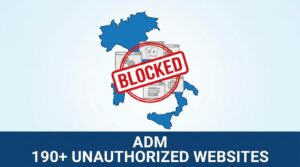
Italy’s gambling regulator, Agenzia delle Dogane e dei Monopoli (ADM), has directed internet service providers to block access to 190 additional unauthorised gambling websites. The order pushes the country’s total blacklist beyond 10,000 domains, a threshold that underscores both the scale of unlicensed online gambling in Italy and the regulator’s sustained appetite for enforcement. This latest batch, confirmed in recent weeks, reflects a pattern of escalating digital crackdowns that have intensified since Italy overhauled its approach to online gambling oversight.
What ADM’s Expanding Blacklist Signals for Italy’s Gambling Market
The blocking order lands at a moment when Italy is simultaneously preparing broader regulatory reforms for its licensed gambling sector. Before diving into the specifics, here are the strategic takeaways from this enforcement action:
- Total blocked domains now exceed 10,000, making Italy’s gambling blacklist one of the most extensive in Europe.
- ADM continues to act without waiting for legislative reform, relying on existing powers to compel ISPs to restrict access at the DNS level.
- The 190 newly blocked sites operated without Italian licences, offering casino, sports betting, or poker products to Italian consumers.
- Unlicensed operators face not just domain blocking but potential criminal referrals under Italian law, which classifies unauthorised gambling promotion as a punishable offence.
- Licensed operators stand to benefit from reduced competition by unregulated platforms that often undercut them on odds, bonuses, or tax-free pricing.
How Italy Built Europe’s Largest Gambling Blacklist
Italy was among the first EU member states to regulate online gambling through a licensing framework, beginning with a 2006 decree and expanding significantly with the 2011 reorganisation of ADM’s predecessor agency. Since then, the regulator has maintained an aggressive posture toward unlicensed operators. The blacklist mechanism works through ISP-level DNS blocking: once a domain appears on ADM’s list, Italian internet providers must prevent users from resolving that address.
It is a blunt instrument. And it has known limitations.
VPN usage, mirror domains, and rapid domain cycling all allow determined operators to circumvent blocks. Yet the sheer volume of enforcement actions (a distinction regulators elsewhere have been slow to replicate) creates friction that discourages casual users from reaching unauthorised sites. That friction, arguably, matters more than perfect enforcement. Most recreational gamblers will not bother with workarounds when licensed alternatives from operators like Bet365’s regulated Italian platform or Sisal are readily accessible.
The Numbers Behind the Crackdown
| Metric | Detail |
|---|---|
| Newly blocked domains | 190 | Total blacklisted domains | Over 10,000 |
| Enforcement mechanism | ISP-level DNS blocking |
| Legal basis | Italian gambling legislation and ADM administrative powers |
| Penalty for unauthorised operators | Criminal referral, fines, domain seizure |
Why the Timing Matters: Italy’s Regulatory Overhaul Looms
Italy’s government has been working toward a comprehensive reorganisation of its gambling concession system. New tenders for online gambling licences are expected to reshape the competitive landscape, with higher entry costs and stricter compliance requirements likely to thin the field of licensed operators. Against that backdrop, ADM’s continued blacklist enforcement serves a dual purpose: it protects the integrity of the licensing framework that is about to be refreshed, and it sends a clear signal to prospective bidders that the regulator will actively defend their market exclusivity.
Still, whether blocking alone can meaningfully reduce the channelisation gap remains an open question. Industry estimates suggest that unlicensed gambling captures a non-trivial share of Italian wagering activity, though reliable figures are difficult to pin down. ADM has not published a comprehensive channelisation study in recent years, and independent estimates vary widely.
Broader European Context: Enforcement Divergence
Not every European regulator has followed Italy’s path. Some jurisdictions, notably Germany during its prolonged transition to the Interstate Treaty on Gambling, relied more heavily on payment blocking than domain blocking. Others, like the UK’s Gambling Commission, focus enforcement on operator licensing conditions rather than ISP-level restrictions. Italy’s approach sits at the more interventionist end of the spectrum, combining domain blocking with financial transaction monitoring and advertising restrictions.
What makes Italy’s model distinctive is its persistence. Many regulators issue blocking orders in sporadic bursts. ADM treats it as a continuous operational function, adding domains in batches of dozens or hundreds on a rolling basis. The cumulative effect, at least on paper, is a progressively tighter net around unlicensed operators targeting Italian consumers.
What Unlicensed Operators Risk Under Italian Law
Operating without an ADM licence in Italy carries consequences beyond domain blocking. Italian criminal law treats the promotion and organisation of unauthorised gambling as an offence, with penalties that can include imprisonment. Payment processors facilitating transactions with blacklisted operators also face regulatory scrutiny, and ADM has previously coordinated with financial authorities to disrupt payment flows to unlicensed sites.
For operators considering the Italian market, the calculus is straightforward: the cost of non-compliance has risen steadily, and the upcoming concession reform will likely raise it further. Whether that deters the most aggressive offshore operators, many of whom cycle through disposable domains and corporate shells, is another matter entirely.
Frequently Asked Questions
What does ADM’s blocking order mean for Italian players?
Italian internet users attempting to access any of the 190 newly blocked domains will find them unreachable through standard browsing. Licensed alternatives remain fully accessible, and ADM’s intent is to redirect gambling activity toward regulated platforms where consumer protections apply.
Can blocked gambling sites still be accessed?
Technically, yes. VPNs and alternative DNS resolvers can bypass ISP-level blocks. But the regulator’s goal is not hermetic enforcement; it is raising the barrier high enough that most users default to licensed options.
How does Italy’s approach compare to other EU countries?
Italy maintains one of Europe’s most aggressive domain-blocking programmes. Countries like France and Spain also block unlicensed sites, though typically at lower volumes. The UK takes a different tack, focusing on operator accountability rather than ISP restrictions. Italy’s model combines both strategies, which makes its enforcement posture unusually layered for a European market.
Will the upcoming licence reform affect enforcement?
Almost certainly. New concession terms are expected to include stricter technical and financial requirements, and ADM has signalled that protecting licensees from unlicensed competition will remain a priority. The blacklist, in that sense, is infrastructure for the next regulatory era, not just a response to the current one.



