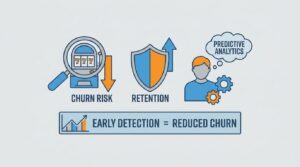
Player churn in online casinos rarely arrives as a single, dramatic exit. It builds quietly — session times shrink, deposit frequency drops, bonus engagement fades. By the time an operator notices, the player has already moved on. Understanding and intercepting this gradual disengagement has become one of the most consequential challenges facing iGaming operators in 2025, where acquisition costs continue to climb and retention economics increasingly determine profitability.
Why Churn Prevention Has Become a Strategic Priority for iGaming Operators
The economics are stark. Acquiring a new online casino player can cost anywhere from $200 to $500 depending on the market, while retaining an existing one costs a fraction of that. Yet many operators still allocate disproportionate budgets toward acquisition funnels rather than retention infrastructure. Before diving into the mechanics of churn detection, here are the core strategic takeaways shaping this shift:
- Behavioural signals precede departure by weeks: Changes in session duration, bet sizing, and game selection often appear 14–21 days before a player fully disengages
- Reactivation campaigns have diminishing returns: Once a player has been inactive for 30+ days, the probability of re-engagement drops below 12% in most markets
- Personalised retention interventions triggered by real-time data outperform blanket bonus offers by a factor of 3–4x in conversion rates
- Churn is not uniform: High-value players exhibit different pre-churn patterns than recreational users, requiring segmented detection models
- Operators investing in predictive analytics for retention report 18–25% improvements in player lifetime value within the first year of deployment
The Anatomy of Player Disengagement
A player does not usually announce a departure. Instead, the signals are embedded in behavioural data that most platforms already collect but fail to act upon. The typical disengagement arc follows a recognisable pattern: reduced login frequency, shorter sessions, migration from preferred games to random browsing, and eventually, a halt in deposits.
What makes this particularly challenging is that some of these behaviours overlap with natural fluctuations. A player might reduce activity during a holiday period or after a large win. The distinction between temporary pause and permanent exit is where machine learning models have started to prove their value, parsing hundreds of micro-signals that human analysts would miss.
Still, technology alone doesn’t solve the problem.
Predictive Models and the Data They Need
Effective churn prediction relies on layered data inputs. The table below outlines the primary behavioural indicators that feed into modern retention models:
| Behavioural Indicator | Signal Strength | Typical Detection Window |
|---|---|---|
| Decline in deposit frequency | High | 7–14 days before churn |
| Reduced session duration | Medium-High | 10–21 days before churn |
| Shift away from preferred game category | Medium | 14–28 days before churn |
| Decreased bonus redemption rate | Medium | 7–14 days before churn |
| Customer support complaints or unresolved tickets — particularly around withdrawals or verification delays | High | Immediate to 7 days |
Operators running platforms with integrated CRM and analytics stacks (a distinction that separates tier-one operators from the rest) can trigger automated interventions based on these signals. But the intervention itself matters enormously. A poorly timed or irrelevant bonus can accelerate churn rather than prevent it.
What Actually Works in Retention
Generic retention tactics — mass email blasts, identical free spin offers, one-size-fits-all deposit bonuses — have lost their edge. Players in 2025 are sophisticated consumers who recognise templated outreach instantly. The operators seeing measurable results are those deploying contextually aware retention strategies.
Personalisation goes beyond inserting a first name into an email subject line. It means understanding that a player who primarily engages with live dealer blackjack during evening hours responds differently than a slots-focused player who logs in during commute times. The former might respond to a VIP table invitation; the latter to a new game launch notification with a tailored free-play allocation.
And while many online casino platforms offering live dealer experiences have invested heavily in front-end product quality, back-end retention intelligence often lags behind. That gap is where churn festers.
Applying Behavioural Psychology to Player Retention
Beyond data models and automated triggers, there is a deeper layer to churn prevention rooted in how players perceive value, autonomy, and reward. Neuro-linguistic programming principles and behavioural psychology offer frameworks that iGaming operators have only recently begun to adopt systematically.
The concept of anchoring plays a significant role. When a player’s first experience with a platform involves a generous welcome bonus, their internal reference point for value is set high. Every subsequent interaction is measured against that anchor. Operators who front-load value without building a graduated reward curve often create a psychological cliff — the experience can only diminish from the initial peak.
More effective approaches use variable ratio reinforcement schedules, the same mechanism that makes slot gameplay compelling in the first place. Applying this principle to the broader player journey means delivering unexpected rewards at irregular intervals: a surprise cashback after a losing session, an invitation to an exclusive tournament, or early access to a new game vertical. These moments create what behavioural scientists call “positive uncertainty,” which sustains engagement far more effectively than predictable reward cycles.
Loss aversion also shapes retention dynamics. Players who have accumulated loyalty points, progressed through VIP tiers, or built a gameplay history on a platform experience a psychological cost when considering departure. Operators who make this accumulated value visible — through progress dashboards, milestone reminders, and tier-proximity notifications — leverage loss aversion without resorting to aggressive tactics. The framing matters: “You’re 200 points from Gold status” activates a different cognitive response than “Deposit now for bonus credits.”
Autonomy is another underappreciated factor. Players who feel they are choosing to stay engage differently than those who feel manipulated into staying. Offering genuine choice in reward types, communication frequency preferences, and gameplay recommendations builds what psychologists term “intrinsic motivation” — the kind of engagement that doesn’t require constant external incentives to sustain.
Frequently Asked Questions
What is player churn in online casinos?
Player churn refers to the gradual or sudden disengagement and eventual departure of a player from an online casino platform. It is measured by tracking inactivity periods, deposit cessation, and declining session metrics over time.
How early can churn be predicted?
With the right data infrastructure, behavioural signals can flag at-risk players 14 to 28 days before full disengagement. The accuracy depends heavily on the granularity of data being captured and the sophistication of the predictive model in use.
Are bonus offers effective at preventing churn?
Only when they’re contextually relevant. Blanket bonus campaigns show diminishing returns, while personalised, behaviourally triggered offers can improve retention rates by 3–4x compared to generic alternatives.
Does responsible gambling conflict with retention strategies?
Not inherently. Responsible retention focuses on re-engaging players who have drifted due to product dissatisfaction or competitive switching, not on encouraging problematic behaviour. Operators with mature responsible gambling frameworks can pursue both objectives without contradiction — though the line requires constant vigilance.



