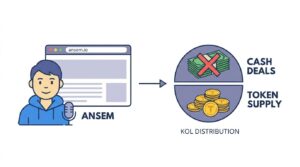
Crypto influencer Zion “Ansem” Thomas launched ansem.io on Aug. 17, introducing a promotion model where token teams compensate him not in cash but by distributing supply directly to holders of his memecoin. The platform represents a structural departure from the conventional Key Opinion Leader (KOL) arrangement that has defined crypto marketing for years. By tying promotional incentives to token holder benefits rather than personal payouts, the model raises questions about alignment, transparency, and whether this actually changes the underlying economics of influence in decentralized markets.
What Ansem’s New Platform Signals for Crypto Marketing
Before unpacking the mechanics, it’s worth framing what this shift means at a strategic level. The standard KOL deal in crypto has long operated in a grey zone: influencers receive cash, tokens, or both in exchange for social media promotion, often without clear disclosure. Ansem’s model doesn’t eliminate the promotional relationship, but it restructures who benefits from it. Here are the key takeaways:
- Incentive realignment: Token teams now route supply to Ansem’s memecoin holders rather than paying the influencer directly, creating a distribution layer between promotion and personal profit
- The model could pressure other high-profile KOLs to adopt similar structures, particularly as regulatory scrutiny around undisclosed crypto promotions intensifies
- Holder value proposition: Memecoin holders gain a tangible reason to hold beyond speculation, effectively turning the token into an access pass for airdrops from promoted projects
- Risk transfer: Token teams still give up supply, but the reputational risk shifts partially onto Ansem’s community rather than sitting entirely with the influencer
- Whether this constitutes a genuine innovation or a repackaging of the same dynamics (a distinction regulators have been slow to enforce) remains an open question
How the Model Actually Works
The mechanics are straightforward on the surface. A token project approaches Ansem seeking promotion. Instead of negotiating a flat fee or a token allocation paid to the influencer personally, the project allocates a portion of its token supply to holders of Ansem’s memecoin. Ansem promotes the project across his social channels, and his community receives the tokens.
This flips the typical KOL arrangement in one important way: the influencer’s compensation becomes indirect. Ansem benefits not from the deal itself but from the increased demand and utility his memecoin gains as a result of these distribution events. The more attractive the deals he secures, the more valuable holding his token becomes.
Still, the underlying transaction hasn’t vanished. A project is paying for attention. The currency has changed, the routing has changed, but the exchange of value for visibility persists.
Comparing Traditional KOL Deals and the Ansem Model
| Feature | Traditional KOL Deal | Ansem.io Model |
|---|---|---|
| Payment to influencer | Cash, tokens, or equity | Indirect (via memecoin demand) |
| Beneficiary of token allocation | The influencer | Memecoin holders |
| Disclosure norms | Inconsistent, often absent | Publicly visible through platform structure |
| Community alignment | Low — followers bear risk, influencer captures upside | Higher in theory, though execution risk remains significant |
| Regulatory clarity | Uncertain | Equally uncertain, arguably more complex |
Why This Matters Beyond One Influencer
Ansem commands a substantial following in crypto-native circles, particularly within the Solana memecoin ecosystem. His moves carry weight not because of institutional backing but because retail traders watch closely and act on his signals. That dynamic makes ansem.io more than a personal project.
If the model gains traction, it introduces a template other influencers could replicate. And that replication would reshape how token projects allocate marketing budgets. Instead of negotiating with individual KOLs over private Telegram channels, teams would route supply through structured platforms tied to specific communities. The opacity that currently defines most KOL deals would, at least on paper, give way to something more traceable.
But traceability isn’t the same as accountability. Whether Ansem vets the projects he promotes, what criteria he applies, and how much due diligence his holders can realistically perform on incoming token allocations are all questions the platform doesn’t yet answer publicly.
The Broader Influence Economy in Crypto
Crypto’s relationship with influencer marketing has been turbulent. The SEC has pursued enforcement actions against celebrities promoting tokens without disclosing compensation. The FTC’s endorsement guidelines apply broadly, though enforcement in decentralized markets remains patchy at best. Against this backdrop, any structural change to how KOL deals operate deserves scrutiny rather than applause.
What Ansem has built is, arguably, a more honest version of the same game. The promotion is visible. The beneficiaries are identifiable. The influencer’s incentive is tied to community satisfaction rather than a one-time payout. These are real improvements over the status quo.
Yet the model also concentrates power. Ansem becomes a gatekeeper: projects need his approval to access his holders, and holders depend on his judgment to receive quality allocations. That’s a lot of trust placed in a single actor operating without regulatory oversight or formal governance structures.
What Holders and Projects Should Consider
For memecoin holders evaluating whether to participate, the calculus involves more than potential airdrops. Holding Ansem’s token means accepting exposure to every project he chooses to promote. Some of those projects will perform. Others won’t. The holder absorbs that variance.
Projects considering the platform face a different calculation. Distributing supply to an influencer’s community can generate attention, but it also fragments the token’s holder base in ways that may not align with long-term protocol goals. A thousand new holders acquired through an airdrop behave differently than a thousand holders who discovered the project organically.
Frequently Asked Questions
What is ansem.io?
It’s a platform launched by crypto influencer Zion “Ansem” Thomas where token projects promote themselves by distributing supply to holders of his memecoin, rather than paying the influencer directly in cash or tokens.
How does Ansem benefit if he isn’t paid directly?
His memecoin gains utility and demand as more projects distribute tokens through the platform. The value of his token rises as the deals he secures become more attractive to holders, creating an indirect but potentially substantial financial incentive.
Is this model regulated?
No specific regulatory framework governs this arrangement. Existing securities laws, FTC endorsement guidelines, and SEC enforcement precedents may apply, but no regulator has addressed this particular structure directly. That ambiguity cuts both ways.
Does this eliminate the conflicts of interest in KOL marketing?
Not entirely. It redistributes them. The influencer still selects which projects to promote, and holders still rely on that judgment without formal recourse if a promoted project fails or turns out to be low quality.