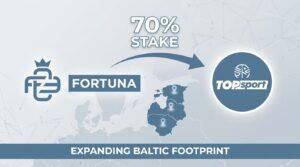
Fortuna Entertainment Group (FEG) has finalized its acquisition of a 70% stake in Lithuanian sports betting operator TOPsport, marking a significant expansion of the Prague-based company’s presence across the Baltic region. The deal positions FEG as a dominant multi-market operator in Central and Eastern Europe, adding Lithuania’s leading licensed betting brand to a portfolio that already spans the Czech Republic, Slovakia, Poland, Romania, and Croatia. With TOPsport generating strong domestic market share, the transaction carries strategic weight well beyond its immediate financial terms.
What FEG’s Baltic Expansion Signals for the Industry
This acquisition is not simply a geographic bolt-on. It reflects a broader pattern among mid-cap European operators consolidating regional strength before larger competitors move in. Below are the key strategic takeaways from the deal:
- Market leadership acquired, not built: TOPsport holds a commanding position in Lithuania’s regulated betting market, giving FEG instant scale without the years-long brand-building process a greenfield entry would require.
- Regulatory alignment: Lithuania maintains a well-defined licensing framework for gambling operators, reducing compliance risk for FEG compared to entering less mature jurisdictions.
- FEG retains operational flexibility by acquiring 70% rather than full ownership, keeping existing TOPsport management incentivized and embedded in day-to-day operations.
- Portfolio diversification: The addition of a sixth national market reduces FEG’s revenue concentration risk, particularly its historical dependence on Czech and Slovak markets.
- Competitive positioning: As pan-European consolidation accelerates, holding a strong Baltic asset could make FEG itself a more attractive acquisition target or merger partner down the line.
TOPsport: A Closer Look at the Asset
TOPsport has operated in Lithuania for over two decades, building what is arguably the country’s most recognized sports betting brand. The company holds a full Lithuanian gambling license and operates both retail and online channels. Its digital platform has grown steadily as Lithuania’s regulatory environment matured, particularly after the country tightened its licensing rules in 2016 to create clearer market boundaries.
Lithuania’s gambling market, while modest by Western European standards, has shown consistent year-on-year growth. The country’s population of roughly 2.8 million supports a compact but loyal customer base, and TOPsport’s online betting platform has captured a disproportionate share of that demand. That kind of domestic dominance is difficult to replicate organically.
Why the 70% Structure Matters
FEG’s decision to acquire a majority stake rather than pursue full ownership deserves attention. Retaining 30% in the hands of existing shareholders (a distinction that carries operational as well as financial implications) suggests FEG values continuity. Local management teams in regulated gambling markets often hold relationships with regulators, media partners, and payment providers that are not easily transferred.
And while full ownership would have given FEG complete strategic control, the 70/30 split creates a built-in alignment mechanism. The remaining shareholders still have skin in the game. That matters in a sector where regulatory missteps or brand erosion can destroy value quickly.
How Does This Fit FEG’s Broader Strategy?
Fortuna Entertainment Group has been methodical in its expansion across Central and Eastern Europe. The company’s existing footprint covers markets with varying degrees of regulatory maturity, from Poland’s tightly controlled online environment to Romania’s evolving framework. Adding Lithuania fills a geographic gap and strengthens FEG’s narrative as a regional consolidator with genuine multi-market capability.
Still, the harder question is what comes after. FEG now operates in six countries. At some point, the operational complexity of managing multiple regulated jurisdictions begins to weigh against the diversification benefits. Whether FEG pursues further acquisitions in the Baltics (Latvia and Estonia remain fragmented) or pivots toward deeper integration of its current portfolio will reveal much about the company’s medium-term ambitions.
Regulated Betting in the Baltics: A Growing but Watched Market
The Baltic states have taken divergent approaches to gambling regulation. Lithuania’s framework is among the most structured, with clear licensing requirements, advertising restrictions, and responsible gambling obligations. Latvia operates under a similarly defined regime, while Estonia has adopted a somewhat more liberal stance toward online gambling.
For operators like FEG, these differences create both opportunity and friction. A brand that thrives under Lithuanian rules may need meaningful adaptation to compete in Latvia. Cross-border synergies in technology and back-office functions exist, but front-end brand strategy and compliance architecture remain stubbornly local.
| Market | Regulatory Framework | FEG Presence |
|---|---|---|
| Czech Republic | Mature, fully regulated | Established (core market) |
| Slovakia | Regulated, moderate restrictions | Established |
| Poland | Tightly regulated online segment | Active |
| Romania | Evolving regulatory landscape | Active |
| Croatia | Regulated with recent updates | Active |
| Lithuania | Well-defined licensing regime since 2016 reforms | Newly acquired via TOPsport |
Reframing Competitive Advantage Through Strategic Acquisitions
In behavioral terms, FEG’s acquisition pattern mirrors a principle familiar to strategic decision-makers: anchoring future growth on proven assets rather than speculative bets. By acquiring TOPsport, FEG effectively reframes its competitive identity from a Central European operator to a broader regional player. This kind of identity shift matters internally as much as externally. Teams across FEG’s existing markets now operate within a larger, more diverse organization, which tends to attract stronger talent and create more robust knowledge-sharing loops.
The psychology of market perception plays a role here too. Investors, regulators, and potential partners evaluate operators differently once they cross a certain threshold of geographic reach. Six regulated markets, each with its own license and local brand, communicates operational maturity in a way that three or four markets simply do not. Whether FEG capitalizes on that perception through capital markets activity, partnership deals, or further M&A remains an open thread. But the optionality itself has value, and in a consolidating industry, optionality is often the most underpriced asset on the balance sheet.
Frequently Asked Questions
What does FEG’s acquisition of TOPsport include?
FEG has acquired a 70% majority stake in TOPsport, Lithuania’s leading sports betting operator. The remaining 30% stays with existing shareholders, preserving management continuity and local market expertise.
Why is Lithuania’s betting market attractive?
Lithuania offers a well-regulated gambling environment with clear licensing rules, consistent market growth, and a dominant local brand in TOPsport. For an acquirer like FEG, it represents low regulatory risk and immediate market access.
How many markets does FEG now operate in?
With the addition of Lithuania, FEG operates across six regulated European markets: the Czech Republic, Slovakia, Poland, Romania, Croatia, and Lithuania.
Will TOPsport continue to operate under its own brand?
The 70/30 ownership structure suggests FEG intends to maintain TOPsport’s existing brand identity and management team, at least in the near term. Rebranding a market leader rarely makes strategic sense.