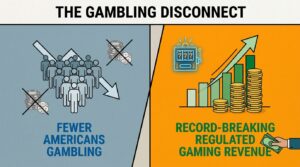
A striking paradox has emerged in the U.S. gambling landscape: fewer Americans say they gamble now compared to a decade ago, yet regulated gaming revenue keeps climbing to new highs. The disconnect between self-reported participation rates and industry earnings raises questions about shifting consumer behavior, the concentration of spending among core players, and how Americans define gambling itself. This tension sits at the heart of an industry navigating rapid digital expansion while its broader cultural footprint appears, at least on paper, to be shrinking.
What the Participation Gap Tells Us About Modern Gambling
Before unpacking the numbers, it helps to frame what’s actually at stake. The decline in self-reported gambling doesn’t necessarily mean fewer people are placing bets. It may instead reflect how respondents interpret the question, how stigma shapes disclosure, and how the migration from physical casinos to digital platforms blurs the line between entertainment and wagering. The business implications, though, are concrete.
- Regulated gaming revenue in the United States has continued its upward trajectory even as survey data shows a smaller share of adults identifying as gamblers
- The gap suggests revenue growth is being driven by higher per-capita spending among a more engaged, possibly narrower, customer base
- Digital and mobile betting platforms have expanded access dramatically, yet this hasn’t translated into a proportional rise in self-reported participation
- Operators and regulators face a measurement problem: traditional surveys may undercount activity that now happens through apps, fantasy sports, and in-play wagering
- For policymakers weighing responsible gambling frameworks, the concentration of spend among fewer players intensifies scrutiny on harm prevention
Revenue Up, Participation Down: How Both Can Be True
The simplest explanation is also the most uncomfortable one for the industry. If revenue is rising while the gambling population contracts, then each active gambler is spending more. That’s a pattern regulators in several states have already flagged as a potential risk indicator for problem gambling.
But there’s a subtler dynamic at work. The definition of “gambling” in public surveys hasn’t kept pace with product innovation. Someone who places a $5 parlay on their phone during a football game may not consider themselves a gambler in the traditional sense. They might call it sports entertainment. The American Gaming Association has tracked this perceptual shift, noting that younger demographics in particular tend to separate casual sports betting from what they associate with casino gambling.
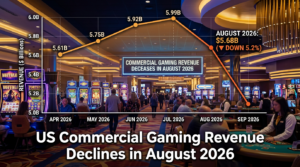
Still, the revenue tells its own story. Commercial gaming revenue in the U.S. surpassed $66 billion in 2023, a record. Sports betting and iGaming accounted for a growing share of that total, with online channels expanding into new state markets throughout the year. The math doesn’t require more players if existing ones are betting more frequently and across more product types.
The Digital Migration and Its Measurement Blind Spots
One factor that complicates any reading of participation data is the shift from land-based to digital gambling. Physical casino visits are observable, social, and memorable. A quick bet placed through a mobile app at halftime? Less so. Survey respondents may genuinely forget or dismiss these micro-transactions when asked whether they gamble.
This isn’t a trivial distinction. It shapes how states estimate gambling prevalence, how they allocate funding for treatment programs, and how they calibrate tax policy. If the true gambling population is larger than surveys suggest (a possibility several researchers have raised), then per-capita spending figures look less alarming, but the scope of potential harm widens.
Which raises a harder question: are regulators building responsible gambling infrastructure based on data that systematically undercounts the people it’s meant to protect?
Concentration Risk and the Operator Playbook
For gaming operators, a shrinking but higher-spending customer base creates a familiar strategic tension. Retention becomes paramount. Loyalty programs, personalized promotions, and VIP tiers all intensify when growth depends on wallet share rather than market penetration.
That model works until it doesn’t. Heavy reliance on a concentrated player base exposes operators to regulatory risk (a distinction regulators have been slow to enforce in some jurisdictions) and reputational vulnerability if high-value players are later identified as exhibiting problem gambling behaviors. Several European markets have already moved to cap deposit limits and restrict bonus offers precisely because of this dynamic.
In the U.S., the regulatory patchwork across states means no uniform approach exists. Some states have implemented self-exclusion databases and mandatory loss limits. Others have taken a lighter touch, prioritizing tax revenue and market growth.
How Perception Shapes Gambling Behavior
Understanding why fewer Americans identify as gamblers requires looking beyond economics into how people frame their own choices. Neuro-linguistic programming principles offer a useful lens here. The language people use to describe their behavior doesn’t just reflect reality; it actively constructs it.
When sports betting operators market their products as “games of skill” or “fan engagement tools,” they’re doing more than advertising. They’re reframing the cognitive category. A person who sees themselves as a sports fan making informed predictions occupies a different mental space than someone who identifies as a gambler. The internal representation shifts, and with it, the willingness to report the activity as gambling in a survey context.
This reframing operates at multiple levels. At the identity level, younger bettors may anchor their self-image to sports knowledge rather than risk-taking. At the behavioral level, the seamlessness of mobile betting reduces the friction and ritual that once marked gambling as a distinct activity. And at the linguistic level, the vocabulary of modern betting (parlays, props, boosts) borrows from gaming and fantasy sports rather than from the casino floor.
The practical consequence is a growing gap between measured participation and actual participation. Operators benefit from this ambiguity because it softens the cultural resistance to gambling expansion. Regulators, however, lose visibility into the true scale of the market they oversee. And individuals who don’t categorize their behavior as gambling may be less likely to recognize early warning signs of problematic patterns, precisely because their internal narrative doesn’t include that label.
Arguably, this perceptual gap represents one of the most underexamined risks in the current U.S. gambling landscape.
Frequently Asked Questions
Why do fewer Americans say they gamble if revenue is at record levels?
The decline in self-reported gambling likely reflects changes in how people define the activity, particularly as mobile and sports betting blur the line between entertainment and wagering. Higher spending per player also drives revenue growth without requiring more participants.
Does this trend indicate a problem gambling crisis?
Not necessarily, but the concentration of revenue among fewer reported gamblers has drawn regulatory attention. If a smaller base is spending more, monitoring for harmful patterns becomes more urgent.
How reliable are gambling participation surveys?
Traditional surveys face growing limitations. They often rely on self-identification, which undercounts people who bet casually through apps or don’t consider activities like fantasy sports to be gambling. Researchers have called for updated methodologies that capture digital betting behavior more accurately.
What should regulators do with this information?
At minimum, reassess how prevalence data informs policy. Funding for responsible gambling programs, deposit limit structures, and advertising restrictions all depend on accurate estimates of who is gambling and how much they’re spending.