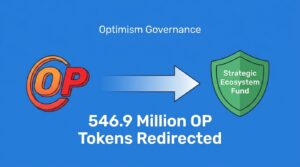
Optimism’s governance body has approved the transfer of 546.9 million OP tokens, worth approximately $49.7 million at the time of the vote, from a pool originally earmarked for future user airdrops into a newly designated Strategic Ecosystem Fund. The Optimism Foundation will administer the fund. This decision effectively eliminates the remaining dedicated airdrop reserve, signaling a sharp pivot in how the Layer 2 network intends to deploy its treasury resources going forward.
What the Token Reallocation Means for OP Stakeholders
The scale of this move deserves attention. Nearly 547 million tokens shifting from a user-facing incentive pool to a foundation-managed strategic fund is not a minor bookkeeping adjustment. It reflects a governance consensus that broad airdrop distributions have diminishing returns compared to targeted ecosystem investment. Before unpacking the implications, here are the critical takeaways:
- Airdrop reserves are gone: The dedicated allocation for future user airdrops no longer exists, closing the door on speculative expectations that had persisted since Optimism’s initial token distribution.
- Foundation gains discretionary control: The Optimism Foundation now manages these tokens through a Strategic Ecosystem Fund, giving it broader latitude in deployment decisions.
- The vote passed through Optimism’s on-chain governance process, meaning token holders themselves endorsed the reallocation.
- Market signal: At roughly $49.7 million in value, this is one of the larger single treasury movements in recent Layer 2 governance history.
- The shift suggests Optimism is prioritizing protocol-level growth partnerships and infrastructure funding over retail user acquisition through token giveaways.
Why Airdrops Lost Their Strategic Appeal
Airdrops were once the dominant playbook for bootstrapping user bases across DeFi and Layer 2 ecosystems. Optimism’s own initial airdrop in mid-2022 distributed tokens to early users and generated significant attention. But the calculus has changed. Sybil farming, where individuals create multiple wallets to game eligibility criteria, eroded the effectiveness of subsequent rounds. Retention rates from airdrop recipients have consistently disappointed across the industry, with many recipients selling tokens immediately upon receipt.
That pattern arguably made the remaining airdrop reserve a depreciating asset in strategic terms. Governance participants appear to have concluded that deploying capital through a managed fund, with accountability structures and targeted objectives, offers better long-term value creation for the Optimism ecosystem than distributing tokens to wallets that may never engage with the protocol again.
The Strategic Ecosystem Fund: Structure and Questions
Details on how the Optimism Foundation’s Strategic Ecosystem Fund will operate remain somewhat sparse. What we know: the Foundation administers the tokens, and the fund is intended to support ecosystem growth initiatives. What remains less clear is the governance framework around disbursements. Will individual grants require further on-chain votes? Are there spending limits per quarter? How will the Foundation report on fund utilization?
These are not trivial questions. A pool of nearly 547 million tokens under foundation discretion introduces concentration risk (a distinction governance purists have been quick to flag). Even so, the vote passed, which suggests a majority of participating token holders trust the Foundation’s stewardship capacity more than they trust the open-ended promise of future airdrops.
Broader Layer 2 Treasury Dynamics
Optimism is not operating in a vacuum. Competing Layer 2 networks like Arbitrum, zkSync, and Starknet are all navigating similar treasury allocation debates. Arbitrum’s DAO has faced its own controversies around foundation spending authority, and zkSync’s recent token launch drew criticism for airdrop distribution mechanics.
| Network | Treasury Strategy | Airdrop Status |
|---|---|---|
| Optimism | Strategic Ecosystem Fund (Foundation-managed) | Dedicated reserve eliminated |
| Arbitrum | DAO-governed treasury with grant programs | Single airdrop completed; no announced follow-up |
| zkSync | Foundation-led with community allocation | Initial airdrop completed June 2024 |
| Starknet | Foundation and ecosystem grants | Provisions distributed early 2024 |
The trend across Layer 2s is unmistakable: foundations and DAOs are consolidating treasury management and moving away from broad token distributions. Whether this produces better outcomes depends entirely on execution and transparency.
How Framing Shapes Governance Outcomes
One underappreciated dimension of this vote is the role of narrative framing in governance participation. Proposals that position themselves as “strategic” and “ecosystem-aligned” tend to attract higher approval rates than those framed around redistribution or user rewards. This is consistent with broader behavioral patterns in collective decision-making: participants gravitate toward language that signals professionalism and long-term thinking, even when the underlying trade-offs are ambiguous.
In Optimism’s governance model, where token-weighted voting determines outcomes, the framing effect compounds with holder concentration. Large token holders, who disproportionately influence vote results, are more likely to favor foundation-managed deployment because it aligns with their interest in protocol value accrual rather than dilutive distribution. Smaller holders, who might benefit most from airdrops, often lack sufficient voting weight to shift outcomes. The result: a market caught between two frameworks for what “community benefit” actually means.
Understanding these dynamics matters for anyone evaluating DAO governance proposals across crypto. The language of a proposal shapes its reception as much as its substance. Participants who recognize this asymmetry can engage more critically with future votes, asking not just what a proposal does, but how it positions what it does.
Frequently Asked Questions
Will Optimism conduct any more airdrops?
With the dedicated airdrop reserve now redirected to the Strategic Ecosystem Fund, there is no remaining allocation specifically designated for future airdrops. The Foundation could theoretically fund airdrops from the new pool, but nothing in the approved proposal suggests that is the intent.
How much are the transferred tokens worth?
At the time of the governance vote, the 546.9 million OP tokens were valued at approximately $49.7 million. That figure fluctuates with market conditions.
Who controls the Strategic Ecosystem Fund?
The Optimism Foundation administers the fund. Specific guardrails around spending authority and reporting obligations have not been fully detailed in public documentation, which leaves open questions about accountability structures.
Does this affect existing OP token holders?
Not directly in terms of token supply mechanics. The tokens already existed within Optimism’s treasury. But the reallocation changes how and where those tokens enter circulation, which could influence market dynamics over time depending on the Foundation’s deployment pace and strategy.