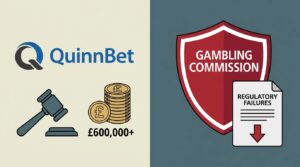
The UK Gambling Commission has imposed a financial penalty exceeding £600,000 on QuinnBet, the online betting operator, following a regulatory settlement tied to failures in social responsibility and anti-money laundering obligations. The enforcement action, which targets the operator’s licence conditions, underscores the Commission’s increasingly assertive posture toward operators that fall short of compliance standards. QuinnBet, which holds a licence to offer gambling services in Great Britain, now faces both the financial burden and the reputational scrutiny that accompanies a public regulatory settlement.
What the QuinnBet Settlement Reveals About Enforcement Priorities
Before unpacking the specifics, it’s worth framing what this case signals for the broader licensed gambling sector. The penalty sits within a pattern of escalating enforcement actions by the Gambling Commission, particularly against operators whose customer interaction and due diligence frameworks have proven inadequate. Here are the key strategic takeaways:
- QuinnBet must pay a financial penalty of more than £600,000, a figure that reflects the severity and duration of the identified failings
- The failures relate to both social responsibility protections and anti-money laundering controls, two areas the Gambling Commission has repeatedly flagged as non-negotiable
- This settlement adds to a growing list of regulatory actions in 2024 and 2025, reinforcing the message that smaller or mid-tier operators face the same scrutiny as major brands
- Operators relying on reactive compliance models rather than proactive frameworks are increasingly exposed to enforcement risk
- The case may prompt other licensees to reassess their own customer interaction triggers and source-of-funds processes
Where QuinnBet Fell Short
The Gambling Commission’s investigation identified deficiencies across two critical compliance pillars. On the social responsibility front, QuinnBet reportedly failed to interact with customers displaying markers of harm at the appropriate thresholds. That means customers who should have triggered affordability checks or safer gambling interventions were, at least on paper, allowed to continue gambling without adequate oversight.
Anti-money laundering shortcomings compounded the picture. The operator’s systems for verifying the source of customer funds and monitoring transactional patterns did not meet the standards set out in the Commission’s Licence Conditions and Codes of Practice (LCCP). In practice, this gap creates a dual risk: it exposes the operator to potential criminal exploitation while simultaneously undermining the integrity of the licensed market.
Whether these failures stemmed from under-resourcing, poor system design, or a cultural deprioritisation of compliance is something the public settlement documents don’t fully resolve (a distinction regulators have been slow to elaborate on in most cases).
Gambling Commission’s Escalating Enforcement Cadence
This action against QuinnBet’s online gambling platform does not exist in isolation. The Gambling Commission has issued a series of regulatory settlements and licence reviews over the past eighteen months, targeting operators across the market spectrum. From major high-street brands to digital-first challengers, the pattern is consistent: failures in customer interaction and AML controls attract the sharpest penalties.
And while the £600,000-plus figure may seem modest relative to some headline-grabbing fines levied against larger operators, it carries proportional weight for a business of QuinnBet’s scale. The financial impact is one dimension. But the operational consequences, including mandated process overhauls and heightened ongoing scrutiny, arguably impose a longer-lasting cost.
| Compliance Area | Issue Identified | Regulatory Expectation |
|---|---|---|
| Social Responsibility | Insufficient customer interaction at harm markers | Proactive engagement triggered by behavioural and spend indicators |
| Anti-Money Laundering | Inadequate source-of-funds verification and transaction monitoring | Robust, documented processes aligned with LCCP and POCA requirements |
| Overall Governance | Systemic rather than isolated failings | Board-level accountability and continuous compliance assurance frameworks |
How Operators Should Recalibrate
The QuinnBet case offers a concrete reference point for other licensees evaluating their own compliance architecture. Three areas demand particular attention.
First, customer interaction frameworks need to move beyond tick-box compliance. The Commission expects operators to demonstrate that interactions are meaningful, timely, and proportionate to risk. A templated email sent three days after a threshold breach won’t satisfy that standard.
Second, AML processes must be stress-tested against real customer data, not just designed around theoretical scenarios. Source-of-funds checks that exist in policy documents but fail to trigger in live operations represent exactly the kind of gap that draws enforcement action.
Third, governance structures matter. The Commission has signalled repeatedly that it expects personal management licence holders to take direct accountability for compliance outcomes. Delegating responsibility without oversight is itself a risk factor.
Reframing Compliance as Strategic Advantage
There’s a broader shift underway in how the licensed UK gambling sector relates to regulation. For years, compliance was treated by many operators as a cost centre, something to manage rather than invest in. That framing is becoming untenable. Operators that embed compliance into product design, customer journeys, and executive decision-making are not just reducing enforcement risk. They’re building a more sustainable operating model in a market where the regulatory floor keeps rising.
Still, the gap between aspiration and execution remains wide across parts of the industry. Mid-tier operators in particular face a resource challenge: they must meet the same standards as billion-pound enterprises but with a fraction of the compliance budget. Whether the Commission’s enforcement approach adequately accounts for that asymmetry is a question that surfaces with each new settlement.
From a behavioural perspective, the most effective compliance cultures are those where teams internalise regulatory objectives rather than simply responding to external pressure. Operators that train staff to recognise harm indicators instinctively, rather than relying solely on automated triggers, tend to produce better outcomes. This isn’t about replacing technology with human judgment. It’s about layering the two so that neither operates in isolation. The mental model shifts from “what must we do to avoid a fine” to “what would a responsible operator do here,” and that reframing, subtle as it sounds, changes how teams prioritise, escalate, and document their decisions daily.
Frequently Asked Questions
What specific regulations did QuinnBet breach?
The Gambling Commission identified failures related to the operator’s social responsibility obligations and anti-money laundering controls under the Licence Conditions and Codes of Practice. These are foundational requirements for all GB-licensed operators.
How does this penalty compare to other recent Gambling Commission actions?
At over £600,000, the penalty is significant for an operator of QuinnBet’s size, though larger operators have faced multi-million-pound settlements. The Commission calibrates penalties based on the nature, severity, and duration of the failings, as well as the operator’s revenue.
Will QuinnBet lose its licence?
The settlement does not indicate licence revocation. However, the operator will likely face enhanced monitoring and must demonstrate that it has remediated the identified failings. Continued non-compliance could trigger further action.
What should other operators learn from this case?
Proactive compliance investment, particularly in customer interaction systems and AML verification processes, is no longer optional. The Commission’s enforcement record makes clear that reactive approaches carry substantial financial and operational risk.