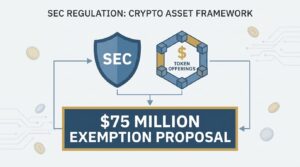
The Securities and Exchange Commission unveiled its proposed Regulation Crypto Assets on Aug. 18, introducing a framework that would allow token issuers to raise up to $75 million annually without registering the offering. A separate safe harbor provision within the proposal goes further, potentially removing certain tokens from the definition of a security entirely. The dual-track approach signals the most concrete regulatory architecture the SEC has put forward for digital assets, and it arrives at a moment when the industry has been demanding exactly this kind of clarity.
What the SEC’s Crypto Exemption Framework Actually Entails
Before unpacking the strategic implications, here’s what matters most for issuers, investors, and legal teams watching this space:
- $75 million annual cap: Token issuers could raise funds through exempt offerings up to this threshold, bypassing the full SEC registration process that has historically deterred smaller crypto projects from operating within U.S. borders.
- Safe harbor for token reclassification: Certain tokens that meet defined criteria could be excluded from the securities classification altogether, a shift that would fundamentally alter compliance obligations.
- The proposal does not eliminate SEC oversight; it restructures the entry point for compliance, arguably lowering the barrier without removing the guardrails.
- Timing is deliberate: The proposal lands amid ongoing congressional debates over crypto market structure legislation and follows years of enforcement-first policy under the previous SEC leadership.
- Industry participants who have operated in regulatory grey zones now face a more defined (if still evolving) set of rules to build around.
Why $75 Million Is the Number That Matters
The $75 million threshold is not arbitrary. It mirrors the ceiling established under Regulation A+, the existing exemption framework for smaller public offerings. By anchoring Regulation Crypto Assets to a familiar structure, the SEC appears to be drawing crypto token sales into an established regulatory vocabulary rather than inventing something from scratch.
That choice carries weight.
For early-stage blockchain projects, the cost and complexity of a full SEC registration have long been prohibitive. Many simply moved offshore or structured their token distributions to avoid U.S. investors entirely. A $75 million exemption creates a viable domestic path for fundraising, one that doesn’t require the legal infrastructure of a traditional IPO but still demands disclosure and investor protections. Whether the disclosure requirements prove workable for decentralized projects (a distinction regulators have been slow to enforce) remains an open question the proposal doesn’t fully resolve.
The Safe Harbor Provision: Reclassifying What Counts as a Security
Perhaps more consequential than the fundraising exemption is the safe harbor mechanism. Under this provision, tokens that achieve sufficient decentralization or utility could be removed from securities classification. The implications ripple across exchanges, DeFi protocols, and any platform currently navigating the Howey Test’s application to digital assets.
Still, the details will determine everything. What qualifies as “sufficient decentralization” has been debated since the SEC’s 2018 guidance on Ethereum, and the proposed framework will need to draw lines that prior guidance deliberately left blurred. Token projects that launched through initial coin offerings and later transitioned to community governance could find themselves eligible for reclassification, but the burden of proof likely falls on the issuer.
The SEC’s approach to digital asset regulation has historically leaned on enforcement actions rather than rulemaking. This proposal represents a structural pivot, at least on paper.
How This Reshapes the Competitive Landscape for U.S. Crypto Markets
For years, regulatory uncertainty pushed crypto innovation toward jurisdictions with clearer frameworks. Singapore, the UAE, and parts of the EU (particularly under MiCA) attracted projects that might otherwise have launched in the United States. Regulation Crypto Assets, if finalized in a form close to what’s been proposed, could reverse some of that capital flight.
Consider the downstream effects:
| Stakeholder | Potential Impact |
|---|---|
| Token Issuers | Clearer fundraising pathway up to $75M; reduced legal costs compared to full registration |
| Crypto Exchanges | Tokens reclassified under the safe harbor could be listed with fewer compliance risks, expanding tradeable asset pools |
| Institutional Investors | Regulatory clarity may lower perceived risk, opening allocation channels that compliance teams previously blocked |
| DeFi Protocols | Decentralization criteria could create a formal off-ramp from securities law, though meeting the threshold remains uncertain |
| International Competitors | U.S. re-entry into the regulatory competition for crypto projects; jurisdictional arbitrage becomes less attractive |
Reading Between the Regulatory Lines
What makes this proposal particularly notable is its framing. The SEC isn’t abandoning its position that many tokens are securities. Instead, it’s creating structured exceptions, a move that implicitly reinforces the default classification while offering defined exits from it. This is regulatory architecture designed to preserve authority while accommodating market reality.
And while the crypto industry has broadly welcomed the proposal’s direction, not all market participants agree on whether the conditions attached to the safe harbor will prove practical. Projects built on progressive decentralization models may struggle to demonstrate compliance at the exact moment regulators demand proof. The timeline for public comment and potential revisions will shape whether this framework becomes a genuine on-ramp or another set of requirements that only well-funded projects can navigate.
One thing is clear: the enforcement-only era appears to be giving way to something more structured. Whether that structure serves the breadth of the crypto ecosystem or primarily benefits larger, better-resourced issuers is the tension that will define the next phase of this rulemaking.
Frequently Asked Questions
Does Regulation Crypto Assets mean all tokens are no longer securities?
No. The proposal creates specific exemptions and a safe harbor for tokens meeting defined criteria. The default SEC position that many tokens qualify as securities under the Howey Test remains intact. Only tokens that satisfy the safe harbor’s conditions, likely related to decentralization and utility, would be reclassified.
When would this regulation take effect?
The proposal is in its early stages. A public comment period will follow, and revisions based on industry and public feedback are expected before any final rule is adopted. Timelines for SEC rulemaking can stretch months or longer.
How does the $75 million exemption compare to existing frameworks?
It parallels Regulation A+ in scale, which allows companies to raise up to $75 million in a 12-month period through exempt offerings. The crypto-specific version adapts this model for token sales, though the disclosure and qualification requirements may differ in important ways that haven’t been fully detailed yet.
Will this affect DeFi protocols?
Potentially, yes. The safe harbor provision’s decentralization criteria could offer DeFi projects a formal path out of securities regulation. But the practical application depends entirely on how “sufficient decentralization” gets defined in the final rule.