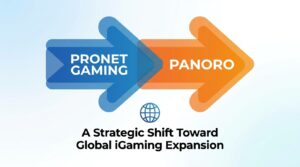
Pronet Gaming, the B2B iGaming technology supplier, has unveiled a comprehensive rebrand under the name Panoro, signalling a deliberate pivot toward broader international reach and a sharper customer-centric identity. Announced on 26th August, the transformation goes beyond cosmetics. It reflects structural changes within the company’s operations, product suite, and go-to-market strategy as it positions itself to compete more aggressively across regulated markets worldwide.
What the Rebrand to Panoro Actually Signals
Corporate rebrands in the iGaming technology sector are rarely just about a new logo. In this case, the shift from Pronet Gaming to Panoro encapsulates an evolution that has been underway for some time, touching product development, client relationships, and geographic ambition. The company has been building out its platform capabilities and expanding its licensing footprint, and the new identity is designed to better reflect that trajectory.
Before unpacking the strategic implications, here are the core takeaways:
- Brand consolidation: The move to Panoro unifies the company’s identity as it scales across multiple jurisdictions, replacing a name that arguably carried more regional connotations
- Customer-first positioning: Leadership has emphasised that the rebrand aligns with a deeper operational commitment to tailored solutions for operator partners
- The timing coincides with intensifying competition among B2B iGaming platform providers, particularly in emerging regulated markets across Latin America, Africa, and parts of Asia
- Technology investment: Panoro’s platform offering has been enhanced with modular architecture designed to give operators greater flexibility in content integration and player management
- International licensing push: The company continues to pursue regulatory approvals in new territories, a process that benefits from a refreshed, globally oriented brand identity
Why Now? Competitive Pressures and Market Timing
The B2B iGaming platform market has grown increasingly crowded. Established players like Kambi, EveryMatrix, and SoftSwiss continue to expand their footprints, while newer entrants chip away at niche segments. For a mid-tier supplier like the former Pronet Gaming, standing still was not a viable option.
Panoro’s leadership appears to recognise that brand perception matters in enterprise sales cycles. Operators evaluating platform partners weigh not just technology and pricing but also the perceived stability and ambition of their suppliers. A name change, when backed by substantive operational improvements, can shift that perception meaningfully. Still, the real test will come in whether the rebrand translates into measurable commercial traction over the next 12 to 18 months.
What remains less clear is how Panoro plans to differentiate its sportsbook and casino aggregation capabilities from competitors who have spent years building deep content libraries and data partnerships. The company has signalled investment in these areas, but specifics on exclusive content deals or proprietary data feeds have not been disclosed publicly.
The Platform Behind the Name
Panoro’s iGaming technology platform offers operators a turnkey solution spanning sportsbook, casino, and player management tools. The modular design allows clients to deploy specific components rather than committing to a full-stack integration, which lowers the barrier to entry for smaller operators testing new markets.
Key platform features include:
| Capability | Details |
|---|---|
| Sportsbook | Pre-match and live betting across 30,000+ events monthly, with configurable risk management tools |
| Casino Aggregation | Access to thousands of titles from tier-one and emerging game studios through a single API integration |
| Player Management | CRM, bonus engine, and segmentation tools designed for multi-market compliance |
| Payments | Localised payment gateway support covering fiat and, in select jurisdictions, cryptocurrency options |
| Regulatory Compliance | Built-in responsible gambling features and KYC/AML workflows adapted to jurisdiction-specific requirements |
That modular approach is increasingly the industry standard. But execution quality varies enormously between providers, and operators report that integration timelines and post-launch support often matter more than feature lists on paper.
Framing Identity in a Fragmented Market
There is a psychological dimension to rebranding that extends beyond marketing. In neuro-linguistic programming terms, the way a company frames its identity shapes how stakeholders anchor their expectations. The name “Panoro” carries no legacy baggage from the company’s earlier, more regionally focused phase. It creates a blank cognitive frame (a useful advantage when entering conversations with operators in unfamiliar markets who have no prior association with the brand).
This matters because B2B purchasing decisions in iGaming are rarely purely rational. Operators evaluate suppliers through a lens that blends technical due diligence with gut-level trust signals. A coherent, internationally resonant brand identity functions as one of those signals. It communicates ambition without requiring the prospect to dig into case studies or reference calls before forming an initial impression.
And while sceptics might dismiss naming exercises as superficial, research in organisational psychology consistently shows that identity coherence between a company’s internal culture and external brand correlates with stronger commercial outcomes. The question for Panoro is whether the internal transformation matches the external signal. If the operational culture, hiring strategy, and product roadmap genuinely reflect the new positioning, the rebrand becomes a force multiplier. If not, it risks becoming a distraction.
Language patterns also play a role here. The company’s messaging has shifted from feature-heavy technical language toward outcome-oriented framing: words like “partnership,” “flexibility,” and “growth” now dominate its communications. That linguistic pivot mirrors a broader trend among B2B iGaming suppliers who have learned that operators respond more strongly to business-outcome language than to specification sheets.
Frequently Asked Questions
Why did Pronet Gaming change its name to Panoro?
The rebrand reflects the company’s evolution from a regionally focused supplier into a broader international iGaming technology partner, with enhanced platform capabilities and a customer-centric strategy.
Does the rebrand affect existing operator partnerships?
No. Existing contracts and integrations remain in place. The change is organisational and brand-level, not a restructuring of client agreements or technical infrastructure.
What markets is Panoro targeting?
The company is pursuing growth across regulated and newly regulating markets globally, with particular interest in Latin America, Africa, and select Asian jurisdictions. Specific licensing applications have not all been publicly disclosed.
Is Panoro’s platform suitable for smaller operators?
Its modular architecture is designed precisely for that flexibility, allowing operators to deploy individual components without a full-stack commitment. How well that works in practice depends on the operator’s technical resources and the complexity of their target market’s regulatory environment.



