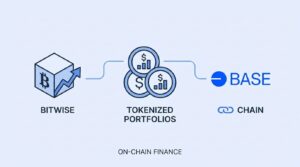
Bitwise rolled out its Automated Token Portfolios (ATPs) on Tuesday, offering eligible non-U.S. investors a novel way to hold Coinbase-issued tokenized equities directly in self-custodied wallets on the Base blockchain. The product leverages Glider’s automated rebalancing engine to keep holdings aligned with Bitwise’s model portfolios, removing the friction of manual position management. It marks a tangible step in Coinbase’s broader strategy to bring traditional financial instruments on-chain. And it raises a question few have fully answered yet: how quickly can tokenized securities move from proof-of-concept to genuine portfolio infrastructure?
What the ATP Launch Signals for Tokenized Finance
Before diving into the specifics, it’s worth framing why this product matters beyond its technical novelty. The convergence of asset management, blockchain custody, and automated portfolio construction into a single on-chain product is not something the industry has seen at this scale from established players. Here are the key strategic takeaways:
- Bitwise is positioning itself as a bridge between traditional index-style investing and decentralized infrastructure, targeting a segment of investors who want exposure to equities without leaving the crypto-native ecosystem.
- Coinbase’s tokenized stocks gain a distribution channel that goes beyond simple trading, embedding them into managed portfolio strategies.
- Glider’s rebalancing layer adds a DeFi-native automation component, reducing the operational burden that has historically kept institutional-grade portfolio management off-chain.
- The restriction to non-U.S. investors highlights the persistent regulatory asymmetry that continues to shape where tokenized securities products can launch first.
- Base, Coinbase’s Layer 2 network, picks up another high-profile use case that strengthens its bid to become the default settlement layer for tokenized real-world assets.
How the Product Actually Works
ATPs allow investors to deposit funds into a wallet on Base and gain exposure to a basket of Coinbase-issued tokenized stocks. Glider handles the ongoing rebalancing, automatically adjusting allocations to match Bitwise’s model portfolio weights. The investor retains self-custody throughout, a design choice that distinguishes this from traditional managed accounts where a custodian holds assets on the client’s behalf.
That self-custody element is significant. It means the investor bears responsibility for wallet security, but also retains full transparency over holdings at all times. No intermediary sits between the portfolio logic and the assets themselves (a distinction regulators have been slow to enforce in the tokenized securities space).
The underlying tokenized stocks are issued by Coinbase, which has been steadily expanding its tokenized asset offerings as part of a broader push to make Base a hub for on-chain financial products. Each token represents a claim on a corresponding equity, though the precise legal wrapper and redemption mechanics vary by jurisdiction.
Why Base Keeps Winning These Deployments
Base has quietly accumulated a critical mass of tokenized asset projects over the past year. Its low transaction costs, Ethereum-compatible architecture, and direct integration with Coinbase’s infrastructure make it a natural home for products that need both retail accessibility and institutional credibility.
Bitwise’s decision to build on Base rather than Ethereum mainnet or a competing Layer 2 is telling. Cost matters when you’re rebalancing portfolios automatically. Every rebalance triggers on-chain transactions, and on mainnet Ethereum, gas fees would erode returns in a way that undermines the product’s value proposition entirely. On Base, those costs drop to fractions of a cent.
Still, Base is not without competition. Arbitrum, Optimism, and newer entrants like Blast are all courting tokenized asset issuers. What Base has that others arguably lack is the Coinbase brand and its direct pipeline of tokenized securities supply.
The Regulatory Geography of Tokenized Equities
The U.S. exclusion is the elephant in the room. Bitwise, a San Francisco-based firm, cannot offer this product to its home market. The SEC’s posture toward tokenized securities remains cautious at best, adversarial at worst. Until there is clearer guidance on how tokenized stocks fit within existing securities frameworks, products like ATPs will continue to launch offshore first.
This creates an odd dynamic. American firms build the technology, issue the tokens, and design the portfolios, but American investors cannot participate. Whether that changes under evolving regulatory leadership remains an open question, though recent signals from the SEC suggest at least some appetite for revisiting digital asset classifications.
| Feature | ATPs on Base | Traditional Managed Account |
|---|---|---|
| Custody | Self-custody (investor wallet) | Third-party custodian |
| Rebalancing | Automated via Glider | Manual or semi-automated |
| Settlement | On-chain, near-instant | T+1 or T+2 |
| Transparency | Full on-chain visibility | Periodic statements |
| Geographic access | Non-U.S. eligible investors | Varies by jurisdiction, generally broader |
Reframing Portfolio Construction Through On-Chain Automation
What makes ATPs genuinely interesting beyond the tokenization angle is the rebalancing automation layer. In traditional finance, automated rebalancing exists but typically runs through centralized platforms with opaque execution. Glider’s approach puts the logic on-chain, meaning every rebalance is verifiable, auditable, and transparent.
For investors who have grown accustomed to DeFi’s composability, this feels like a natural evolution. For those coming from traditional asset management, it represents a fundamentally different trust model. You don’t need to trust the manager’s back office. You verify the smart contract.
That shift in trust architecture, from institutional reputation to code transparency, is arguably the deeper story here. Bitwise is not just launching a product; it is testing whether the mental model of portfolio management can migrate to a system where the rules are embedded in software rather than service agreements.
Frequently Asked Questions
What are Bitwise Automated Token Portfolios?
ATPs are on-chain managed portfolios that hold Coinbase-issued tokenized stocks on the Base blockchain. Glider’s automation keeps the portfolio aligned with Bitwise’s model allocations, and investors maintain self-custody of their assets throughout.
Who can invest in ATPs?
Currently, only eligible investors outside the United States can access ATPs. U.S. investors are excluded due to the regulatory environment surrounding tokenized securities.
How does rebalancing work?
Glider automatically executes on-chain transactions to adjust portfolio weights when they drift from Bitwise’s target model. Every rebalance is recorded on Base, giving investors full visibility into what changed and when. The process requires no manual intervention from the investor.
Why was Base chosen over other blockchains?
Base offers low transaction fees, Ethereum compatibility, and tight integration with Coinbase’s tokenized asset infrastructure. For a product that triggers frequent rebalancing transactions, keeping costs minimal is essential to preserving investor returns.



