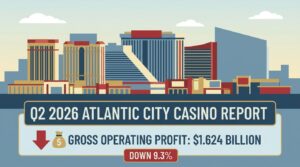
Atlantic City’s nine casino hotel properties collectively generated $1.624 billion in gross operating profit during the second quarter of 2026, marking a 9.3% decline compared to the same period a year earlier. The downturn signals mounting pressure on an already competitive market, raising questions about whether the boardwalk destination can sustain profitability amid shifting consumer spending patterns and intensifying regional competition. The figures, reported through New Jersey’s regulatory filings, paint a more nuanced picture than the headline number suggests.
What the Q2 2026 Numbers Reveal About Atlantic City’s Casino Sector
A nearly double-digit drop in gross operating profit across a single quarter demands scrutiny. Before diving into the specifics, here are the strategic takeaways that matter most for industry stakeholders:
- Aggregate gross operating profit fell to $1.624 billion, a 9.3% year-over-year decline that reflects both revenue softness and rising operational costs across the market
- The decline comes despite relatively stable visitation numbers, suggesting that per-visitor spend may be contracting
- Cost pressures from labor, energy, and compliance continue to erode margins for operators who have limited room to raise prices without deterring guests
- Regional competition from neighboring states with expanded gaming options is arguably the single largest structural headwind facing Atlantic City properties
- Not all nine properties experienced the same degree of decline, pointing to divergent strategies among operators in managing profitability
Revenue Erosion Meets Rising Costs
The 9.3% decline in gross operating profit doesn’t exist in isolation. It sits at the intersection of two forces that have been building for several quarters: softening top-line revenue and a cost structure that refuses to cooperate.
Labor costs across Atlantic City’s hospitality and gaming workforce have climbed steadily, driven by contract renegotiations and broader wage inflation in the service sector. Energy expenses, while somewhat moderated from their 2023–2024 peaks, remain elevated relative to pre-pandemic baselines. And regulatory compliance costs (a category that rarely shrinks) continue to layer onto operating budgets.
What makes this quarter particularly telling is the gap between revenue performance and profit performance. Even properties that maintained or grew their gaming revenue saw profit margins compress. That compression points to a structural issue, not a cyclical blip.
How Regional Competition Is Reshaping the Landscape
Atlantic City no longer operates in the same competitive vacuum it once did. Expanded gaming in Pennsylvania, New York’s push toward full-scale commercial casinos in the New York City metro area, and the continued maturation of online gaming platforms have all chipped away at the market’s gravitational pull.
For decades, Atlantic City’s casino and resort corridor benefited from geographic monopoly across the northeastern United States. That advantage has eroded substantially. Pennsylvania alone now hosts more than a dozen licensed casino properties, several of which sit within a two-hour drive of Atlantic City’s core feeder markets.
Still, the boardwalk market retains certain advantages that pure gaming destinations cannot replicate: beachfront hospitality, entertainment programming, and a concentration of dining and nightlife that appeals to a broader demographic than slot floors alone.
Property-Level Divergence Worth Watching
Not every operator felt the downturn equally. While aggregate numbers declined 9.3%, individual property performance varied considerably. Some casino hotels managed to hold margins through aggressive cost management and targeted reinvestment in high-yield amenities. Others absorbed steeper declines, particularly those with older physical plants requiring higher maintenance capital.
This divergence matters. It suggests that the market’s challenges are not uniformly distributed and that operator strategy, rather than market conditions alone, will increasingly determine which properties thrive and which face existential questions about long-term viability.
Q2 2026 Performance Snapshot
| Metric | Q2 2026 | Q2 2025 | Change |
|---|---|---|---|
| Gross Operating Profit (All Properties) | $1.624 Billion | ~$1.790 Billion | -9.3% |
| Number of Reporting Casino Hotels | 9 | 9 | No change |
| Primary Cost Drivers | Labor, energy, regulatory compliance, capital maintenance | ||
What Operators Can Control in a Tightening Market
When external forces squeeze margins, the instinct is to cut. But the operators showing the most resilience in Atlantic City appear to be taking a different approach: selective reinvestment paired with disciplined cost management. Rather than slashing amenities or reducing staffing to bare minimums, several properties have focused on enhancing revenue per available room and optimizing their gaming floor mix to favor higher-margin offerings.
This is where behavioral economics intersects with operational strategy. Properties that understand how guests make spending decisions, from the moment they book a room to the moment they leave the casino floor, can engineer environments that encourage higher spend without relying on discounting. Anchoring room rates to perceived value through bundled experiences, designing floor layouts that extend time-on-device, and deploying loyalty program incentives calibrated to individual player profiles all represent levers that sophisticated operators are pulling.
The psychological dimension of guest experience cannot be overstated. Research in consumer behavior consistently shows that perceived value drives repeat visitation more reliably than raw price competition. Operators who frame their offerings around experiential richness rather than transactional cost tend to build more durable customer relationships. In practice, this means investing in staff training, curating entertainment lineups that create social media momentum, and ensuring that every touchpoint, from valet to checkout, reinforces a narrative of quality. The properties that internalize this framework will likely outperform peers even as the broader market contracts.
Frequently Asked Questions
Why did Atlantic City casino profits decline in Q2 2026?
The 9.3% decline in gross operating profit resulted from a combination of softening consumer spending, rising labor and energy costs, and intensifying competition from gaming operations in neighboring states. No single factor explains the drop entirely.
How many casino hotels operate in Atlantic City?
Nine casino hotel properties currently operate in Atlantic City and report financial results through New Jersey’s regulatory framework.
Is Atlantic City losing market share to other states?
Yes, at least in relative terms. Pennsylvania, New York, and online gaming platforms have all captured portions of the northeastern gaming market that Atlantic City once dominated. Whether this trend accelerates depends partly on how quickly New York’s downstate casino licenses move forward.
What can casino operators do to reverse the profit decline?
Operators are focusing on revenue optimization strategies including enhanced loyalty programs, higher-margin gaming products, and experiential hospitality investments. Cost discipline remains important, but cutting alone is unlikely to restore margins without corresponding revenue innovation.



