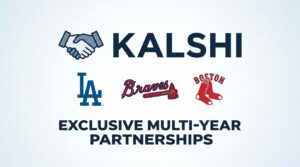
Kalshi, the federally regulated prediction market platform, has secured exclusive multi-year brand partnerships with several Major League Baseball franchises, including the Atlanta Braves, Boston Red Sox, Los Angeles Dodgers, and San Diego Padres. The deals mark a significant expansion of event contracts into mainstream professional sports sponsorship territory. For a platform that only recently won regulatory battles to offer sports-adjacent contracts, the speed of this commercial push is striking.
What These MLB Deals Signal for Prediction Markets
The partnerships represent more than logo placements on stadium signage. They position Kalshi alongside traditional sportsbooks and fintech brands that have spent years cultivating relationships with major league teams. Before unpacking the strategic details, here are the key business implications worth tracking:
- Kalshi gains direct access to millions of MLB fans across four of the league’s most prominent and commercially valuable franchises
- Exclusive, multi-year terms suggest the teams see prediction markets as a distinct category from daily fantasy or traditional sports betting
- The move accelerates Kalshi’s brand-building efforts at a time when regulatory clarity around event contracts remains uneven across states
- Competing prediction market platforms now face a visibility gap in one of America’s highest-attendance professional sports leagues
- For MLB teams, these deals diversify sponsorship revenue beyond the increasingly crowded sportsbook category
Why MLB, and Why Now?
Baseball has historically been more cautious than the NFL or NBA in embracing gambling-adjacent partnerships. Yet the economics have shifted. Average MLB attendance across the league topped 26,000 per game in 2024, and the Dodgers alone drew over 3.9 million fans to Dodger Stadium last season. That kind of foot traffic, combined with broadcast reach, makes these franchises powerful distribution channels for a brand still building mainstream awareness.
Kalshi’s timing is deliberate. The platform secured a legal victory in 2023 when a federal court ruled in its favor against the CFTC’s attempt to block event contracts tied to congressional elections. Since then, the company has expanded its product lineup aggressively, listing contracts on everything from economic data releases to weather events. But consumer awareness has lagged behind product development (a common challenge for fintech platforms operating in novel regulatory categories).
Partnering with franchises like the Atlanta Braves and the Red Sox solves part of that problem. Stadium branding, in-venue activations, and co-branded content give Kalshi repeated touchpoints with a demographic that skews toward the financially engaged male audience prediction markets tend to attract.
How Prediction Market Sponsorships Differ from Sportsbook Deals
There is a distinction worth drawing here. Sportsbooks like DraftKings and FanDuel have spent billions on sports sponsorships since the Supreme Court’s 2018 PASPA ruling opened the door to legal sports betting. Their partnerships are transactional: bet on tonight’s game, claim a bonus, download the app.
Kalshi’s pitch is structurally different. The platform does not offer traditional sports wagers. Instead, it operates under CFTC oversight as a designated contract market, listing binary event contracts that function more like financial instruments than bets. Whether that distinction resonates with a casual fan watching a Padres game on a Tuesday night remains an open question.
Still, the exclusivity clause matters. By locking out other prediction market operators from these franchises, Kalshi ensures it won’t share the emerging category with rivals like Polymarket or PredictIt in these high-visibility venues. That first-mover advantage in physical brand presence could prove difficult to replicate.
The Regulatory Landscape Kalshi Is Navigating
Prediction markets sit in a regulatory gray zone that varies by jurisdiction. Kalshi holds a DCM license from the CFTC, which gives it a legal framework that most competitors lack. But the agency has not been uniformly supportive. Its attempt to block Kalshi’s election contracts demonstrated that the boundaries of permissible event markets are still being drawn.
State-level complexity adds another layer. Sports betting is legal in roughly 38 states plus Washington, D.C., but prediction market contracts operate under federal commodity law, not state gaming statutes. At least on paper, this gives Kalshi broader geographic reach than a typical sportsbook. Whether state regulators eventually push back on that interpretation is a question the industry hasn’t fully answered.
| MLB Franchise | Market Size | 2024 Attendance (Approx.) | Partnership Type |
|---|---|---|---|
| Los Angeles Dodgers | 2nd largest U.S. metro | 3.9M+ | Exclusive, multi-year |
| Boston Red Sox | 10th largest U.S. metro | 2.5M+ | Exclusive, multi-year |
| Atlanta Braves | 9th largest U.S. metro | 2.6M+ | Exclusive, multi-year |
| San Diego Padres | 17th largest U.S. metro | 2.8M+ | Exclusive, multi-year |
Building Trust Through Familiarity: The Psychology Behind Stadium Branding
From a behavioral standpoint, Kalshi’s strategy taps into well-documented principles of repeated exposure and associative conditioning. When a consumer encounters a brand in a trusted environment, surrounded by familiar rituals and positive emotions, the brain forms implicit associations that no digital ad can replicate. This is the mere exposure effect at work: the more frequently someone sees a brand in a context they already trust, the more favorably they tend to evaluate it, even without conscious deliberation.
Prediction markets carry an inherent educational burden. Most Americans have never traded an event contract. They may not understand the difference between placing a bet and buying a binary contract on whether the Federal Reserve will cut rates. Stadium presence doesn’t explain that difference directly, but it does something arguably more valuable: it normalizes the brand. Kalshi becomes something fans see next to Coca-Cola and Toyota, not something they encounter in a Reddit thread about crypto-adjacent platforms.
There is also an anchoring effect in play. By associating with established, century-old franchises like the storied Red Sox organization, Kalshi borrows institutional credibility. The implicit message is one of legitimacy and permanence. For a company operating in a category that regulators have actively challenged, that borrowed trust carries real commercial weight. And the multi-year commitment signals to both consumers and regulators that Kalshi is building for durability, not running a promotional sprint.
Whether this translates into meaningful user acquisition depends on execution. In-venue QR codes, interactive fan experiences, and co-branded content will matter more than a logo on an outfield wall. The partnerships create the stage. What Kalshi builds on it will determine whether prediction markets cross from niche financial product to mainstream consumer category.
Frequently Asked Questions
What is Kalshi?
Kalshi is a CFTC-regulated prediction market platform where users trade binary event contracts on outcomes ranging from economic indicators to weather events. It operates as a designated contract market under federal commodity law.
Are prediction markets the same as sports betting?
No. Prediction markets trade event contracts regulated as financial instruments, not wagers. Kalshi does not offer bets on individual game outcomes the way a sportsbook does, though the line between the two categories continues to generate regulatory debate.
Which MLB teams has Kalshi partnered with?
The announced partnerships include the Atlanta Braves, Boston Red Sox, Los Angeles Dodgers, and San Diego Padres, all structured as exclusive, multi-year agreements.
Why does exclusivity matter in these deals?
It prevents competing prediction market platforms from securing sponsorship visibility with these franchises during the contract term. In a nascent category, being the only brand of your type inside a major league stadium carries outsized weight.



