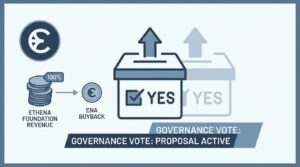
The Ethena Foundation has launched a governance vote that would channel all net revenue from Ethena-branded businesses into programmatic ENA token buybacks. The proposal, which went live on Snapshot on Thursday, August 27, represents one of the more aggressive fee-switch mechanisms seen in DeFi governance this year. If approved, effectively 100% of net revenue would be redirected toward purchasing ENA on the open market, a move designed to create sustained buy pressure and align protocol economics with token holders.
What the Ethena Buyback Proposal Signals for ENA Holders
Fee-switch proposals have become a recurring theme across DeFi protocols, but few have gone as far as proposing a full revenue allocation. Before unpacking the strategic layers, here are the core takeaways from this governance action:
- Full revenue commitment: Unlike partial buyback models adopted by other protocols, Ethena’s proposal dedicates 100% of net revenue to ENA purchases, leaving no ambiguity about where value flows.
- Programmatic execution: Buybacks would be conducted systematically rather than at the discretion of a multisig or committee, reducing governance overhead and trust assumptions.
- The proposal’s passage depends on Snapshot voting, meaning ENA token holders themselves decide whether to activate this mechanism.
- Market signal: Approval would position Ethena among a small group of DeFi protocols that have committed to direct, measurable value accrual for their governance token.
- Revenue sustainability remains the open question — buyback programs are only as durable as the income streams funding them.
How Ethena’s Revenue Engine Works
Ethena operates a synthetic dollar protocol built around USDe, a stablecoin backed by delta-neutral hedging strategies. The protocol generates revenue primarily through funding rate arbitrage and staking yields across centralized and decentralized venues. That revenue has grown substantially as USDe’s circulating supply expanded through 2024 and into 2025, making the Ethena protocol’s fee-switch discussion increasingly material to token holders.
What makes this proposal distinct is scope. Most DeFi protocols that have activated fee switches — Uniswap’s long-debated version comes to mind — tend to allocate a fraction of fees, often 10% to 30%, toward token buybacks or distributions. Ethena’s governance is being asked to approve a model where the entire net revenue stream (after operational costs, presumably) feeds directly into buy-side pressure on ENA.
The Broader DeFi Fee-Switch Trend
Ethena’s proposal lands at a moment when DeFi governance tokens face persistent skepticism about their intrinsic value. For years, critics have argued that most governance tokens lack direct cash flow rights, making them functionally speculative assets with voting privileges attached. Fee switches attempt to bridge that gap.
Aave, Maker (now Sky), and Jupiter have each explored or implemented variations of revenue-sharing or buyback mechanisms in recent months. But the approaches differ considerably:
| Protocol | Mechanism | Revenue Allocation |
|---|---|---|
| Ethena (proposed) | Programmatic buyback | 100% of net revenue |
| Aave | Buyback and distribute | Partial, tied to safety module reform |
| Jupiter | Token buyback | 50% of protocol fees |
| Sky (formerly Maker) | Burn mechanism | Variable, surplus-dependent |
Ethena’s 100% figure stands out. Whether it proves sustainable over multiple market cycles is another matter entirely.
Why Programmatic Buybacks Matter More Than Discretionary Ones
A subtle but important detail in the proposal is the word “programmatic.” Discretionary buybacks — where a team or DAO committee decides when and how much to buy — introduce timing risk and trust dependencies. Programmatic models, by contrast, operate on predefined rules. They execute regardless of market sentiment, which arguably creates more predictable tokenomics.
Still, programmatic doesn’t mean inflexible. Governance can always vote to modify parameters later. And that flexibility cuts both ways (a distinction token holders should weigh carefully before treating this as a permanent commitment).
Strategic Framing: What Token Holders Should Consider
For ENA holders evaluating this vote, the calculus involves more than just “buybacks are good.” Several dimensions deserve scrutiny:
First, net revenue definition matters. How operational expenses are calculated before the buyback allocation kicks in will determine actual buy pressure. A protocol spending heavily on growth initiatives could see modest net revenue even with strong gross numbers. The proposal’s specifics on this point will shape its real-world impact.
Second, there’s the question of opportunity cost. Revenue directed entirely toward buybacks cannot fund new product development, security audits, or ecosystem grants. Protocols that starve their treasuries in favor of short-term token price support sometimes find themselves underfunded when market conditions shift. Ethena’s governance participants will need to assess whether the protocol’s existing treasury and operational runway can absorb this tradeoff.
Third, market structure effects. Consistent programmatic buying creates a price floor dynamic that market makers and traders will price in. Over time, this can reduce volatility and improve liquidity depth around ENA — or it can create predictable patterns that sophisticated actors exploit.
Frequently Asked Questions
What is the Ethena fee switch?
The fee switch refers to a governance mechanism that redirects protocol revenue toward ENA token buybacks instead of retaining it in the treasury or distributing it through other means. In this case, the proposal allocates 100% of net revenue.
When does the vote close?
The proposal went live on Snapshot on August 27. Snapshot votes typically run for several days, though the exact closing date depends on the parameters set by the Ethena Foundation.
How would buybacks be executed?
Programmatically. Rather than relying on a committee to time purchases, the mechanism would execute ENA buys according to predefined rules, removing discretionary timing from the process.
Does this guarantee ENA’s price will increase?
No. Buybacks create additional demand, but token price depends on a range of factors including broader market conditions, protocol adoption, and overall crypto sentiment. Sustained revenue generation is the prerequisite that makes any buyback program meaningful.



