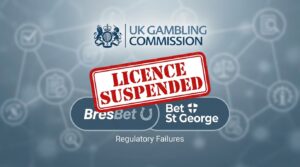
The UK Gambling Commission has suspended the operating licences of BresBet Ltd and Bet St George Ltd with immediate effect, citing serious concerns about both operators’ ability to meet regulatory standards. The enforcement action, which prevents both companies from transacting with customers until further notice, signals a continued tightening of compliance expectations across Britain’s licensed gambling sector. Neither operator had established a significant consumer-facing presence in the UK market, but the suspensions carry broader implications for how the regulator treats early-stage licensees that fail to demonstrate adequate controls.
What the Suspensions Mean for UK Gambling Oversight
Before examining the specifics, it’s worth framing what this action tells us about the Gambling Commission’s current posture. These are not household names. Yet the regulator chose to act publicly and decisively, reinforcing a pattern of intervention that has accelerated over the past 18 months.
- Both licences suspended simultaneously, suggesting the Commission identified systemic rather than isolated failings across the two operators
- The suspensions prevent all customer-facing gambling activity, including accepting deposits, processing wagers, and paying out winnings
- BresBet and Bet St George must now satisfy the Commission that they can meet licence conditions before any reinstatement is considered
- This action adds to a growing list of enforcement measures taken against smaller operators that arguably lack the compliance infrastructure of larger rivals
- The Commission has not disclosed whether the concerns relate to anti-money laundering controls, social responsibility obligations, or both
Regulatory Grounds and What Triggered the Action
The Gambling Commission’s formal announcement referenced concerns about the operators’ compliance with licence conditions and codes of practice. While the regulator did not specify individual breaches in granular detail, suspension (as opposed to revocation) typically indicates the Commission believes remediation is possible but that continued operation during the review period poses unacceptable risk.
Under Section 118 of the Gambling Act 2005, the Commission holds authority to suspend a licence where it has reasonable grounds to suspect that activities are being carried on in a manner inconsistent with the licensing objectives. Those objectives include preventing gambling from being a source of crime, ensuring gambling is conducted fairly, and protecting children and vulnerable persons.
That both companies were acted upon at the same time raises questions about shared ownership structures, common compliance frameworks, or overlapping operational deficiencies. The Commission has not confirmed any corporate link between the two entities.
A Pattern of Escalating Enforcement
This is not an isolated event. The Gambling Commission has issued a series of licence suspensions and revocations targeting smaller and mid-tier operators throughout 2024 and into 2025. The trend reflects a deliberate strategic shift: rather than focusing enforcement resources exclusively on the largest operators (where headline fines attract media attention), the regulator has broadened its scrutiny to include licensees at every scale.
Consider the numbers. In the 12 months to March 2025, the Commission initiated more than a dozen formal enforcement actions against operators holding remote and non-remote licences. Several of those resulted in permanent revocations. The message is blunt: holding a UK gambling licence carries obligations that begin on day one, not once an operator reaches commercial scale.
Still, some industry observers question whether the Commission’s resources are optimally deployed. Pursuing operators with minimal market presence, while larger compliance gaps persist elsewhere, is a tension the regulator has yet to fully resolve (a distinction that matters more than the Commission publicly acknowledges).
How Operators Can Reframe Compliance as Strategic Advantage
For operators watching from the sidelines, these suspensions carry a lesson that extends beyond regulatory risk. Compliance is often framed in negative terms: cost, burden, constraint. But reframing that perspective can fundamentally alter how a business approaches its licence obligations.
Operators that embed compliance into their operational identity, treating it not as a checkbox exercise but as a core business function, tend to build more resilient organisations. This is where principles drawn from neuro-linguistic programming offer a useful lens. NLP emphasises the power of internal framing: how an organisation talks about compliance internally shapes how it behaves externally. When leadership describes regulatory adherence as “something we have to do,” teams respond with minimal effort. When the language shifts to “this is how we protect our customers and our licence,” behaviour follows.
Anchoring positive associations with compliance processes, celebrating audit readiness rather than dreading it, and modelling regulatory engagement as a partnership rather than an adversarial relationship are all techniques that high-performing operators deploy. The operators that struggle most often share a common trait: they treat compliance as peripheral until the regulator forces it to the centre.
Visualisation techniques, another NLP staple, can also play a role. Compliance teams that regularly rehearse worst-case scenarios and mentally walk through their response protocols tend to perform better under actual regulatory scrutiny. The goal is not paranoia but preparedness, building the kind of institutional muscle memory that prevents the failures leading to suspensions like those imposed on operators under Gambling Commission oversight.
What Comes Next for BresBet and Bet St George
Both operators now face a formal review process. The Commission will assess whether the concerns that triggered the suspensions can be adequately addressed. If the operators demonstrate sufficient remediation, including strengthened policies, improved governance, and evidence of effective implementation, licences may be reinstated with additional conditions attached.
If they cannot, revocation remains on the table.
The timeline for resolution is uncertain. Historically, suspension reviews have taken anywhere from several weeks to several months, depending on the complexity of the issues and the operator’s responsiveness. During this period, any customer funds held by the operators must be protected in accordance with the Commission’s requirements.
Frequently Asked Questions
What does a licence suspension mean for existing customers?
Customers cannot place bets or access gambling services during the suspension. Operators remain obligated to protect customer funds and process legitimate withdrawal requests, though the practical speed of those withdrawals may vary depending on the operator’s financial position.
Can suspended operators appeal?
Yes. Operators may make representations to the Gambling Commission during the review process. They also retain the right to appeal to the First-tier Tribunal if the Commission proceeds to revocation.
Is suspension the same as revocation?
No, and the difference matters. Suspension is temporary and reversible. Revocation is permanent. The Commission uses suspension when it believes the operator may be capable of addressing the identified concerns, but considers continued operation too risky in the interim.
How often does the Gambling Commission suspend licences?
Suspensions have become more frequent. The Commission does not publish a single consolidated tracker, but public notices suggest the pace of formal enforcement actions has increased markedly since 2023, particularly against smaller licensees.



