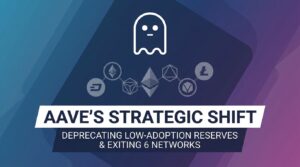
Aave, the dominant DeFi lending protocol currently holding $14.3 billion in deposits, has initiated a governance proposal to deprecate 50 underperforming asset reserves and fully wind down operations across six blockchain networks. The proposal, posted Wednesday by risk provider LlamaRisk, targets deployments on Sonic, Scroll, zkSync, Metis, Soneium, and Aptos. If approved, this would represent one of the most significant consolidation moves in decentralized finance this year, signaling a sharper focus on capital efficiency over broad multi-chain presence.
What Aave’s Consolidation Signals for DeFi Strategy
The proposal isn’t a surprise to those tracking Aave’s trajectory. Over the past eighteen months, the protocol expanded aggressively across Layer 2 rollups and alternative Layer 1 chains, chasing liquidity and user growth wherever gas fees were low and incentives were high. But expansion without proportional adoption creates drag. Maintaining smart contract deployments, oracle integrations, and risk parameters across dozens of chains demands engineering bandwidth and governance attention that could be directed elsewhere.
Before diving into the specifics, here are the strategic takeaways from this proposal:
- Capital reallocation over growth-at-all-costs: Deprecating 50 reserves suggests Aave is pruning assets that contribute minimal lending volume relative to the risk and overhead they introduce.
- Six full network exits: Withdrawing from Sonic, Scroll, zkSync, Metis, Soneium, and Aptos marks a retreat from chains where user traction failed to materialize at meaningful scale.
- Governance-driven risk management: LlamaRisk’s role in initiating the proposal underscores how third-party risk providers are increasingly shaping protocol-level decisions in DeFi.
- The move could pressure other multi-chain protocols to audit their own deployment footprints, particularly those subsidizing presence on low-volume networks.
- User migration logistics: Existing depositors and borrowers on affected chains will need to unwind positions, raising questions about timelines and potential liquidation risks during the transition.
Why These Six Chains?
Each of the six networks slated for wind-down shares a common thread: insufficient organic demand for Aave’s lending and borrowing services. Sonic and Soneium, both relatively newer entrants, never attracted the critical mass of DeFi users needed to justify ongoing deployment costs. Scroll and zkSync, despite strong technical narratives around zero-knowledge rollups, have seen fragmented liquidity across too many protocols competing for a limited user base.
Metis, once positioned as a promising Optimistic rollup, has struggled with TVL retention. And Aptos, a Move-language Layer 1, represents a fundamentally different smart contract environment (a distinction that arguably made Aave’s deployment there more expensive to maintain than EVM-compatible alternatives).
Whether these chains can attract replacement lending protocols remains an open question.
The 50 Reserve Deprecations: Trimming the Long Tail
Beyond full chain exits, the proposal targets 50 individual asset reserves across Aave’s remaining deployments. These are tokens that were listed as collateral or borrowable assets but failed to generate meaningful utilization rates. Low-adoption reserves carry real costs: each one requires oracle price feeds, risk parameter calibration, and periodic governance review. When utilization hovers near zero, those costs become pure overhead.
This kind of pruning mirrors what traditional financial institutions do when they discontinue products with insufficient demand. The difference in DeFi is that every deprecation must pass through on-chain governance, making the process slower but arguably more transparent than a bank quietly delisting a product.
How Risk Providers Are Reshaping Protocol Governance
LlamaRisk’s central role here deserves attention. The firm operates as an independent risk assessment provider for Aave’s governance framework, analyzing asset risk profiles and recommending parameter changes. That a third-party risk entity, not the core development team, initiated this sweeping consolidation proposal reflects a maturing governance model in DeFi.
Still, the arrangement raises its own tensions. Risk providers wield significant influence over which assets survive and which chains retain deployments. Their methodologies, while published, are not universally agreed upon by all token holders. Governance voters ultimately decide, but the framing power of the initial proposal shapes outcomes considerably.
Market and Competitive Implications
Aave’s retrenchment creates both vacuum and precedent. Competing lending protocols like Compound, Spark, and Morpho may see an opportunity to capture users on the abandoned chains. Or they may read the same data Aave did and stay away.
| Network | Status Under Proposal | Likely Impact |
|---|---|---|
| Sonic | Full wind-down | Limited alternative lending options remain |
| Scroll | Full wind-down | ZK rollup DeFi ecosystem loses anchor protocol |
| zkSync | Full wind-down | Competitive lending gap opens for smaller protocols |
| Metis | Full wind-down | TVL likely to contract further without Aave presence |
| Soneium | Full wind-down | Early-stage chain loses credibility signal |
| Aptos | Full wind-down | Non-EVM DeFi expansion narrative weakened |
For the broader DeFi sector, the message is blunt: multi-chain expansion without organic demand is unsustainable, even for a protocol with $14.3 billion in deposits.
What Depositors on Affected Chains Should Know
Users with active positions on any of the six networks face a practical question: when and how to exit. Deprecation proposals typically include a grace period during which borrowing is disabled but withdrawals remain open. Interest rate models may be adjusted to incentivize repayment of outstanding loans. But the specifics depend on the final governance vote and implementation timeline.
Liquidation risk during wind-down periods is real, particularly for leveraged positions. Users should monitor governance forums closely and consider unwinding positions before any parameter changes take effect.
Frequently Asked Questions
Will Aave users on deprecated chains lose their funds?
No. Wind-down procedures are designed to allow full withdrawal of deposited assets. Borrowers will need to repay loans, but the protocol does not seize collateral simply because a deployment is being retired. Timelines matter, though, and waiting until the last moment introduces unnecessary risk.
Does this affect Aave on Ethereum or major Layer 2s?
Not at all. The proposal targets only low-adoption deployments. Aave’s core markets on Ethereum, Arbitrum, Optimism, Polygon, and Base remain unaffected and continue to hold the vast majority of protocol TVL.
Who decides whether this proposal passes?
AAVE token holders vote through on-chain governance. LlamaRisk authored the proposal, but approval requires sufficient quorum and majority support from voting participants.
Could Aave return to these chains later?
In theory, yes. Governance proposals can authorize new deployments at any time. But re-entry would require demonstrable demand that doesn’t exist today.



