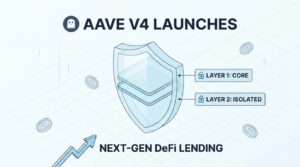
Aave V4 has entered its capped launch phase, introducing a fundamentally reworked market architecture built around a two-layer isolation model. Stani Kulechov, the protocol’s founder, confirmed the rollout, which segments collateral across separate Hubs and Spokes to manage liquidity and risk with far greater granularity than previous versions. The redesign signals a deliberate shift in how decentralized lending protocols think about capital efficiency and systemic exposure — and it arrives at a moment when DeFi’s largest platforms are under pressure to prove they can scale without compounding risk.
What Aave V4’s Architecture Overhaul Means for DeFi Lending
Before diving into the specifics, it’s worth framing why this matters beyond the technical details. Aave remains one of the most widely used lending protocols in decentralized finance, with billions in total value locked across multiple chains. A structural upgrade at this scale doesn’t just affect Aave users; it sets a benchmark that competing protocols will inevitably be measured against.
- The two-layer isolation model (Hubs and Spokes) creates compartmentalized risk zones, limiting contagion if a single collateral type experiences a liquidity crisis
- Capped launch suggests a phased deployment strategy, allowing stress-testing under controlled conditions before full-scale rollout
- Liquidity segmentation across Spokes could improve capital efficiency for institutional participants who need predictable risk exposure
- The redesign positions Aave to compete more directly with emerging modular lending protocols that have gained traction by offering customizable risk parameters
- Governance implications are significant — Hub-level isolation may require new frameworks for how the Aave DAO manages risk across fragmented pools
Hubs, Spokes, and the Logic of Isolation
At its core, the V4 architecture replaces the monolithic pool model that characterized earlier versions. In Aave V3, markets were unified under a single liquidity umbrella with efficiency modes layered on top. V4 breaks that apart.
Each Hub operates as an independent market environment. Within a Hub, Spokes further subdivide collateral and borrowing activity into discrete segments. Think of it as moving from a single warehouse where all inventory sits together to a network of vaults, each with its own access controls and exposure limits. That’s not just a cosmetic change.
Why does isolation matter so much right now? The DeFi sector has learned hard lessons from cascading liquidations — events where one asset’s collapse drags down an entire lending pool. By isolating collateral at two levels, Aave V4 attempts to build structural firebreaks into the protocol itself. Whether those firebreaks hold under genuine market stress remains the open question (a distinction that only live conditions, not testnets, can resolve).
Capped Launch: Controlled Ambition
The decision to launch with caps is telling. Rather than opening the floodgates, Aave’s team is constraining initial deposits and borrowing limits. This approach mirrors what traditional financial institutions call a “soft launch” — deploying infrastructure at reduced capacity to identify vulnerabilities before they become systemic.
Still, capped launches carry their own tension. They limit early adoption and can frustrate liquidity providers eager to deploy capital. And while controlled rollouts reduce downside risk, they also delay the network effects that make lending protocols valuable in the first place.
Competitive Positioning in a Crowded Field
Aave doesn’t operate in a vacuum. Morpho, Euler, and a growing roster of modular lending platforms have been chipping away at the market by offering borrowers and lenders more customizable risk-return profiles. The V4 redesign is, arguably, Aave’s answer to that competitive pressure.
The Aave protocol’s new isolation framework borrows conceptually from the modular approach — giving users more granular control over which risk pools they participate in — while retaining the brand recognition and liquidity depth that newer entrants lack. It’s a bet that architecture can be modernized without fragmenting the user base.
| Feature | Aave V3 | Aave V4 |
|---|---|---|
| Market Structure | Unified pools with efficiency modes | Two-layer isolation (Hubs + Spokes) |
| Risk Segmentation | Limited isolation mode | Granular, multi-level compartmentalization |
| Launch Strategy | Full deployment | Capped, phased rollout |
| Contagion Mitigation | Protocol-level circuit breakers | Structural isolation at the collateral layer — a fundamentally different approach to containing cascading failures |
How Risk Perception Shapes Protocol Adoption
Beyond the technical mechanics, Aave V4’s launch taps into something more fundamental: how participants perceive and process risk in decentralized markets. In behavioral terms, the isolation model reframes the lending experience. Instead of asking users to trust a single, opaque pool, it offers visible boundaries — containers that make risk feel more manageable, even quantifiable.
This matters because DeFi adoption, particularly among institutional allocators, has been constrained less by yield opportunity and more by the inability to scope downside exposure. When a protocol can articulate where one risk ends and another begins, it reduces the cognitive load on decision-makers. That reduction isn’t trivial. It’s the difference between a risk committee approving a DeFi allocation and tabling it indefinitely.
Framing also plays a role. By labeling the architecture in intuitive terms — Hubs and Spokes — Aave makes a complex system legible to participants who aren’t smart contract auditors. The language itself becomes a trust signal. And in markets where trust is the scarcest resource, legibility compounds into liquidity over time.
There’s a subtler dynamic at work too. Isolation models create a sense of agency. Users choose which Hub to enter, which Spoke to allocate to. That sense of control, even if partially illusory in highly correlated markets, changes how participants engage with the protocol. They become active risk managers rather than passive depositors. Protocols that facilitate that shift tend to retain users longer — and attract the kind of capital that doesn’t flee at the first sign of volatility.
Frequently Asked Questions
What is the two-layer isolation model in Aave V4?
It’s an architecture that separates collateral into Hubs (independent market environments) and Spokes (subdivisions within each Hub). The goal is to prevent a problem in one collateral type from spreading across the entire protocol.
Why is Aave V4 launching with caps?
Caps limit initial deposits and borrowing to stress-test the new architecture under real but controlled conditions. It’s a risk management decision — not a permanent constraint.
How does this compare to Aave V3?
V3 used unified pools with some isolation features bolted on. V4 rebuilds the foundation entirely, making isolation a structural default rather than an optional mode. The difference is architectural, not incremental.
Does this affect existing Aave users?
During the capped launch phase, existing V3 markets continue to operate. Migration paths and timelines for broader V4 adoption have not yet been fully detailed by the Aave governance community.



