Arbitrum rolled out its ArbOS 61 Elara upgrade on August 20, introducing protocol-level transaction screening as an optional feature, priority-fee support, and a revamped data-availability interface tailored for dedicated chains. The upgrade also restructures base-fee administration and broadens Stylus capacity on Arbitrum One. It marks one of the more consequential protocol updates for the Layer 2 network in recent months, touching governance, developer tooling, and chain economics simultaneously.
What the Elara Upgrade Actually Changes for Arbitrum’s Ecosystem
Before unpacking the strategic implications, here’s what matters most for builders, operators, and stakeholders watching Arbitrum’s trajectory:
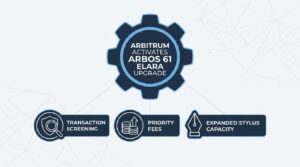
- Optional transaction screening at the protocol level gives chain operators a compliance-adjacent tool without mandating its use across all deployments
- Priority-fee support introduces a mechanism that could reshape how transaction ordering and MEV dynamics play out on Arbitrum
- A new alternative data-availability interface opens the door for dedicated chains (Orbit chains) to plug into external DA layers more flexibly
- Base-fee administration changes alter the economic model underpinning gas pricing on the network
- Expanded Stylus capacity on Arbitrum One means developers writing smart contracts in Rust, C, and C++ gain more room to build
Protocol-Level Screening: A Calculated Move
The inclusion of optional transaction screening is arguably the most politically charged element of the Elara upgrade. By embedding this capability at the protocol layer rather than leaving it entirely to application-level solutions, Arbitrum is giving Orbit chain operators a native toggle for compliance filtering. Whether operators actually flip that switch depends on jurisdiction, risk appetite, and the regulatory posture of the teams running those chains.
This is not a blanket censorship mechanism. The “optional” qualifier matters here (a distinction that will likely draw scrutiny from both regulators and decentralization advocates). Still, the very existence of a protocol-native screening option signals that Arbitrum’s infrastructure layer is preparing for a world where institutional and enterprise deployments demand configurable compliance tooling.
Priority Fees and the Economics of Block Space
Adding priority-fee support brings Arbitrum closer to the fee-market mechanics familiar on Ethereum’s mainnet. Users and applications can now attach priority fees to transactions, which in practice means faster inclusion during periods of congestion. The implications ripple outward: MEV searchers, DeFi protocols relying on time-sensitive execution, and high-frequency trading operations on the network all stand to recalibrate their strategies.
What remains less clear is how this interacts with Arbitrum’s sequencer model. Priority fees on a network with a centralized sequencer operate differently than on a fully decentralized block-production system. The fee goes somewhere, and who captures that value shapes incentives across the entire chain.
Data Availability Gets More Modular
The alternative data-availability interface is a quieter but structurally significant addition. Orbit chains, which are custom Layer 2 and Layer 3 deployments built on Arbitrum’s stack, can now integrate with DA providers beyond Ethereum’s calldata or blob space. Think Celestia, EigenDA, or other emerging DA layers.
This modularity is table stakes in the current rollup landscape. But Arbitrum embedding it as a first-class protocol feature rather than a workaround reduces friction for teams launching sovereign or application-specific chains. It also positions the Arbitrum Orbit ecosystem as more composable, at least on paper, than competing rollup frameworks that lock operators into a single DA path.
Stylus Expansion: Broadening the Developer Funnel
Stylus, Arbitrum’s environment for executing smart contracts written in languages like Rust and C++, receives expanded capacity under Elara. For developers outside the Solidity ecosystem, this is a tangible improvement. More capacity means larger and more complex programs can run natively on Arbitrum One without hitting execution ceilings that previously constrained what Stylus-based applications could do.
The bet here is straightforward: attract developers who already know systems-level languages and give them fewer reasons to look elsewhere.
How Does This Position Arbitrum Competitively?
Layer 2 networks are in an arms race across multiple fronts: throughput, cost, developer experience, and increasingly, institutional readiness. The Elara upgrade touches all four. And while no single upgrade decides a competitive outcome, the combination of compliance optionality, fee-market sophistication, modular DA, and multi-language smart contract support paints a picture of a protocol trying to serve both DeFi-native users and enterprise entrants simultaneously.
| Feature | Impact Area | Primary Beneficiary |
|---|---|---|
| Optional transaction screening | Compliance / Governance | Orbit chain operators, institutional deployers |
| Priority-fee support | Transaction economics | DeFi protocols, MEV participants, power users |
| Alternative DA interface | Infrastructure modularity | Orbit chain builders seeking cost-efficient DA |
| Base-fee administration changes | Gas pricing model | All network participants |
| Expanded Stylus capacity | Developer tooling | Rust/C++ developers building on Arbitrum One |
Strategic Context: Why Timing Matters
Arbitrum’s upgrade lands during a period when regulatory frameworks for Layer 2 networks remain unsettled across most major jurisdictions. The optional screening feature, in particular, reads like a preemptive move. Rather than waiting for regulators to impose requirements, the protocol is offering the infrastructure and letting operators decide. That kind of optionality can be a powerful negotiating position when compliance conversations inevitably intensify.
At the same time, Ethereum’s own roadmap continues to evolve. With blob space economics shifting post-Dencun and future upgrades expected to further reduce L2 posting costs, Arbitrum’s decision to build a flexible DA interface hedges against a future where Ethereum’s base layer may not always be the cheapest or most practical DA option for every use case.
Frequently Asked Questions
Does the transaction screening feature mean Arbitrum is censoring transactions?
No. The screening capability is optional and applies only to Orbit chains whose operators choose to enable it. Arbitrum One itself does not mandate its use, and the feature is designed as a configurable tool rather than a network-wide policy.
What are priority fees on Arbitrum?
Priority fees allow users to pay an additional amount above the base fee to incentivize faster transaction inclusion. This mechanism is similar to Ethereum’s EIP-1559 tip structure, though its behavior on Arbitrum is shaped by the network’s sequencer architecture.
Will Stylus support more programming languages in the future?
Stylus currently supports Rust, C, and C++. The expanded capacity under Elara improves what’s already possible, though future language additions would depend on subsequent protocol decisions and community demand.