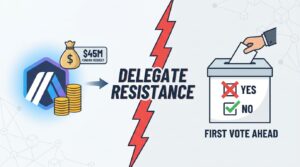
The Arbitrum Foundation is pushing a funding proposal valued at roughly $45 million at current token prices, and it’s already drawing sharp criticism. Delegates and independent analysts argue the request far exceeds what the Layer 2 network currently generates in revenue for ARB token holders. The proposal, which heads to its first governance vote this week, has become a flashpoint for broader questions about treasury management, accountability, and the gap between operational ambition and on-chain value creation in decentralized organizations.
Why the Arbitrum Funding Debate Matters Right Now
At its core, this isn’t just a budget dispute. The tension between the Arbitrum Foundation’s spending appetite and the network’s actual revenue trajectory reflects a structural challenge facing many DAO-governed protocols: how much runway should a foundation receive when token holders bear the dilution risk but have limited visibility into spending outcomes? Before diving into the specifics, here are the key strategic takeaways from this proposal and the backlash it has generated.
- Revenue mismatch: Critics contend that a $45 million ask is disproportionate relative to Arbitrum’s current fee revenue accruing to token holders, raising sustainability concerns.
- Delegate pushback signals governance maturity: The organized resistance from delegates suggests Arbitrum’s governance layer is becoming more assertive, not merely a rubber-stamp mechanism.
- The outcome of this vote could set a precedent for how other DAO treasuries handle large foundation-level funding requests across the broader Layer 2 ecosystem.
- Transparency expectations are rising: Analysts are demanding clearer KPIs and milestone-based disbursements rather than lump-sum allocations.
What the Foundation Is Asking For
The Arbitrum Foundation, which serves as the legal entity coordinating development and ecosystem growth for the Arbitrum network’s governance and operations, submitted the proposal to fund ongoing initiatives including protocol development, ecosystem grants, and operational overhead. At approximately $45 million in ARB tokens, the package represents one of the larger single-tranche requests seen in DAO governance this cycle.
Details on the exact breakdown remain somewhat opaque. And that opacity is part of the problem, according to several vocal delegates who have posted their objections on the Arbitrum governance forum. The concern isn’t necessarily that the Foundation shouldn’t be funded. It’s that the scale of the request lacks sufficient justification tied to measurable deliverables.
The Revenue Question No One Can Ignore
Here’s where the math gets uncomfortable. Arbitrum, despite being one of the most widely used Ethereum Layer 2 rollups by transaction volume, generates relatively modest protocol revenue that flows back to ARB holders. Sequencer fees, the primary revenue mechanism, have fluctuated considerably, and the protocol has yet to implement a fee-sharing or buyback structure that would give token holders a direct economic claim on network activity.
So when a $45 million funding request lands on the governance dashboard, delegates are left asking a pointed question: what exactly is the return on this capital for the people voting to approve it?
That question is arguably more important than the dollar figure itself. Without a clear framework linking foundation spending to token value accrual (or at least network growth metrics that could eventually support such accrual), large treasury drawdowns risk looking like cost centers with no accountability loop.
Governance Friction as a Feature, Not a Bug
Still, the pushback itself tells a more encouraging story about Arbitrum’s governance ecosystem. Early DAO votes across crypto were often characterized by low participation and near-unanimous approval. The fact that delegates are publicly challenging the Foundation, demanding granular budget breakdowns, and proposing alternative disbursement structures suggests the governance process is maturing.
Several delegates have floated the idea of milestone-based funding, where tranches would unlock only after the Foundation demonstrates progress against predefined KPIs. Others want quarterly reporting obligations baked into the proposal itself. These aren’t radical demands by corporate governance standards, but in the DAO context, they represent a meaningful shift toward institutional-grade oversight.
How This Compares Across the Layer 2 Landscape
| Factor | Arbitrum | Typical L2 DAO Precedent |
|---|---|---|
| Funding request size | ~$45 million (single proposal) | $5–20 million per quarter |
| Revenue-to-request ratio | Low relative to ask | Varies widely; often similarly misaligned |
| Delegate engagement | High; organized opposition | Generally low participation rates |
| Disbursement structure | Lump-sum proposed | Increasingly milestone-based across peers |
Reframing the Narrative: What Stakeholders Should Consider
Beyond the governance mechanics, this episode invites a broader reframing of how protocol communities evaluate foundation funding. The instinct to compare spending against current revenue is understandable but potentially incomplete. Networks at Arbitrum’s stage are still investing in developer tooling, ecosystem partnerships, and user acquisition. These are pre-revenue activities by nature, and judging them purely on today’s fee generation may underweight their long-term strategic value.
But that argument only holds if the Foundation can articulate what success looks like. Vague references to “ecosystem growth” don’t satisfy a delegate base that has grown more sophisticated. What specific developer adoption targets justify this spend? Which grant programs have produced measurable results in previous cycles? How does operational overhead compare to peer foundations with similar mandates? These are the questions that separate a credible funding request from one that feels like institutional inertia wrapped in governance language.
The psychological dimension matters too. When token holders perceive that large sums are being allocated without proportional accountability, it erodes trust in the governance process itself (a dynamic that compounds over time and becomes harder to reverse). Conversely, a Foundation that proactively embraces transparency and milestone-based accountability can strengthen community conviction, turning a contentious vote into a trust-building exercise.
Frequently Asked Questions
What is the Arbitrum Foundation’s $45 million proposal for?
The funding covers protocol development, ecosystem grants, and operational costs. Specific line-item breakdowns have been a point of contention among delegates who want more granular disclosure before voting.
Why are delegates opposing the request?
The primary objection centers on the size of the ask relative to the revenue Arbitrum currently generates for ARB token holders. Delegates also want milestone-based disbursement rather than a lump-sum allocation.
When does the vote take place?
The proposal is heading to its first on-chain vote this week, though additional voting rounds may follow depending on the governance framework’s requirements.
Could this affect ARB token price?
Large treasury disbursements in native tokens carry dilution risk. Whether that translates into price pressure depends on how the market interprets the vote outcome and the Foundation’s spending plans. No guarantees either way.



