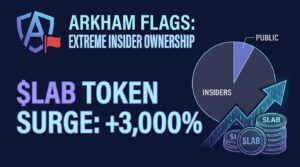
Blockchain analytics firm Arkham Intelligence has identified what it describes as extreme insider ownership concentration in the $LAB token, a digital asset that has posted a staggering 3,000% price increase over the past three months. The finding raises pointed questions about token distribution practices and the risks facing retail participants who may be entering a heavily concentrated market. While rapid price appreciation in crypto is not unusual, the degree of insider control flagged here stands out even by the sector’s own standards.
What Arkham’s Analysis Reveals About $LAB
The core of the issue is structural. According to Arkham Intelligence’s on-chain tracking platform, a disproportionate share of $LAB’s circulating supply sits in wallets linked to insiders or early participants. That kind of concentration doesn’t just skew governance or staking dynamics. It creates a market where a small number of holders can move the price with minimal effort, and where retail buyers absorb most of the downside risk if those holders decide to exit.
A 3,000% gain in 90 days is the kind of number that attracts attention, and capital, from speculators chasing momentum. But when ownership data reveals that the rally has been powered by a narrow base of holders, the narrative shifts from organic growth to something more precarious.
Why Concentrated Token Holdings Warrant Scrutiny
Token ownership concentration is arguably the most underexamined risk in crypto markets today. Traditional equity markets have disclosure requirements that force major shareholders to reveal their positions. Crypto, at least on paper, operates without those guardrails. On-chain data provides a partial substitute, but interpreting wallet clusters and attributing them to specific actors requires the kind of forensic analysis that firms like Arkham specialize in.
When a handful of wallets control a large percentage of supply, several risks compound simultaneously:
- Liquidity fragility: A single large sell order can overwhelm thin order books, triggering cascading liquidations
- Retail investors face an asymmetric information disadvantage, often unaware of who holds what
- Price discovery distortion: Market capitalization figures become misleading when most tokens never actually trade on the open market
- Governance mechanisms tied to token holdings can be captured by insiders, undermining decentralization claims
None of this makes $LAB’s situation unlawful. But it does place the token in a category that regulators and informed investors increasingly treat with caution (a distinction the broader market has been slow to internalize).
Interpreting the 3,000% Rally in Context
Three-month returns of this magnitude tend to follow one of two patterns: either genuine protocol adoption is driving demand, or speculative momentum is feeding on itself in a low-float environment. The ownership data Arkham has surfaced points toward the latter scenario. When insiders hold a dominant share of supply, even modest buying pressure from new entrants can produce outsized price moves, because so few tokens are actually available for trading.
This is the mechanics of a low-float squeeze, dressed up as organic growth.
Still, it would be premature to dismiss the project entirely on this basis alone. Some early-stage tokens exhibit high insider concentration simply because the project is young and distribution hasn’t fully played out. What matters is the trajectory: are insiders distributing tokens gradually to a broader base, or are they holding and allowing price appreciation to inflate paper valuations? The on-chain record, over the coming weeks, will answer that question more definitively than any press release.
Strategic Signals for Market Participants
Before diving into the tactical implications, it’s worth framing what this case represents more broadly. Arkham’s flagging of $LAB is not an isolated event; it reflects a growing capability among blockchain intelligence firms to surface risks that were previously invisible to most market participants. That shift has consequences for how tokens are evaluated, traded, and regulated.
- On-chain transparency is becoming a competitive moat for analytics firms, and a liability for projects with opaque distribution
- Retail investors relying solely on price charts and social media sentiment are operating with incomplete information
- Regulatory bodies monitoring crypto markets are likely to treat concentrated ownership as a red flag in enforcement prioritization
- Projects that proactively disclose token distribution and vesting schedules may gain a trust premium as the market matures
How Investors Can Assess Token Distribution Risk
Understanding who holds what in a token’s supply is not just an analytical exercise. It shapes how investors frame risk, set position sizes, and decide when to exit. The psychological dimension matters here as much as the technical one. Retail participants often anchor to price momentum, interpreting a rising chart as confirmation that a token is safe or legitimate. That cognitive shortcut, known in behavioral finance as the representativeness heuristic, can be particularly dangerous in concentrated markets where the price signal itself is unreliable.
A more disciplined approach involves checking on-chain distribution data before entering a position. Tools from Arkham, Nansen, and similar platforms allow users to see wallet-level holdings and track large transfers in near real-time. Cross-referencing this data with a project’s stated vesting schedule and tokenomics documentation provides a clearer picture of whether the supply structure supports sustainable price discovery or merely enables insider-driven volatility.
Investors should also pay attention to the ratio between reported market capitalization and actual daily trading volume. A token with a billion-dollar market cap but only a few hundred thousand dollars in daily volume is, in practice, far less liquid than it appears. That gap between headline valuation and tradeable reality is where losses concentrate when sentiment turns.
Frequently Asked Questions
| Question | Answer |
|---|---|
| What is $LAB? | $LAB is a cryptocurrency token that has gained attention after a 3,000% price surge over three months, now flagged by Arkham Intelligence for extreme insider ownership concentration. |
| What does insider ownership concentration mean? | It means a small number of wallets, often linked to project founders or early investors, hold a disproportionately large share of the token’s total supply. This can distort price discovery and amplify risk for later buyers. |
| Is concentrated token ownership illegal? | Not inherently. Crypto markets largely lack the disclosure mandates that govern traditional securities. However, regulators are increasingly scrutinizing such patterns. |
| How can I check token distribution? | On-chain analytics platforms like Arkham Intelligence and Nansen allow users to examine wallet-level holdings, track large transactions, and assess whether a token’s supply is broadly distributed or tightly held. |