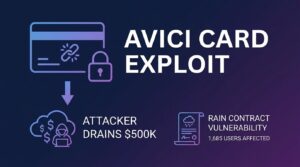
An attacker siphoned $500,859.22 from the card balances of 1,685 Avici users on Friday, exploiting a vulnerability not in Avici’s own infrastructure but in a smart contract operated by Rain, the card issuer behind Avici’s Visa product. Avici confirmed that every affected user will receive a full refund. Rain stated its monitoring systems detected the breach, though the damage had already been done by the time intervention occurred. The incident raises pointed questions about third-party risk in crypto-linked card programs and the security responsibilities that sit between issuers and front-end platforms.
What the Avici-Rain Exploit Reveals About Crypto Card Security
Before unpacking the broader implications, here are the critical facts and strategic takeaways from this incident:
- The exploit targeted a contract belonging to Rain, not Avici’s codebase, highlighting the often-invisible dependency chain in crypto card products
- 1,685 users were affected, with a total loss of $500,859.22, averaging roughly $297 per compromised account
- Full refunds have been pledged by Avici, a move that will test the platform’s reserves and its relationship with Rain regarding liability allocation
- Rain’s monitoring infrastructure flagged the activity, but not quickly enough to prevent the drain, raising questions about real-time response capabilities
- The breach underscores a growing pattern: crypto-native fintech products remain vulnerable at the integration layer, where smart contracts meet traditional payment rails
How the Attack Unfolded
Details remain sparse on the exact exploit vector. What Avici has disclosed is that the vulnerability resided in Rain’s contract infrastructure, which manages the card balance logic for its Visa-branded product. The attacker was able to extract funds directly from user balances, suggesting either a privilege escalation flaw or a logic error in the contract’s withdrawal mechanisms.
Rain’s monitoring systems did detect anomalous activity. But detection and prevention are different things entirely.
By the time the breach was flagged, the attacker had already moved $500,859.22 across 1,685 accounts. Whether the funds were subsequently bridged, laundered through mixers, or remain traceable on-chain has not been publicly confirmed by either party. That gap in disclosure matters, particularly for users trying to assess ongoing risk.
Third-Party Risk in Crypto-Linked Financial Products
This incident is not just about one contract flaw. It exposes a structural tension in how crypto card products are architected. Platforms like Avici’s crypto-linked Visa card program typically rely on a layered stack: a user-facing app, a card issuer (in this case Rain), a payment network (Visa), and underlying smart contract logic that governs balances and settlements.
Each layer introduces its own attack surface. And while Avici’s own code was not compromised, the end user doesn’t experience the distinction. Their money was gone regardless of which contract failed (a distinction regulators have been slow to enforce in the crypto card space).
This dynamic creates an accountability puzzle. Who bears the cost? Avici has committed to full refunds, but whether Rain will absorb part of that liability, or whether insurance mechanisms exist to cover such events, remains undisclosed. In traditional finance, card issuers carry fraud liability under well-established network rules. In crypto-native card programs, those rules are still being written.
Why This Pattern Keeps Repeating
Smart contract exploits are not new. Yet the frequency of breaches at integration points, where DeFi logic meets centralized financial products, has arguably accelerated in 2024 and into 2025. The issue is not always code quality in isolation. It’s the seams between systems, the handoff zones where one protocol’s assumptions about state or permissions don’t align with another’s.
Rain operates as a backend issuer for multiple crypto card products. A vulnerability in its contract layer could, in theory, affect more than just Avici’s user base. Whether other Rain-powered products were exposed has not been addressed publicly.
Regulatory and Market Implications
Regulators in the U.S. and EU have been tightening scrutiny on crypto-linked payment products. The European MiCA framework and evolving U.S. state-level money transmitter rules both place increasing emphasis on consumer protection and operational resilience. An exploit like this, even with full refunds promised, provides ammunition for regulators who argue that crypto card products lack the safeguards of traditional payment instruments.
| Factor | Traditional Card Programs | Crypto-Linked Card Programs |
|---|---|---|
| Fraud liability framework | Established network rules (Visa/Mastercard) | Varies; often contractually ambiguous between issuer and platform |
| Real-time monitoring | Mature, AI-driven fraud detection | Emerging; dependent on on-chain monitoring tools |
| Consumer recourse | Chargeback rights, FDIC coverage (deposits) | Platform-dependent; no standardized recourse mechanism yet |
| Smart contract risk | Not applicable | Core infrastructure risk; audits vary in depth and frequency |
Still, the crypto card market continues to grow. User demand for spending digital assets through familiar payment networks isn’t slowing. What this exploit may accelerate is a push toward mandatory audit standards and real-time circuit breakers in issuer contracts.
What Users and Platforms Should Reassess Now
For users holding balances on crypto card platforms, this incident is a reminder that “not your keys, not your coins” extends beyond exchange wallets. Card balances sit in smart contracts governed by third parties, and the security posture of those third parties is rarely transparent to the end user.
Platforms, meanwhile, face a harder question: how do you vet and continuously monitor the contract infrastructure of your issuing partners? Periodic audits are necessary but insufficient. The industry arguably needs continuous formal verification or at minimum real-time invariant monitoring on issuer contracts, not just the platform’s own code.
Frequently Asked Questions
Were Avici users’ private keys or personal data compromised?
Based on available disclosures, no. The exploit targeted card balance logic within Rain’s smart contract, not user credentials or wallet keys. The scope appears limited to fund extraction from card balances.
When will affected users receive refunds?
Avici has committed to full refunds for all 1,685 affected users. A specific timeline has not been publicly announced, and users should monitor official Avici communications for updates.
Is Rain’s infrastructure safe for other products that use it?
That remains an open question. Rain has not disclosed whether the vulnerability was isolated to Avici’s integration or present across its broader contract suite. Other platforms using Rain as an issuer may want to conduct independent security reviews.
Should users withdraw funds from crypto card platforms?
Risk tolerance varies. What this event makes clear is that users should treat crypto card balances with the same caution they’d apply to any smart-contract-based holding: keep only what you intend to spend, and verify the audit history of the underlying issuer contracts where possible.



