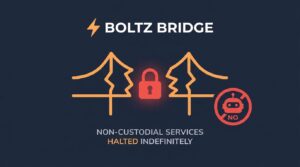
Boltz, the non-custodial bridge facilitating swaps between Bitcoin’s mainchain, the Lightning Network, and the Liquid sidechain, suspended its service indefinitely on Monday. The shutdown follows months of automated, AI-assisted attacks that overwhelmed the platform’s engineering capacity to deploy countermeasures. The move marks one of the first publicly acknowledged cases where a crypto infrastructure provider has been forced offline specifically by AI-powered exploit campaigns, raising uncomfortable questions about the resilience of decentralized bridging protocols.
What Boltz’s Shutdown Signals for Cross-Chain Infrastructure
Before diving into the specifics, it’s worth framing what this disruption means at a strategic level. Boltz occupied a niche but important role in Bitcoin’s broader ecosystem, enabling trustless swaps across layers without requiring users to surrender custody of their funds. Its closure, even if temporary, removes a key piece of connective tissue between Bitcoin’s scaling solutions.
- AI-assisted attack vectors against crypto bridges have escalated from theoretical risk to operational reality, forcing at least one provider to halt service entirely.
- Non-custodial bridge operators face a structural disadvantage: they must defend open, permissionless infrastructure against adversaries who can iterate attacks faster than patches ship.
- The Lightning Network and Liquid sidechain lose a significant interoperability tool, potentially fragmenting liquidity across Bitcoin’s layer-2 ecosystem.
- This incident may accelerate regulatory and industry scrutiny of bridge security standards, particularly around automated threat detection.
- Projects relying on Boltz for programmatic swaps now face integration risk with no clear timeline for restoration.
The Attack Pattern: Automation Meets Persistence
Boltz first flagged issues with its swap infrastructure before ultimately pulling the service offline. What distinguishes this incident from typical DeFi exploits is the nature of the threat: not a single vulnerability exploited once, but a sustained campaign of probing, adapting, and re-attacking. The attackers reportedly leveraged AI tooling to automate the discovery of edge cases in Boltz’s swap logic, cycling through variations faster than the team could identify and patch them.
That speed differential is the core problem.
Traditional security response assumes a human-paced adversary. A team finds a bug, writes a fix, tests it, deploys it. But when the attacker’s iteration loop is measured in minutes rather than days, the defender’s workflow breaks down. Boltz’s engineers, by their own account, found themselves in a reactive spiral where each fix exposed or created a new surface for the next automated probe. Even so, the team attempted to maintain service continuity for months before concluding the situation was untenable.
Why Non-Custodial Bridges Carry Unique Risk
Bridges have long been crypto’s softest target. According to various industry estimates, bridge exploits accounted for billions in losses across 2022 and 2023 alone. But non-custodial designs like the one Boltz built for Bitcoin layer swaps introduce a particular tension: the very openness that makes them trustless also makes them harder to defend. There’s no central chokepoint where suspicious transactions can be paused or flagged before settlement.
Custodial bridges can freeze funds, blacklist addresses, or impose rate limits with relative ease. Non-custodial protocols, by design, lack those levers. Which raises a harder question: can permissionless infrastructure survive an era where attack tooling is cheap, fast, and increasingly autonomous?
A Comparison of Bridge Security Models
| Feature | Custodial Bridge | Non-Custodial Bridge (e.g., Boltz) |
|---|---|---|
| Fund Control | Operator holds assets during swap | Users retain custody throughout the process |
| Emergency Response | Can freeze or reverse transactions | Limited ability to intervene once a swap is initiated |
| Attack Surface | Centralized but controllable | Distributed and harder to monitor comprehensively |
| Trust Assumption | Users trust the operator | Users trust the protocol’s code and cryptographic guarantees |
| Regulatory Flexibility | Easier to implement compliance controls | Compliance mechanisms are architecturally constrained, sometimes by intent |
The AI Factor Changes the Calculus
Arguably, the most significant dimension of the Boltz incident isn’t the shutdown itself but what it reveals about the shifting economics of attack and defense in decentralized systems. AI-assisted offensive tooling lowers the cost of finding exploitable conditions to near zero, while defensive engineering remains expensive, slow, and human-dependent. The asymmetry isn’t new in cybersecurity, but the degree of imbalance is accelerating.
Security researchers have warned for over a year that large language models and automated fuzzing tools would eventually be weaponized against smart contracts and protocol logic. Boltz appears to be among the first concrete casualties of that prediction playing out. And while the company has not disclosed the precise financial impact of the attacks, the decision to suspend operations entirely suggests the damage, whether economic or reputational or both, crossed a threshold the team could no longer absorb.
Ripple Effects Across Bitcoin’s Layer-2 Landscape
For users and developers who relied on Boltz to move value between the Lightning Network and Liquid, the immediate impact is practical: those pathways are now severed. Lightning-to-Liquid swaps served a specific but meaningful function, enabling users to shift between fast payment rails and Liquid’s confidential transaction features without touching a centralized exchange.
Alternative swap providers exist, but few offer the same non-custodial guarantees. In practice, this may push some users toward custodial solutions, at least temporarily (a distinction regulators have been slow to enforce). The longer Boltz remains offline, the more entrenched those alternatives become.
Frequently Asked Questions
What exactly did Boltz do?
Boltz operated a non-custodial atomic swap service, allowing users to exchange Bitcoin across its mainchain, the Lightning Network, and the Liquid sidechain without handing over control of their funds to a third party.
Is user fund loss confirmed?
Boltz has not disclosed specific financial losses resulting from the attacks. The company’s public statements focused on the unsustainability of defending against the ongoing automated campaign rather than detailing stolen amounts.
Could Boltz come back online?
The suspension is described as indefinite, not permanent. But restarting would require the team to fundamentally rearchitect its defenses against a class of threats that, at least on paper, will only grow more capable over time. No timeline has been offered.
Are other bridges at similar risk?
Any bridge with publicly auditable logic and permissionless access faces a version of this threat. Non-custodial designs are particularly exposed because they lack the administrative controls that custodial operators can deploy in emergencies.



