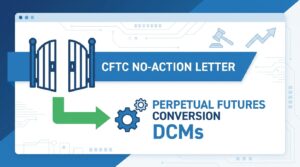
The Commodity Futures Trading Commission’s staff on Friday issued a no-action letter that allows designated contract markets (DCMs) to convert existing perpetual-style digital commodity futures contracts into true perpetual futures. The move represents another structural step in the agency’s broader effort to build out regulated infrastructure for crypto derivatives in the United States. While the letter stops short of formal rulemaking, it provides the operational clarity that exchanges and market participants have been waiting for, arguably more consequential in the near term than any pending legislation.
What the CFTC’s No-Action Letter Actually Enables
Before this letter, exchanges operating as DCMs faced a practical problem. Several had listed digital commodity futures products designed to mimic the mechanics of perpetual contracts, which are the dominant trading instrument on offshore crypto platforms. But these products existed in a regulatory grey zone: structured to behave like perpetuals without technically being classified as such under CFTC oversight. The no-action letter resolves that tension by giving DCMs a pathway to reclassify these instruments as genuine perpetual futures, without requiring a full new product listing or separate approval process.
That distinction matters more than it might appear on the surface.
Perpetual futures, contracts with no expiration date that use a funding rate mechanism to track spot prices, account for the vast majority of crypto derivatives volume globally. Platforms like Binance and Bybit have built enormous businesses around them. Yet until recently, U.S.-regulated exchanges had no clear framework for offering a comparable product. The CFTC’s evolving regulatory posture toward digital asset derivatives now appears designed to change that, one administrative action at a time.
Strategic Signals for Exchanges, Traders, and Regulators
The no-action letter carries implications that extend well beyond the specific contracts it covers. Here’s a concise breakdown of what industry participants should take from this development:
- Regulatory legitimacy for perpetual futures: By enabling conversion rather than requiring new listings, the CFTC signals that perpetual futures are a recognized and permissible product category within the existing regulatory framework.
- Lower barriers for DCMs: Exchanges avoid the cost and delay of launching entirely new contracts, which could accelerate the availability of regulated perpetual products in the U.S. market.
- Offshore platforms face a narrowing competitive moat, as U.S. venues gain the ability to offer structurally equivalent instruments under a compliance umbrella
- No-action is not rulemaking: The letter provides staff-level relief, not a binding rule. It can be withdrawn, and it does not establish precedent in the way a formal regulation would. Market participants should treat it as a strong signal, not a guarantee.
- Institutional appetite may grow: Regulated perpetual futures could attract institutional capital that has so far stayed away from offshore venues due to counterparty and compliance risk.
How This Fits Into the Broader Crypto Derivatives Landscape
The timing here is not accidental. Over the past several months, the CFTC has taken a series of incremental steps to accommodate digital asset products within its existing market structure. Acting Chair Caroline Pham has publicly advocated for a more permissive approach to crypto innovation, and the agency’s Division of Market Oversight has been actively engaging with exchanges on product design and compliance requirements. Still, the gap between staff-level guidance and codified regulation remains wide, and not all market participants agree on whether this pace is fast enough.
What makes perpetual futures particularly significant is their sheer dominance in global crypto trading. By some estimates, perpetual contracts account for more than 75% of all crypto derivatives volume worldwide. The absence of a regulated U.S. equivalent has been a persistent structural disadvantage for domestic exchanges, pushing volume and liquidity offshore. Whether this letter begins to reverse that flow depends on execution: how quickly DCMs act on the conversion pathway, and whether the products they offer can compete on funding rates, margin requirements, and user experience.
The Regulatory Plumbing Behind Market Architecture
It’s worth pausing on the phrase the CFTC itself used: “regulatory plumbing.” The agency appears to be constructing a domestic crypto derivatives market not through sweeping legislation (which remains stalled in Congress) but through targeted administrative actions. No-action letters, staff advisories, and pilot programs are doing the work that statute has not yet accomplished. This approach has advantages: it’s faster, more flexible, and can be tailored to specific market realities. But it also carries risk. Staff letters can be rescinded. They don’t bind future commissions. And they leave the market dependent on the policy preferences of whoever holds the chair.
For exchanges weighing whether to invest in perpetual futures infrastructure, that uncertainty creates a calculation that is as much political as it is commercial.
What Remains Less Clear
Several questions linger. Will the CFTC extend similar treatment to other novel contract types in the digital asset space? How will margin and risk management standards for perpetual futures evolve as volumes grow on regulated platforms? And perhaps most critically, what happens if Congressional action on crypto market structure legislation eventually contradicts or supersedes the framework the CFTC is building through administrative channels?
Frequently Asked Questions
What is a CFTC no-action letter?
A no-action letter is a statement from CFTC staff indicating that they will not recommend enforcement action against an entity for engaging in a specific activity. It provides practical relief but does not carry the legal weight of a formal rule or regulation, and it can be modified or withdrawn.
What are perpetual futures?
Perpetual futures are derivative contracts that have no expiration date. Unlike traditional futures, which settle on a fixed date, perpetuals use a funding rate mechanism to keep the contract price aligned with the underlying spot price. They are the most widely traded crypto derivative instrument globally.
Does this mean U.S. exchanges can now list perpetual futures?
Not exactly. The letter allows DCMs to convert existing perpetual-style contracts into true perpetual futures. It does not create a blanket approval for new perpetual futures listings, though it does signal regulatory openness to the product category. Each exchange will still need to operate within its existing compliance framework.
Why does this matter for institutional investors?
Institutional participants have largely avoided offshore perpetual futures markets due to counterparty risk and regulatory uncertainty. Regulated U.S. perpetual futures could open a pathway for hedge funds, asset managers, and proprietary trading firms to access this market segment under a familiar compliance structure, though product design and liquidity will determine actual adoption.



