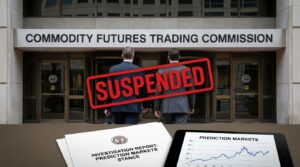
A New York Times investigation has revealed that officials at the Commodity Futures Trading Commission (CFTC) who raised concerns about the agency’s handling of prediction markets were suspended and removed from their roles. The report exposes significant internal friction at one of the most consequential U.S. financial regulators during a period when prediction markets have surged into mainstream political and economic discourse. The revelations carry implications not only for the CFTC’s credibility but for the broader regulatory trajectory of event-based derivatives trading in the United States.
What the Suspensions Signal for U.S. Derivatives Oversight
Before parsing the details, it helps to frame what’s at stake. The CFTC sits at the intersection of financial innovation and consumer protection, and prediction markets have tested that boundary more aggressively than almost any other product class in recent years. Internal dissent being met with removal rather than deliberation raises questions that extend well beyond personnel decisions.
- Officials who challenged the agency’s posture on prediction markets were reportedly suspended, suggesting a low tolerance for internal policy debate at the CFTC during a politically sensitive period
- The episode could undermine confidence in the CFTC’s independence, particularly among market participants seeking regulatory clarity on event contracts
- Prediction market operators, including platforms like Kalshi and Polymarket, now face a regulatory environment shaped in part by suppressed dissent rather than open deliberation
- Congressional oversight committees may use the findings to press for greater transparency in how the CFTC formulates its enforcement and approval decisions
- The broader message: regulatory agencies that silence internal critics risk producing policy that is both fragile and poorly stress-tested
Inside the CFTC’s Prediction Market Dilemma
Prediction markets allow participants to trade contracts tied to the outcome of real-world events, from elections to economic indicators. The CFTC has long grappled with where these instruments fall on the spectrum between legitimate hedging tools and what critics call glorified gambling. That tension has only sharpened as platforms have grown in scale and visibility.
According to the investigation, officials who voiced skepticism about the direction the agency was taking were not simply overruled. They were removed from their positions. The distinction matters. Disagreement within a regulatory body is routine; punishing it is not (a distinction regulators have been slow to acknowledge publicly). And while the specific policy positions these officials held have not been fully detailed, the pattern of retaliation suggests the internal debate touched on fundamental questions about the CFTC’s mandate.
Still, the CFTC has not issued a formal public response addressing the allegations directly.
Why Prediction Markets Keep Testing Regulatory Boundaries
The timing of these revelations is not incidental. Prediction markets have experienced a dramatic expansion, particularly around U.S. political events. Polymarket’s event-based trading platform attracted billions in volume during the 2024 U.S. presidential election cycle, drawing attention from regulators, media, and lawmakers alike. Kalshi, meanwhile, fought a high-profile legal battle with the CFTC over its right to list election-related contracts, ultimately winning a federal court ruling that forced the agency to allow such products.
That court defeat was already a bruising moment for the CFTC. The revelation that internal critics were silenced during this same period adds a layer of institutional dysfunction to what was already a policy setback. Whether the suspensions were directly connected to the Kalshi litigation or to broader prediction market strategy remains unclear from the reporting so far.
A Regulatory Culture Under Scrutiny
What makes this episode particularly corrosive is the precedent it sets for internal governance at federal agencies. Regulators derive their authority in part from the perception that their decisions emerge from rigorous, good-faith deliberation. When dissenting voices are removed rather than heard, the resulting policy lacks the adversarial testing that produces durable regulation. It also creates a chilling effect: career staff who might flag risks or legal vulnerabilities in a proposed approach learn quickly that doing so carries professional consequences. The long-term cost of that silence is difficult to quantify but easy to imagine.
How Market Participants Should Read This
For prediction market operators, the immediate takeaway is paradoxically reassuring and destabilizing at once. On one hand, the CFTC’s current posture appears more permissive toward event contracts than the suspended officials may have preferred. On the other, policy built on suppressed dissent tends to be brittle. A change in administration, a new CFTC chair, or a congressional inquiry could reverse course rapidly, and the absence of a robust internal record of deliberation makes any future pivot harder to predict.
Institutional investors and compliance teams evaluating exposure to prediction market platforms should factor this governance risk into their assessments. Regulatory clarity that was achieved by silencing objectors is not the same as regulatory consensus.
Frequently Asked Questions
What are prediction markets?
Prediction markets are platforms where participants buy and sell contracts whose value depends on the outcome of future events, such as elections, economic data releases, or geopolitical developments. They function similarly to derivatives markets but are tied to real-world occurrences rather than traditional financial assets.
Why does the CFTC regulate prediction markets?
The CFTC oversees derivatives and futures markets in the United States. Because prediction market contracts resemble futures or swaps, they fall under the agency’s jurisdiction. The CFTC determines which event contracts can be legally listed and traded on regulated exchanges.
Could these suspensions lead to policy changes?
Potentially. Congressional oversight bodies may investigate, and a shift in CFTC leadership could reopen debates that were apparently shut down internally. The durability of the agency’s current approach to prediction markets is now less certain than it appeared even weeks ago.
How does this affect platforms like Kalshi and Polymarket?
Both platforms operate in a regulatory environment that this investigation has shown to be more contested internally than previously understood. Kalshi, which holds a CFTC-regulated designation, could face renewed scrutiny if the agency’s posture shifts. Polymarket, which operates largely outside U.S. regulatory perimeters, faces a different but related set of uncertainties around enforcement priorities.



