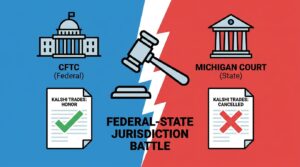
The U.S. Commodity Futures Trading Commission has directed prediction-market operator KalshiEX, LLC to fulfill trades that a Michigan state court had previously ordered the company to cancel. The directive, issued under Release Number 9267-26, sharpens an already contentious dispute over whether individual states possess the authority to intervene in federally regulated derivatives markets. At stake is not merely one company’s compliance obligations but the broader architecture of market oversight in the United States, where prediction markets have grown rapidly and regulatory boundaries remain contested.
Why the CFTC’s Directive Against Kalshi Reshapes the Regulatory Landscape
This confrontation between a federal regulator and a state court order is unusual in both scope and timing. Prediction markets sit at a volatile intersection of finance, technology, and politics, and the CFTC’s willingness to assert supremacy here sends a pointed signal to state-level authorities. Before unpacking the broader implications, here are the core takeaways from this development:
- Federal preemption in action: The CFTC is asserting that its regulatory authority over designated contract markets like Kalshi supersedes conflicting state court orders, a position that could set precedent for future jurisdictional clashes.
- Operational risk for prediction markets: Platforms operating under CFTC oversight now face the possibility of contradictory legal obligations from state and federal authorities, complicating compliance strategies.
- Market participants who traded on Kalshi’s platform may see their positions restored or honored, reinforcing the federal framework’s role as the ultimate arbiter of contract validity.
- State regulatory ambitions curtailed: Michigan’s attempt to direct cancellation of trades on a federally regulated venue could discourage similar actions by other states, at least on paper.
- The episode underscores how rapidly prediction markets have outpaced the regulatory consensus needed to govern them cleanly.
What Actually Happened Between Michigan and the CFTC
The sequence of events is worth tracing carefully. A Michigan state court issued an order requiring KalshiEX, the CFTC-regulated prediction market exchange, to cancel certain trades executed on its platform. The specifics of which contracts triggered the state court’s intervention have not been fully disclosed in the public release, but the CFTC’s response was unambiguous: Kalshi must honor those trades, not cancel them.
That puts Kalshi in a genuinely difficult position. Two separate legal authorities are issuing directly contradictory instructions. And while federal law generally preempts state law in areas where Congress has established a comprehensive regulatory scheme (a distinction regulators have historically defended with vigor in derivatives markets), the practical mechanics of resolving such conflicts are rarely this visible.
The Federal Preemption Question
Federal preemption doctrine holds that when Congress occupies a regulatory field, state laws and court orders that conflict with federal rules are displaced. The Commodity Exchange Act grants the CFTC broad authority over designated contract markets, and Kalshi operates under that designation. Still, the doctrine’s application is not always straightforward. Courts have carved out exceptions, and states have occasionally tested the boundaries, particularly in consumer protection and gaming law contexts.
Michigan’s intervention raises a harder question: did the state court view the trades in question as falling outside the CFTC’s jurisdiction entirely, perhaps categorizing them as gambling contracts rather than derivatives? If so, the dispute is not merely procedural but definitional. The answer could determine whether other states attempt similar maneuvers.
How Prediction Markets Complicate Traditional Categories
Prediction markets blur the line between financial instruments and wagering in ways that existing regulatory frameworks were never designed to handle. A contract on whether a particular political event will occur looks, to some regulators, like a derivative. To others, it resembles a bet. The CFTC has taken the position that event contracts listed on its regulated exchanges are derivatives, full stop. Not every state attorney general or judge agrees.
Broader Market and Industry Implications
For the growing ecosystem of prediction-market platforms, this confrontation carries real operational weight. Consider the following comparison of how federal and state authorities have approached these markets:
| Dimension | Federal (CFTC) Approach | State-Level Approach |
|---|---|---|
| Classification | Derivatives / event contracts | Varies; some states treat as gambling |
| Regulatory authority | Commodity Exchange Act | State gaming and consumer protection statutes |
| Enforcement posture | Proactive oversight of designated exchanges | Reactive, often triggered by complaints or political pressure |
| Trade validity | Honored under federal framework | Subject to cancellation under state court orders, as seen in Michigan’s action |
The asymmetry is stark. And for platforms seeking to scale nationally, navigating fifty different state interpretations while operating under a single federal license creates a compliance burden that arguably favors larger, better-resourced operators.
What This Means for Kalshi’s Strategic Position
Kalshi has been among the most aggressive movers in the U.S. prediction-market space, having previously won a high-profile legal battle against the CFTC itself over the right to list election-related contracts. The irony here is notable: the same federal regulator Kalshi fought in court is now defending the validity of trades on its platform against a state authority. That reversal of roles suggests the CFTC views the integrity of its regulatory perimeter as more important than any single dispute with a market participant.
Whether Kalshi emerges from this episode with stronger legal footing depends on how the federal-state conflict resolves. If the CFTC’s order holds, it reinforces the company’s operating model. If Michigan pushes back successfully, every state border becomes a potential fault line for contract enforcement.
Frequently Asked Questions
Can a state court override the CFTC’s authority over a regulated exchange?
Under federal preemption doctrine, generally no, provided the activity falls squarely within the CFTC’s statutory mandate. But the boundaries are tested case by case, and courts have not always drawn the line in the same place.
What happens to traders whose contracts were caught in this dispute?
The CFTC’s directive instructs Kalshi to honor those trades. If the order stands, affected traders should see their positions treated as valid under the exchange’s normal settlement procedures.
Does this affect other prediction-market platforms?
Directly, no. Indirectly, it matters a great deal. Any platform operating under CFTC designation can now point to this episode as evidence that federal oversight shields their contracts from state-level interference. Platforms without that designation enjoy no such protection.
Why did Michigan target these specific trades?
The full reasoning behind the state court’s order has not been publicly detailed. Possible motivations include consumer protection concerns, classification of certain event contracts as unlicensed gambling, or political pressure related to the nature of the contracts themselves.



