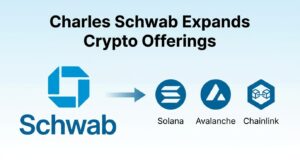
Charles Schwab announced plans to broaden the token selection in its Schwab Crypto accounts, adding Solana (SOL), Avalanche (AVAX), and Chainlink (LINK) to a platform that has only supported Bitcoin and Ether since its May launch. The news arrived as Bitcoin traded above $80,000 on Thursday, and all three newly listed tokens rallied in response. For a retail brokerage managing trillions in client assets, the move signals a deepening institutional commitment to digital assets beyond the two largest cryptocurrencies by market capitalization.
What Schwab’s Token Expansion Means for Crypto Markets
Before diving into the strategic takeaways, it’s worth framing why this matters at scale. Schwab isn’t a crypto-native exchange. It’s a legacy financial institution with roughly 35 million brokerage accounts, and its decisions about which assets to list carry weight that extends well beyond trading volume. When a firm of this size adds tokens, it effectively validates those projects in the eyes of a vast retail and advisory audience that may never open a Coinbase or Kraken account.
- Retail access widens significantly: Solana, Avalanche, and Chainlink now reach an investor base that skews toward traditional equities and ETFs, potentially unlocking demand from demographics underrepresented on crypto-native platforms.
- Token price reaction was immediate: All three named tokens outpaced the broader crypto market on the announcement, suggesting traders view Schwab’s endorsement as a material catalyst.
- Schwab’s expansion hints at a longer pipeline of token additions, which could reshape competitive dynamics among mid-cap layer-1 and oracle projects vying for institutional distribution.
- Brokerage competition intensifies: Fidelity, Interactive Brokers, and Robinhood already offer varying degrees of crypto access. Schwab’s move narrows the gap and pressures rivals to expand their own token menus.
Why These Three Tokens?
The selection of Solana, Avalanche, and Chainlink is not arbitrary. Each occupies a distinct niche in the digital asset ecosystem, and together they represent a calculated broadening of exposure across smart contract platforms and decentralized infrastructure.
Solana has emerged as the highest-throughput layer-1 blockchain with a vibrant DeFi and NFT ecosystem. Its transaction speeds and low fees have attracted both retail users and institutional builders. Avalanche, meanwhile, has carved out a role in tokenized real-world assets and subnet architecture that appeals to enterprise use cases. Chainlink’s oracle network underpins much of decentralized finance by feeding off-chain data to smart contracts (a distinction that makes it infrastructure rather than a competing chain).
Still, the question lingers: what criteria is Schwab using internally to vet tokens, and how many more might clear that bar in the coming quarters?
The Institutional Crypto Race Heats Up
Schwab’s expansion doesn’t happen in a vacuum. The broader brokerage industry has been inching toward deeper crypto integration for over two years, accelerated by the approval of spot Bitcoin ETFs in January 2024 and growing client demand.
| Brokerage | Crypto Assets Offered | Notable Feature |
|---|---|---|
| Charles Schwab | BTC, ETH, SOL, AVAX, LINK | Integrated into existing brokerage accounts with traditional asset access |
| Fidelity | BTC, ETH | Offers crypto through Fidelity Digital Assets custody arm |
| Robinhood | 15+ tokens | Commission-free crypto trading alongside equities |
| Interactive Brokers | BTC, ETH, LTC, BCH | Available across multiple global jurisdictions |
What separates Schwab from some competitors is the sheer depth of its advisory network. Registered investment advisors who custody through Schwab can now discuss a wider range of digital assets with clients, arguably shifting the conversation from “should we own crypto” to “which crypto exposure fits your portfolio.”
How Framing Shapes Investor Behavior
There’s a psychological dimension to this expansion that deserves attention. When a trusted, decades-old brokerage like Charles Schwab adds crypto tokens to its platform, it reframes digital assets from speculative curiosity to legitimate portfolio component. This is classic anchoring at work: investors evaluate risk partly based on who else is participating. And when the answer is “my brokerage, the same one holding my retirement account,” the perceived risk drops considerably.
Behavioral finance research consistently shows that accessibility and familiarity drive adoption more than raw performance data. By placing SOL, AVAX, and LINK alongside S&P 500 index funds in the same account interface, Schwab collapses the psychological distance between traditional and digital assets. That collapse matters. It lowers the activation energy required for a first-time crypto allocation.
Consider also the role of social proof. Every additional mainstream institution that lists a token reinforces the narrative that crypto has crossed a threshold of legitimacy. For advisors managing client relationships, the ability to point to Schwab’s due diligence process provides cover for recommending allocations they might have avoided a year ago. The framing isn’t just cosmetic; it reshapes decision architecture in ways that compound over time.
Even the sequencing sends a signal. By starting with only Bitcoin and Ether, then expanding deliberately, Schwab has constructed a narrative of measured progression rather than speculative enthusiasm. That cadence builds trust with conservative investors who might recoil from a platform listing dozens of tokens overnight.
What Comes Next for Brokerage Crypto Integration
The trajectory here points in one direction: more tokens, more features, and eventually, more complex crypto products embedded within traditional brokerage wrappers. Staking, yield products, and tokenized securities all sit on the horizon, though regulatory clarity remains uneven.
But Schwab’s latest move already changes the competitive calculus. Brokerages that limit their crypto offerings to Bitcoin and Ether now look conservative by comparison. And projects not yet listed on major brokerage platforms face a new strategic imperative: meeting whatever compliance, liquidity, and risk thresholds these institutions require.
Whether this expansion accelerates a broader altcoin rally or simply redirects existing crypto capital through new channels is something the market will answer in the weeks ahead. What’s already clear is that the wall between traditional finance and digital assets just got a little thinner.
Frequently Asked Questions
Which new cryptocurrencies did Charles Schwab add?
Schwab added Solana (SOL), Avalanche (AVAX), and Chainlink (LINK) to its Schwab Crypto accounts, joining Bitcoin and Ether which were already available since May.
Can I trade these tokens directly through a Schwab brokerage account?
Yes. The tokens are accessible through Schwab Crypto accounts, which are integrated with the broader Schwab brokerage platform. This means investors can manage crypto alongside traditional holdings like stocks and ETFs within the same ecosystem.
Does this affect Bitcoin’s price?
Bitcoin was already trading above $80,000 at the time of the announcement. While the expansion primarily boosted the three newly added tokens, broader institutional adoption of crypto through platforms like Schwab tends to support positive sentiment across the entire market.
Will Schwab add more tokens in the future?
Schwab has not publicly confirmed a timeline for additional listings. However, the pattern of starting with two tokens and expanding to five suggests an ongoing evaluation process that could yield further additions as regulatory and market conditions evolve.



