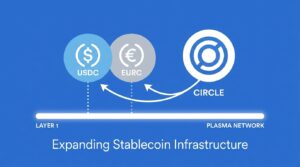
Stablecoin issuer Circle has launched native USDC and EURC on Plasma, a stablecoin-focused Layer 1 blockchain, alongside its Cross-Chain Transfer Protocol (CCTP) and Bridge Kit tooling. The integration gives Plasma first-party access to Circle-issued dollar and euro tokens and a crosschain transfer stack that has already gained traction across multiple networks. For Plasma, which has positioned itself as purpose-built infrastructure for stablecoin settlement, the move represents a significant validation of its architectural thesis.
What Circle’s Plasma Integration Signals for Stablecoin-Native Chains
Before unpacking the details, here’s what matters most for executives and builders tracking stablecoin infrastructure developments:
- Native issuance, not bridged tokens: USDC and EURC on Plasma are Circle-issued directly, eliminating the counterparty risk and liquidity fragmentation that come with third-party bridge-wrapped assets
- CCTP deployment enables seamless crosschain movement of USDC without relying on external bridging protocols, a persistent pain point in multi-chain DeFi
- Bridge Kit availability lowers the integration barrier for developers building payment and settlement applications on Plasma
- The launch reinforces a broader pattern: Circle is selectively expanding native support to chains that demonstrate clear stablecoin-centric use cases rather than blanket deployment across every EVM-compatible network
- Plasma gains credibility as a settlement layer, though whether transaction volume follows remains the open question
Why Native Issuance Matters More Than It Sounds
The distinction between native and bridged stablecoins is easy to overlook. It shouldn’t be.
When USDC exists on a chain through a third-party bridge, users hold a wrapped representation of the token, not the token itself. That wrapper introduces a trust dependency on the bridge operator, and the history of bridge exploits (Wormhole’s $320 million incident in 2022, Ronin’s $625 million hack the same year) has made this a non-trivial concern for institutional participants. Native issuance by Circle removes that intermediary layer entirely. The tokens on Plasma are backed by the same reserves and redemption mechanisms as USDC on Ethereum or Solana.
For a chain marketing itself as stablecoin infrastructure, this is table stakes. But earning Circle’s direct support is not automatic. The issuer has been deliberate about where it deploys natively, and each new chain addition reflects a judgment call about demand, architecture, and regulatory alignment.
CCTP and Bridge Kit: The Plumbing Behind the Headlines
Circle’s Cross-Chain Transfer Protocol handles the burn-and-mint mechanics that allow USDC to move between supported chains without liquidity pools or wrapped intermediaries. A user burns USDC on one chain; Circle mints the equivalent on the destination chain. Simple in concept, but the protocol’s reliability depends on attestation infrastructure and chain-level integration that not every network can support out of the box.
Bridge Kit, meanwhile, provides developers with pre-built tooling to embed crosschain USDC transfers into applications. Think of it as the SDK layer that sits on top of CCTP. For Plasma’s developer ecosystem (still early, by most measures), this lowers the friction of building payment rails, remittance flows, or settlement engines that span multiple blockchains.
Together, these tools position Plasma not just as a destination for stablecoins but as a node in a broader crosschain settlement network. Whether developers actually build on that foundation is a different question entirely.
How Plasma Fits Into the Stablecoin Layer 1 Landscape
Plasma is not the only chain pursuing the stablecoin-native thesis. Projects like Noble (in the Cosmos ecosystem) and, arguably, Stellar have carved similar niches. But Plasma’s approach differs in its explicit focus on being a general-purpose Layer 1 optimized for stablecoin operations rather than a chain designed primarily for asset issuance or interoperability.
The competitive landscape is tightening. With Circle’s stablecoin infrastructure expanding across multiple ecosystems, the chains that secure native USDC support early gain a structural advantage in attracting liquidity and developer attention. Those that don’t risk becoming secondary venues where users interact with bridged versions of the same assets, carrying higher risk and lower capital efficiency.
Reframing the Opportunity: What Builders and Institutions Should Watch
Beyond the technical integration, this launch carries implications worth examining through a strategic lens. Stablecoins have quietly become the most consistently used category of digital assets, with combined circulating supply exceeding $230 billion as of mid-2025. Yet most of that activity still concentrates on Ethereum, Tron, and Solana.
The emergence of dedicated stablecoin settlement layers suggests the market is beginning to differentiate between chains optimized for general-purpose smart contracts and those built specifically for value transfer. That differentiation matters for institutional adoption, where predictability of settlement, regulatory clarity, and counterparty risk management outweigh the novelty of programmability.
Still, infrastructure alone doesn’t guarantee adoption. Plasma will need to demonstrate tangible throughput advantages, lower costs, or regulatory positioning that justifies migrating stablecoin activity away from established networks. The Circle integration provides the toolkit. Demand has to come from somewhere else.
Frequently Asked Questions
What is the difference between native USDC and bridged USDC?
Native USDC is issued directly by Circle on a given blockchain, backed by the same reserves and redemption infrastructure as on any other supported chain. Bridged USDC is a wrapped representation created by a third-party bridge protocol, which introduces additional counterparty risk.
Does this make Plasma a major stablecoin chain?
It gives Plasma the foundational infrastructure to compete for stablecoin volume, but market share will depend on developer adoption, transaction costs, and whether institutional players see sufficient reason to route settlement through the network. The tools are in place; traction is not yet proven.
What chains currently support Circle’s CCTP?
CCTP supports a growing list of blockchains including Ethereum, Solana, Avalanche, Arbitrum, Base, and now Plasma, among others. Circle has been expanding support selectively based on ecosystem demand and technical readiness.
Why does Circle choose certain chains for native USDC deployment?
Circle evaluates factors including chain architecture, regulatory environment, developer ecosystem maturity, and demonstrated demand for stablecoin use cases. Not every chain receives native support, and the selection process reflects Circle’s broader compliance and infrastructure strategy.



