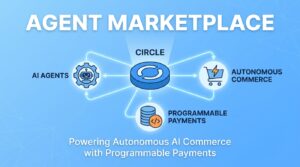
Circle, the company behind the USDC stablecoin, has unveiled its Agent Marketplace as a core component of its broader Agent Stack infrastructure. The platform is designed to let autonomous AI agents discover, negotiate with, and pay for trusted services using programmable, usage-based economic models. It marks a deliberate push into the intersection of agentic AI and blockchain-native payments, a space where few established players have staked a clear position.
What Circle’s Agent Marketplace Signals for AI-Driven Commerce
The launch sits at a crossroads that has been discussed in theory for years but rarely operationalized: machine-to-machine economic activity conducted without human intermediation. Before unpacking the details, here are the strategic takeaways worth tracking.
- Infrastructure play, not a product launch: Circle is positioning itself as the settlement layer for autonomous agent economies, not merely releasing a tool. That distinction matters for how competitors and regulators will respond.
- Usage-based pricing models embedded at the protocol level could reshape how AI service providers monetize, shifting from subscription tiers to granular, per-task billing settled on-chain.
- Trust and discovery are bundled together. By combining a marketplace with identity and verification layers, Circle is attempting to solve the “which agent can I trust?” problem that has stalled broader adoption of multi-agent workflows.
- The move pressures rival stablecoin issuers and payment networks to articulate their own agentic commerce strategies, or risk ceding the category entirely
How the Agent Stack Actually Works
Circle’s Agent Stack is not a single product. It is a layered architecture designed to give AI agents the financial primitives they need to operate independently. At its foundation, USDC serves as the settlement currency, providing a stable unit of account that agents can hold, transfer, and receive without exposure to crypto volatility. On top of that sits the Agent Marketplace itself, which functions as a registry where service-providing agents can list capabilities, pricing structures, and trust credentials.
What makes this more than a directory is the programmability layer. Agents can negotiate terms, execute payments conditionally, and settle transactions based on verified outcomes. Think of it less like an app store and more like a procurement system built for software entities that never sleep (a distinction that traditional payment rails were never designed to accommodate).
The usage-based economic model is arguably the most consequential design choice. Rather than flat-rate access, agents pay per interaction, per data query, or per task completed. This mirrors how cloud computing evolved from fixed server costs to elastic, consumption-based pricing. But here, the buyer and seller are both machines.
Why Autonomous Agent Payments Are Harder Than They Sound
Letting AI agents spend money autonomously introduces problems that go well beyond technical plumbing. Authorization is one. Who approves a transaction when no human is in the loop? Liability is another. If an agent pays for a service that delivers flawed output, what recourse exists?
Circle has not publicly detailed its dispute resolution framework, and the company has not confirmed whether human oversight checkpoints are built into high-value transactions. Still, by anchoring everything to USDC and on-chain settlement, there is at least an auditable trail, something that purely API-based payment flows between agents would lack.
Regulators have yet to weigh in specifically on agent-to-agent financial activity. The existing frameworks around electronic money and payment services were written with human-initiated transactions in mind. Whether autonomous agent payments fall under existing money transmission rules or require new classification remains an open question that no jurisdiction has formally addressed.
The Competitive Landscape Shifts
Circle is not operating in a vacuum. Companies across the AI and crypto sectors have been exploring agentic commerce, from decentralized protocol teams building agent-native blockchains to major cloud providers experimenting with AI orchestration layers. Yet none of the major stablecoin competitors have announced anything as explicitly targeted at autonomous agent economies.
That first-mover positioning carries risk. If the agentic commerce category develops more slowly than anticipated, Circle will have invested infrastructure resources into a market that may not materialize at scale for years. And while the Circle Agent Stack and its marketplace components represent a technically coherent vision, adoption depends on whether AI developers actually build agents that need on-chain payment capabilities rather than simpler off-chain alternatives.
Reframing Value in an Agent-First Economy
Beyond the mechanics of payments and marketplaces, Circle’s move invites a broader rethinking of how value gets created and exchanged in software ecosystems. Traditional SaaS economics assume a human decision-maker evaluating, purchasing, and renewing services. An agent-first model collapses that cycle into milliseconds. The implications ripple outward: sales teams become irrelevant for certain transaction types, marketing shifts from persuading humans to optimizing for agent discovery algorithms, and pricing becomes a real-time negotiation rather than a published rate card.
For enterprises exploring multi-agent architectures, the existence of a trusted marketplace with embedded payment settlement could lower the barrier to deploying agents that interact with external services. In practice, this means a company’s internal AI agent could autonomously source data, pay for compute, and deliver results without a procurement workflow ever touching a human inbox. The psychological shift this demands from enterprise leadership should not be underestimated. Delegating spending authority to software requires a level of trust in system design that most organizations have not yet built.
Organizations that begin experimenting now with agent-authorized micro-transactions will likely develop institutional muscle memory that proves difficult for later entrants to replicate. The question is not whether autonomous agents will transact. It is whether the infrastructure governing those transactions will be open and auditable, or opaque and centralized.
Frequently Asked Questions
What is Circle’s Agent Marketplace?
It is a platform within Circle’s Agent Stack where autonomous AI agents can discover services offered by other agents, evaluate trust credentials, and execute payments using USDC on a usage-based model. It is designed for machine-to-machine commerce without requiring human approval for each transaction.
How do payments work between AI agents on this platform?
Agents settle transactions in USDC through programmable payment flows. Pricing is consumption-based, meaning agents pay per task, per query, or per interaction rather than through fixed subscriptions. All settlements occur on-chain, creating an auditable record.
Does this raise regulatory concerns?
Potentially, yes. No major jurisdiction has issued specific guidance on autonomous agent-to-agent financial transactions. Existing payment and money transmission regulations were built around human-initiated activity, so classification of these new transaction types remains unresolved.
Who benefits most from this launch?
AI developers building multi-agent systems that require external service discovery and payment capabilities stand to gain the most immediate utility. Enterprises exploring autonomous procurement workflows are a secondary audience, though adoption there will likely lag until trust frameworks mature.