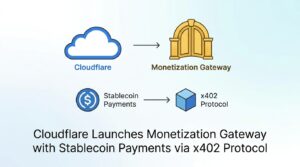
Cloudflare opened a waitlist on Wednesday for its Monetization Gateway, a product that lets customers charge for virtually any digital asset sitting behind its network — web pages, datasets, APIs, or MCP tools. Payments settle in stablecoins using the x402 protocol, signalling a deliberate move by one of the internet’s largest infrastructure providers into crypto-native commerce. The announcement, made via Cloudflare’s official X account, positions the company at an unusual intersection: enterprise web infrastructure meets decentralised payments.
Why Cloudflare’s Stablecoin Monetization Play Matters
This isn’t a minor feature update. Cloudflare sits in front of roughly 20% of all websites globally, which means even a modest adoption rate for the Monetization Gateway could funnel significant transaction volume through stablecoin rails. Before diving into the mechanics, here are the strategic takeaways worth watching:
- Infrastructure-level integration: By embedding payments directly into its reverse proxy and CDN layer, Cloudflare removes the need for third-party payment processors on qualifying digital goods. That changes the cost structure for API providers and data vendors.
- Stablecoin settlement as default: Choosing stablecoins over traditional fiat rails suggests Cloudflare sees enough enterprise appetite for programmable money to justify the regulatory complexity.
- The x402 protocol, still relatively obscure, could gain mainstream credibility simply by association with a company of Cloudflare’s scale.
- Competitive pressure on Stripe, AWS API Gateway, and similar platforms: If developers can monetise endpoints without bolting on separate billing infrastructure, incumbents face a bundling threat from below.
- MCP tool monetisation: Including Model Context Protocol tools in the supported asset types hints at Cloudflare’s bet on AI-agent commerce, where machines pay machines for context and capability.
What the x402 Protocol Actually Does
The x402 protocol borrows its name from HTTP status code 402 (“Payment Required”), a response code that has existed in the HTTP specification since the early 1990s but was never widely implemented. In practice, x402 enables machine-readable payment negotiation at the protocol level. A client hits a paywall-protected resource, receives a 402 response with payment instructions encoded in the header, settles the amount in stablecoins, and gains access — all without human intervention in many cases.
That last point matters more than it might seem. As AI agents increasingly browse, query, and transact on behalf of users, a protocol-level payment layer becomes essential plumbing. Cloudflare appears to be building for a future where API calls carry economic weight by default.
How the Gateway Fits Into Cloudflare’s Broader Architecture
Cloudflare has spent years assembling a full-stack edge computing platform. Workers (serverless compute), R2 (object storage), D1 (database), and now the Monetization Gateway form a progressively complete toolkit for developers who want to build, deploy, and charge for services without leaving Cloudflare’s ecosystem. The strategic logic is vertical integration: reduce the number of vendors a developer touches, and you capture more of the value chain.
| Component | Function | Monetization Gateway Relevance |
|---|---|---|
| Workers | Serverless compute at the edge | Hosts the logic behind paid APIs and tools |
| R2 | S3-compatible object storage | Stores datasets that can now be gated behind payments |
| D1 | SQLite-based edge database | Manages access records and entitlements |
| Monetization Gateway | Payment layer via x402 + stablecoins | Turns any resource into a billable endpoint — the missing commercial piece |
Still, questions linger about which stablecoins will be supported, what fee structure Cloudflare will impose, and whether enterprise compliance teams will greenlight stablecoin settlement for production workloads.
The AI-Agent Economy and Machine-to-Machine Payments
Perhaps the most forward-looking element here is the explicit inclusion of MCP tools. Model Context Protocol is an emerging standard that allows large language models to interact with external tools and data sources in a structured way. By making MCP tools monetisable through the Gateway, Cloudflare is betting that autonomous AI agents will need to purchase capabilities on the fly — retrieving a proprietary dataset, calling a specialised function, accessing a licensed model — and that these transactions will happen without a human approving each one.
This is where stablecoin settlement becomes more than a philosophical choice. Credit card networks weren’t designed for sub-cent microtransactions between software agents. Stablecoins, at least on paper, handle that use case more gracefully: programmable, instant, and with transaction costs that can scale down to fractions of a cent on certain Layer 2 networks.
Whether the market is ready for this remains genuinely uncertain. But Cloudflare is placing infrastructure bets years ahead of demand — a pattern the company has followed before with Workers and its zero-trust security products.
Regulatory and Market Implications
Embedding stablecoin payments into mainstream web infrastructure raises regulatory questions that Cloudflare has not yet publicly addressed. In the United States, stablecoin legislation remains under active congressional debate, with competing proposals from the Senate and House still unreconciled. European markets face their own complexity under MiCA (Markets in Crypto-Assets Regulation), which imposes specific requirements on stablecoin issuers and service providers.
For enterprise customers evaluating the Gateway, the regulatory posture of the stablecoins involved — USDC, USDT, or others — will likely determine adoption speed more than any technical consideration. Compliance departments tend to move slower than engineering teams, and that gap could define the Gateway’s early trajectory.
Frequently Asked Questions
What is Cloudflare’s Monetization Gateway?
It is a new product that allows Cloudflare customers to place any digital resource behind a payment gate. Supported assets include web pages, APIs, datasets, and MCP tools, with payments settling in stablecoins via the x402 protocol.
How does the x402 protocol work?
The protocol uses HTTP’s 402 status code to negotiate payments at the network level. When a client requests a paid resource, it receives payment instructions in the response header, settles in stablecoins, and gains access — often without manual intervention.
Is the Monetization Gateway available now?
Not yet. Cloudflare has opened a waitlist. No public timeline for general availability has been announced, and details on supported stablecoins and fee structures remain undisclosed.
Why does this matter for AI development?
By supporting MCP tool monetisation, the Gateway enables AI agents to autonomously purchase capabilities and data access during inference. That’s a foundational requirement for any economy where software agents transact independently — and it’s a market Cloudflare is clearly positioning itself to serve early.



