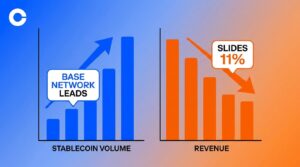
Coinbase disclosed in its second-quarter earnings presentation that Base, its Ethereum Layer 2 network, now processes more stablecoin transaction volume than any other blockchain. Yet the financial picture tells a counterintuitive story: “other” transaction revenue, which captures Base-related income, dropped 11% quarter-over-quarter to $47.4 million. The divergence between surging on-chain activity and declining revenue raises pointed questions about the long-term monetization strategy behind one of crypto’s fastest-growing networks.
What Base’s Stablecoin Dominance Means for Coinbase’s Bottom Line
Before unpacking the numbers, it helps to frame what’s actually at stake. Base has rapidly become a cornerstone of Coinbase’s infrastructure ambitions, but network growth and revenue growth are clearly moving in opposite directions. That tension sits at the heart of the company’s Q2 story.
- Base now leads all blockchains in stablecoin processing volume, a milestone that positions Coinbase at the center of on-chain payments infrastructure
- Despite this dominance, transaction-related revenue from Base fell to $47.4 million, an 11% decline from Q1
- The revenue drop suggests Coinbase is prioritizing adoption and throughput over near-term fee extraction
- Competing Layer 2 networks face the same dilemma: how to balance low fees with sustainable economics
- For institutional observers, Base’s trajectory could signal whether Layer 2 networks can ever become profit centers or remain strategic loss leaders
The Volume-Revenue Paradox
Processing more stablecoin volume than Ethereum mainnet, Solana, Tron, or Arbitrum is no small feat. Base achieved this in roughly a year since its public launch, riding a wave of low-cost transactions and deep integration with the Coinbase exchange and wallet ecosystem. The network’s appeal is straightforward: near-zero gas fees, fast finality, and seamless onboarding for Coinbase’s existing user base.
But near-zero fees are precisely the problem.
When a network competes on cost, every transaction it processes generates a fraction of the revenue that higher-fee chains collect. Coinbase’s Q2 filing makes this arithmetic visible. Even as Base’s stablecoin throughput climbed to industry-leading levels, the revenue line shrank. The company has not disclosed a per-transaction revenue breakdown for Base specifically, though the directional signal is hard to misread. More volume, less money per unit of volume, and the net effect is negative on the quarter.
Why Coinbase May Be Playing a Longer Game
There’s a strategic logic to accepting lower revenue now. Stablecoins are increasingly viewed as the rails for global payments, remittances, and on-chain commerce. Whoever controls the dominant stablecoin settlement layer arguably controls a tollbooth that could be repriced later, once switching costs rise and ecosystem lock-in deepens. Coinbase appears to be building that tollbooth, even if it isn’t collecting much at the gate yet.
Consider the parallels to early cloud computing. Amazon Web Services ran at thin margins for years, subsidizing growth to capture market share that eventually became extraordinarily profitable. Whether Base follows the same arc depends on factors Coinbase doesn’t fully control (a distinction regulators and competitors are watching closely): stablecoin regulatory frameworks, cross-chain interoperability standards, and the willingness of developers to build exclusively on Base rather than hedging across multiple Layer 2s.
How Base Compares to Competing Layer 2 Networks
| Network | Primary Strength | Stablecoin Volume Ranking (Q2) | Fee Structure |
|---|---|---|---|
| Base | Coinbase integration, user onboarding | #1 | Near-zero gas fees |
| Arbitrum | DeFi ecosystem depth | Top 5 | Low, variable |
| Optimism | Superchain architecture, governance model | Top 5 | Low, variable |
| Tron | Legacy stablecoin settlement, particularly USDT | Top 3 | Minimal but network-sustained through high volume and broader token activity |
Reframing the Narrative: Network Effects as the Real Asset
Revenue is one lens. Network effects are another, and arguably the more consequential one at this stage. Every stablecoin transaction settled on Base strengthens the case for developers, merchants, and fintech partners to build there. Each new integration compounds the difficulty of migrating away. Coinbase’s quarterly revenue dip might look less alarming when measured against the compounding value of ecosystem gravity.
Still, investors parsing the Q2 filing will want to see a credible path from volume leadership to margin expansion. The company has not publicly outlined when or how it plans to increase Base’s revenue contribution. And while stablecoin dominance is a powerful narrative, narratives without monetization timelines tend to lose patience on Wall Street faster than they gain traction on-chain.
What Institutional Stakeholders Should Watch Next
Several developments in the coming quarters will determine whether Base’s stablecoin lead translates into durable competitive advantage. Regulatory clarity around stablecoin issuance and settlement, particularly from U.S. lawmakers still debating the parameters of a federal stablecoin framework, could either entrench Base’s position or open the door for regulated competitors to challenge it. Coinbase’s relationship with Circle, the issuer of USDC, adds another variable: if USDC adoption accelerates on Base specifically, the revenue-sharing dynamics between the two companies become increasingly material.
Developer activity on Base also warrants close attention. High stablecoin volume driven primarily by transfers and payments is valuable, but a thriving application layer (lending protocols, on-chain commerce platforms, payroll systems) would deepen the moat considerably. Whether that application layer materializes depends on tooling, incentives, and whether Coinbase can attract builders who might otherwise default to Ethereum mainnet or Solana.
Frequently Asked Questions
What is Base?
Base is an Ethereum Layer 2 blockchain built and operated by Coinbase. It launched publicly in 2023 and uses Optimism’s OP Stack technology to offer low-cost, high-speed transactions while inheriting Ethereum’s security guarantees.
Why did Coinbase’s Base-related revenue decline despite record volume?
Base competes on ultra-low transaction fees, which means each transaction generates minimal revenue. As volume scaled, the per-transaction economics didn’t improve enough to offset the low fee structure. Coinbase appears to be prioritizing adoption over short-term monetization.
How does Base’s stablecoin volume compare to other blockchains?
According to Coinbase’s Q2 earnings presentation, Base now processes more stablecoin volume than any competing blockchain, including established networks like Tron and Ethereum mainnet. The exact figures have not been independently verified in the filing excerpt available.
Is Base profitable for Coinbase?
Coinbase has not broken out Base-specific profitability. The 11% decline in “other” transaction revenue to $47.4 million suggests the network is not yet a significant profit driver, though its strategic value as infrastructure may justify the current economics.



