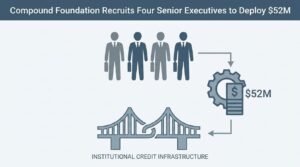
Compound Foundation has appointed four senior executives drawn from Coinbase Custody, Anchorage Digital, the NEAR Foundation, and Maple Finance, tasking them with a $52 million budget to transform the 2018-era DeFi lending protocol into credit infrastructure built for banks and asset managers. The appointments signal a decisive pivot from retail-facing decentralised lending toward institutional-grade financial plumbing. Compound, which once sat near the top of DeFi’s total value locked rankings, has seen its relative market position erode as newer protocols captured liquidity and attention.
What Compound’s Executive Overhaul Means for Institutional DeFi
Before unpacking the individual hires, the strategic calculus here deserves attention. Compound is not simply refreshing its leadership. It is repositioning an entire protocol around a thesis that traditional financial institutions will eventually route credit activity through on-chain rails. That bet carries real capital behind it: $52 million earmarked for development, partnerships, and go-to-market execution.
- The four hires bring direct experience in institutional custody, digital asset compliance, ecosystem growth, and structured credit — a combination tailored to bridge DeFi mechanics with TradFi expectations.
- Coinbase Custody and Anchorage Digital alumni bring regulated-entity credibility, which matters when courting banks that require counterparties with demonstrable compliance track records.
- A $52 million deployment budget positions Compound to build out integrations, audit frameworks, and enterprise tooling that retail-native protocols rarely prioritise
- Maple Finance’s involvement in the talent pipeline is notable given its own focus on undercollateralised institutional lending, suggesting cross-pollination of credit risk expertise.
- The NEAR Foundation hire hints at multichain or infrastructure-layer ambitions beyond Ethereum, though specifics remain unconfirmed.
Why the Timing Matters
Compound launched in 2018 as one of DeFi’s foundational protocols, pioneering algorithmic interest rate markets. But the landscape has shifted beneath it. Aave captured significant market share. Newer entrants like Morpho introduced modular lending designs. And institutional appetite for on-chain credit, while growing, has been channelled through purpose-built platforms rather than retrofitted DeFi protocols.
Still, the macro environment is arguably more favourable now than at any point since 2021. Tokenised treasuries have crossed $2 billion in issuance. BlackRock’s BUIDL fund demonstrated that large asset managers will engage with blockchain-native instruments when the wrapper is right. Regulatory clarity in the U.S. and EU, while incomplete, has advanced enough that compliance-conscious institutions are beginning to experiment.
Compound’s move reads as an attempt to catch that wave before the architecture calcifies around competitors.
The Talent Behind the Pivot
Each hire maps to a specific gap in Compound’s institutional readiness. The Coinbase Custody veteran brings operational knowledge of how large custodians handle digital asset safekeeping under regulatory scrutiny (a distinction that matters more than most protocol teams appreciate). From Anchorage Digital, which holds a federal bank charter, comes experience operating within one of crypto’s most tightly regulated entities.
The Maple Finance structured credit platform alumnus introduces expertise in credit underwriting and risk assessment for on-chain lending — skills that are scarce in DeFi but essential for any protocol hoping to serve institutional borrowers. And the NEAR Foundation recruit suggests Compound may be thinking beyond its Ethereum-native roots, potentially exploring deployment on additional chains or interoperability layers.
What remains less clear is how these executives will navigate the tension between DeFi’s permissionless ethos and the permissioned environments that banks require.
A Protocol Caught Between Two Worlds
Compound’s governance token, COMP, was among the first to popularise yield farming in the summer of 2020. That era feels distant now. The protocol’s current challenge is existential in a quiet way: it works, it is battle-tested, but it lacks the narrative momentum and product differentiation that attract both capital and developer talent.
Repositioning as institutional credit infrastructure is a high-conviction bet. It requires not just technology upgrades but legal structuring, KYC/AML integration, and the kind of enterprise sales motion that most DeFi teams have never attempted. The $52 million budget is substantial, yet modest compared to the resources that TradFi incumbents can deploy when they decide to build competing solutions in-house.
Even so, Compound’s battle-tested smart contract architecture gives it a credibility advantage that newer entrants cannot easily replicate. Seven years of mainnet operation without a catastrophic exploit is a track record that risk committees notice.
How Does This Compare to Competitors?
| Protocol | Primary Focus | Institutional Orientation | Notable Advantage |
|---|---|---|---|
| Compound | Algorithmic lending, now pivoting to credit infra | High (new strategy) | Longest mainnet track record among major lending protocols |
| Aave | Multi-chain lending and borrowing | Moderate (Aave Arc for institutions) | Largest DeFi lending TVL |
| Maple Finance | Undercollateralised institutional lending | High | Direct credit underwriting model |
| Morpho | Modular lending optimisation | Emerging | Capital efficiency improvements over pooled models |
Reframing Protocol Identity in a Crowded Market
One underappreciated dimension of this announcement is psychological. In DeFi, protocol identity shapes capital flows almost as much as technical merit does. Compound has spent the last two years perceived as a legacy protocol — functional but uninspiring. The executive appointments, combined with a clearly articulated institutional mandate, attempt to rewrite that narrative.
This kind of identity reframing operates on multiple levels. For institutional allocators evaluating on-chain credit options, the presence of executives from regulated entities like Anchorage and Coinbase signals seriousness and reduces perceived counterparty risk. For DeFi-native participants, the pivot raises questions about whether Compound’s permissionless markets will coexist with permissioned institutional pools or gradually be deprioritised.
The framing also matters for talent acquisition. Protocol teams compete fiercely for senior engineers and product leaders. A $52 million budget and a clear institutional thesis make Compound a more compelling destination than a protocol drifting without strategic direction. How the foundation communicates this vision over the coming quarters will shape whether the market treats this as a genuine inflection point or another announcement that fades into the noise.
And there is a subtler signal embedded in the choice of source organisations. Pulling from both crypto-native institutions and traditional finance-adjacent entities suggests Compound is trying to build a team that can translate between worlds — not just technically, but culturally. That translation layer, arguably, is where most institutional DeFi efforts have stumbled.
Frequently Asked Questions
What is Compound’s new strategic direction?
Compound is pivoting from its origins as a retail-focused DeFi lending protocol toward becoming credit infrastructure designed for banks and asset managers, backed by a $52 million budget and four senior executive hires from major crypto and finance organisations.
Where did the new executives come from?
The four recruits were drawn from Coinbase Custody, Anchorage Digital, the NEAR Foundation, and Maple Finance — each bringing distinct expertise in custody operations, regulatory compliance, ecosystem development, and institutional credit underwriting.
Will Compound remain a permissionless protocol?
That question hasn’t been definitively answered. The institutional pivot likely requires some permissioned functionality, but whether that supplements or eventually overshadows the existing open markets is something the foundation has yet to clarify publicly.
How does this affect COMP token holders?
If the institutional strategy gains traction, increased protocol revenue and TVL growth could benefit COMP holders. But execution risk is real, and the token’s value will ultimately depend on whether banks and asset managers actually adopt Compound’s infrastructure at scale.



