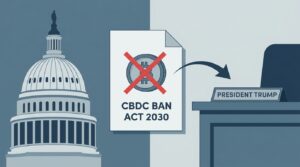
Both chambers of the U.S. Congress have now passed legislation that would prohibit the Federal Reserve from issuing a central bank digital currency (CBDC) through 2030. The bill, embedded within the broader 21st Century ROAD to Housing Act, cleared the House on Tuesday and heads to President Trump for his expected signature. If signed into law, the measure would represent the most definitive legislative stance any major economy has taken against a sovereign digital currency initiative.
What the CBDC Prohibition Means for U.S. Monetary Policy
Before unpacking the strategic implications, it’s worth grounding the discussion in what this legislation actually does. The provision doesn’t merely pause research or delay pilot programs. It erects a statutory barrier preventing the Fed from designing, testing, or deploying a retail CBDC for at least five years. That timeline matters: it effectively shelves the concept through two presidential terms and multiple Congressional cycles, making any reversal politically and procedurally difficult.
- A five-year hard stop: The ban runs through 2030, giving private-sector digital payment and stablecoin projects a wide runway to establish market dominance without competing against a government-issued alternative.
- Stablecoin legislation gains leverage: With CBDC off the table, Congressional attention and lobbying energy will likely consolidate around stablecoin regulatory frameworks already under discussion.
- The Fed loses a policy tool it never fully developed but had actively explored since 2022, when its discussion paper on a potential digital dollar drew over 2,000 public comments.
- Global positioning shift: The U.S. now stands in stark contrast to China’s expanding digital yuan program and the European Central Bank’s ongoing digital euro project, both of which continue to advance through pilot phases.
- Privacy framing wins: Proponents of the ban successfully cast CBDC as a surveillance risk, a narrative that proved more politically durable than arguments about financial inclusion or payment efficiency.
How the Ban Reached This Point
Opposition to a Fed-issued digital currency has been building for years, but the legislative vehicle that carried it to passage is notable. Embedding the CBDC prohibition inside a housing policy bill (a strategy not uncommon in Congressional deal-making, though one that often draws criticism for obscuring individual provisions) allowed it to ride a broader bipartisan coalition. The House passed the package with a large margin, signaling that resistance to CBDC cuts across party lines in ways that few digital asset issues do.
President Trump had already signaled his opposition to a CBDC during his campaign, framing it as government overreach into Americans’ financial lives. His administration’s broader posture toward digital assets has favored private innovation and market-driven solutions, a stance reflected in recent executive orders addressing cryptocurrency regulation.
Still, the legislative path wasn’t without friction. Some Democratic members raised concerns that banning CBDC research could leave the U.S. without a credible public-sector response if private stablecoins face systemic stress. That argument didn’t carry enough votes to alter the outcome.
Private Digital Dollar Projects Stand to Benefit
The clearest beneficiaries are stablecoin issuers and the broader ecosystem of firms building dollar-denominated digital payment infrastructure. Without a government competitor on the horizon, companies operating in the Federal Reserve’s traditional monetary policy domain can pursue market share with greater confidence that the regulatory landscape won’t shift beneath them mid-build.
Circle, Tether, and PayPal’s stablecoin operations all operate in a space that a CBDC would have directly challenged. And while none of these projects replicate what a central bank digital currency could offer in terms of settlement finality or sovereign backing, they’ve collectively processed trillions in transaction volume. The market has, in practice, already chosen its preferred architecture.
What Other Countries Are Doing Differently
| Country/Region | CBDC Status | Stage |
|---|---|---|
| China | Digital Yuan (e-CNY) | Expanded pilot across major cities |
| European Union | Digital Euro | Preparation phase; legislation under review |
| United Kingdom | Digital Pound | Design phase; no launch commitment yet |
| United States | Banned through 2030 | Statutory prohibition pending presidential signature |
| India | Digital Rupee | Pilot with limited retail and wholesale use cases |
The contrast is sharp. Whether the U.S. approach proves prescient or costly depends on variables that won’t resolve within this legislative window.
The Deeper Strategic Calculus
Beyond the immediate policy mechanics, this decision reflects something more fundamental about how the U.S. political system processes emerging financial technology. The CBDC debate was never purely technical. It became a proxy fight over the role of government in digital commerce, the boundaries of financial surveillance, and the degree to which monetary innovation should be led by public institutions or private markets.
Framing matters enormously in these battles. Advocates for a digital dollar emphasized efficiency, financial inclusion, and the need to keep pace with geopolitical rivals. Opponents anchored their argument in privacy, liberty, and distrust of centralized control. The latter framing proved far more resonant with the current political alignment in Washington. Understanding how these narratives shaped legislative outcomes offers a useful lens for anticipating future regulatory fights over tokenized deposits, programmable money, and cross-border payment networks.
What remains less clear is whether this ban forecloses meaningful Fed engagement with digital currency concepts entirely, or whether the central bank will quietly continue research under different labels. The legislation targets issuance, not study. That gap (a distinction regulators have been slow to clarify) could become significant.
Frequently Asked Questions
Does this bill permanently ban a U.S. CBDC?
No. The prohibition extends through 2030. Congress could revisit the issue after that date, though the political and institutional momentum against CBDC makes near-term reversal unlikely.
Can the Federal Reserve still research digital currencies?
The ban targets issuance rather than research. In theory, the Fed could continue studying CBDC concepts, though dedicating significant resources to a legally prohibited initiative would be politically awkward at best.
How does this affect stablecoins?
It removes what many in the industry viewed as the most significant long-term competitive threat. Stablecoin issuers now operate in an environment where the U.S. government has explicitly chosen not to build a public alternative, at least for the next five years.
Will President Trump sign the bill?
All public signals point to yes. He has repeatedly expressed opposition to a CBDC and framed the issue as a matter of individual financial freedom during his campaign.



