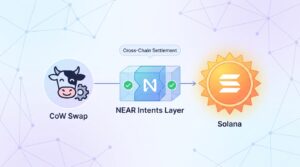
CoW Swap, the intent-based decentralized exchange known for its Coincidence of Wants model, is making its first move beyond Ethereum-compatible chains by launching on Solana. The expansion relies on NEAR Intents as its backend infrastructure, marking a significant step in cross-chain intent settlement architecture. This partnership positions both protocols at the intersection of two fast-growing narratives in DeFi: intent-based trading and multi-chain interoperability.
What CoW Swap’s Solana Expansion Signals for Intent-Based DeFi
The decision to build on Solana through NEAR’s intent layer rather than a conventional bridge or wrapper approach tells us something about where decentralized exchange infrastructure is heading. Here are the strategic takeaways worth tracking:
- Cross-chain without bridges: By routing through NEAR Intents, CoW Swap sidesteps the security and liquidity fragmentation risks that have plagued traditional bridge-based expansions
- Solana’s high-throughput environment could amplify CoW Swap’s batch auction model, potentially reducing MEV extraction for traders on the network
- NEAR’s positioning shift: This integration reframes NEAR less as a competing Layer 1 and more as connective tissue between major ecosystems
- Intent-based architecture gains traction: CoW Swap’s expansion validates the thesis that solvers and intent frameworks can operate across heterogeneous chains, not just EVM-compatible ones
- For Solana DeFi users, this introduces a fundamentally different execution model from the AMM-dominated landscape they currently navigate
How the Coincidence of Wants Model Works Across Chains
CoW Swap’s core mechanism matches traders whose orders naturally offset each other. If one user wants to sell ETH for USDC and another wants the reverse, the protocol pairs them directly, bypassing liquidity pools entirely. Surplus from better-than-expected execution goes back to the trader. That’s the theory, at least on paper.
Extending this to Solana introduces complexity. The two chains run on entirely different virtual machines, consensus mechanisms, and transaction models. NEAR Intents acts as the intermediary settlement layer, translating user intents from one chain’s format into executable operations on another. Solvers competing to fill these intents operate across both ecosystems, seeking the best execution path regardless of which chain holds the liquidity.
What remains less clear is how latency differences between Solana’s sub-second finality and Ethereum’s block times will affect batch auction dynamics. CoW Swap’s Ethereum implementation batches orders over discrete intervals. Solana’s speed could either compress these windows or require an entirely rethought auction cadence.
NEAR Intents: Infrastructure Play, Not Just a Protocol
NEAR’s strategy here deserves its own examination. Rather than competing head-to-head with Solana or Ethereum for DeFi market share, NEAR’s cross-chain intent settlement framework positions the protocol as plumbing. It’s a deliberate pivot toward becoming the layer that other protocols build through, not necessarily on.
This mirrors a broader pattern in crypto infrastructure. Chains that struggle to attract native DeFi activity are finding second lives as interoperability or data availability layers. NEAR’s bet is that intent resolution across chains will become a large enough market to justify the investment. And with CoW Swap as an early adopter, the bet carries more weight than a whitepaper promise.
Solana’s DeFi Landscape Absorbs a New Paradigm
Solana’s decentralized exchange volume has surged over the past year, driven largely by memecoin trading and AMM-based platforms like Jupiter and Raydium. But almost all of that activity runs through conventional automated market maker designs or order book hybrids. CoW Swap introduces something genuinely different: a solver-driven, intent-based execution model where users express what they want rather than how to get it.
Whether Solana’s trading community, which skews toward speed and speculation, will embrace a batch-auction approach is an open question. The model’s strength lies in MEV protection and price improvement, benefits that matter most to larger or more sophisticated traders. Retail memecoin traders may not notice the difference (or care). Still, the infrastructure will be there for protocols and aggregators that want to tap into it.
Understanding Intent-Based Trading: A Framework for Market Participants
For executives and institutional participants evaluating DeFi infrastructure, intent-based systems represent a meaningful shift in how trade execution is conceptualized. Traditional DEX models require users to specify exact parameters: which pool, which route, what slippage tolerance. Intent-based models abstract this away. The user declares an outcome. Solvers compete to deliver it.
This reframing matters because it aligns decentralized trading more closely with how traditional finance operates. A fund manager placing an order with a broker doesn’t specify which dark pool or exchange to route through. They state what they want, and execution quality is the broker’s problem. CoW Swap’s intent-based decentralized exchange applies that same logic on-chain, with solvers replacing brokers and smart contracts replacing trust.
The psychological shift is equally important. Users who understand they are delegating execution to a competitive solver market, rather than navigating complex routing themselves, are more likely to engage with DeFi products confidently. Reducing cognitive load at the interface level while maintaining transparency at the settlement level arguably represents the most sustainable path toward broader institutional adoption.
Perception of control matters here. Intent-based systems give users control over outcomes while offloading process complexity. That distinction, subtle as it sounds, could determine which DeFi models survive the next cycle and which ones remain niche tools for power users.
Frequently Asked Questions
What is CoW Swap’s Coincidence of Wants model?
CoW Swap matches traders whose orders naturally offset each other, enabling peer-to-peer settlement without relying on liquidity pools. When direct matches aren’t available, solvers find the best execution path across on-chain and off-chain liquidity sources.
Why is NEAR Intents used instead of a traditional bridge?
Bridges have historically been major points of failure in cross-chain DeFi, with billions lost to exploits. NEAR Intents provides an intent settlement layer that translates and resolves trade intents across chains without requiring users to lock assets in vulnerable bridge contracts. It’s a fundamentally different architecture.
Will CoW Swap on Solana work the same as on Ethereum?
The core intent-based model carries over, but implementation details will likely differ given Solana’s distinct transaction model and faster finality. How batch auctions adapt to Solana’s speed remains to be seen.
Does this affect Solana’s existing DEX ecosystem?
It adds a new execution paradigm rather than directly competing with AMMs. Aggregators and protocols on Solana could integrate CoW Swap’s solver network as an additional liquidity and execution source, potentially complementing existing platforms rather than displacing them.



