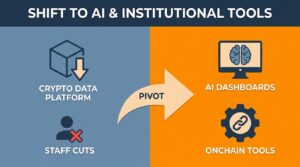
A prominent crypto data platform has laid off roughly a quarter of its workforce this week, signalling a sharp strategic pivot toward AI-powered analytics dashboards and deeper institutional adoption of onchain assets. The cuts, which affect teams across multiple departments, come amid a broader recalibration in the digital asset services sector where companies are trimming headcount to fund technology bets they view as existential. The move reflects a calculation that the next wave of crypto infrastructure revenue will flow not from retail-facing data feeds, but from enterprise-grade tooling built on machine learning and real-time blockchain intelligence.
What the Layoffs Reveal About Crypto’s Shifting Priorities
Before unpacking the strategic implications, it helps to frame what this restructuring actually tells us about where crypto data companies see durable margin. The platform’s decision to shed 25% of its team while simultaneously doubling down on AI and institutional products is not a contradiction. It is a reallocation, and arguably a belated one.
- AI as a retention lever, not a buzzword: The pivot toward AI-powered dashboards suggests the company views automated insight generation as the feature most likely to reduce churn among paying subscribers, particularly institutional ones accustomed to Bloomberg-grade tooling.
- Institutional onchain adoption is accelerating faster than retail: By refocusing resources on institutional clients, the platform is betting that asset managers, compliance teams, and treasury operations represent a more predictable revenue base than retail traders.
- Cost discipline now buys credibility later. In a market where crypto firms have burned through venture capital with little to show for it, visible headcount reduction sends a signal to investors and partners that unit economics matter.
- Talent reallocation over talent elimination: Several roles being cut appear concentrated in content, community, and general operations, while engineering and data science teams are reportedly being preserved or expanded.
Why AI-Powered Dashboards Are the Battleground
The crypto analytics space has grown crowded. Platforms like Dune, Nansen, and Messari all compete for overlapping segments of the same user base, and differentiation has become harder to sustain through raw data alone. What separates the next generation of winners, at least on paper, is the ability to layer intelligence on top of information.
AI-powered dashboards promise exactly that. Rather than presenting users with static charts and downloadable CSVs, these tools aim to surface anomalies, predict liquidity shifts, and flag wallet-level risk patterns before they cascade into market events. For institutional desks managing multi-chain portfolios, the difference between a dashboard that shows data and one that interprets it is the difference between a cost center and a decision engine.
Still, building these capabilities requires significant engineering investment. And that investment has to come from somewhere.
The Trade-Off in Human Terms
Roughly one in four employees lost their role this week. That is not an abstraction. For a mid-sized crypto company, a 25% reduction likely means dozens of people navigating a job market that remains unforgiving in Web3 (a distinction the industry’s optimistic funding headlines tend to obscure). The platform has not disclosed severance terms publicly, though sources familiar with the matter suggest affected employees received transition support.
Institutional Onchain Adoption: Where the Revenue Thesis Lives
The second pillar of this restructuring centers on institutional adoption of onchain assets. Over the past 18 months, the entry of traditional financial players into crypto custody, trading, and tokenization has reshaped demand for data infrastructure. Firms that once needed only price feeds and market cap rankings now require wallet attribution, cross-chain flow analysis, and regulatory-grade audit trails.
This shift creates a natural opening for onchain analytics platforms serving institutional portfolios to charge meaningfully higher subscription fees. Enterprise contracts in this segment can run five to ten times the cost of a retail pro plan, and they tend to renew with greater consistency.
| Metric | Retail Data Users | Institutional Data Users |
|---|---|---|
| Average contract value | $50–$300/month | $2,000–$10,000+/month |
| Churn rate | High (market-cycle dependent) | Lower (tied to compliance needs) |
| Feature demand | Price alerts, portfolio tracking | Wallet clustering, risk scoring, API access |
| Growth driver | Bull market sentiment | Regulatory expansion and tokenization mandates |
The economics speak for themselves. But capturing institutional clients requires a product maturity that many crypto-native firms have struggled to deliver consistently.
Reframing Layoffs Through a Strategic Lens
Workforce reductions in crypto tend to generate reflexive pessimism. And sometimes that pessimism is warranted. Yet this particular restructuring reads less like retreat and more like repositioning. The platform is not shrinking its ambitions; it is narrowing them. That narrowing, when paired with genuine technical capability in AI and blockchain analytics, can produce outsized returns if the institutional thesis holds.
What remains less clear is whether the remaining team has the bandwidth to execute on two simultaneous transformations: building AI-native products while also retooling sales and onboarding for a fundamentally different buyer persona. Institutional sales cycles are long, relationship-intensive, and unforgiving of product gaps. Doing both at once, with fewer people, is a bet on execution speed that not every company wins.
Frequently Asked Questions
Why are crypto data companies laying off staff in 2025?
Many are reallocating resources from broad, retail-focused operations toward specialized AI and institutional products. The shift reflects changing revenue dynamics as enterprise clients demand more sophisticated analytics tooling, and companies need engineering talent more than generalist roles to meet that demand.
What do AI-powered dashboards actually do differently?
They move beyond static data presentation. These dashboards use machine learning to detect anomalies, predict liquidity events, and automate risk assessments across wallets and protocols, turning raw blockchain data into actionable intelligence rather than just visual summaries.
Is institutional adoption of onchain assets growing?
Yes, and measurably so. Tokenized real-world assets surpassed $17 billion in total value locked in early 2025, and major custodians have expanded their onchain service offerings. Regulatory clarity in several jurisdictions has further accelerated institutional entry.
How does this affect retail users of the platform?
The company has not announced any immediate changes to its retail product. However, a strategic pivot toward institutional clients often means that product development priorities shift over time, which could slow the pace of retail-facing feature updates.