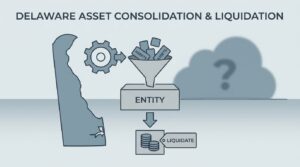
A newly established Delaware entity has been created to consolidate and liquidate the remaining assets of a distressed operation, with leadership signalling that “strategic alternatives” will be announced within the coming weeks. The move marks a decisive pivot toward wind-down proceedings, raising immediate questions for creditors, investors, and counterparties still exposed to the business. While the specific identity of the parent company remains tightly held in early filings, the structural choice of a Delaware consolidation vehicle follows a well-worn playbook in corporate restructuring.
What the Delaware Consolidation Signals for Stakeholders
The formation of a dedicated liquidation entity in Delaware is rarely a neutral act. It carries specific legal and tax advantages that make it the jurisdiction of choice for orderly asset dispositions, and its appearance here suggests the company’s board has already concluded that a going-concern sale is unlikely, or at least no longer the primary path. Before diving into the mechanics, here are the strategic takeaways that matter most:
- Liquidation over restructuring: The decision to form a new entity specifically for asset consolidation and wind-down indicates that turnaround options have been exhausted or rejected by key decision-makers.
- Creditor hierarchy will tighten: Secured creditors are likely to recover first, with unsecured claimants and equity holders facing significantly diluted prospects as assets are monetized.
- The “strategic alternatives” language typically encompasses asset sales, IP licensing deals, or partial business unit divestitures — not a full-company rescue.
- Timeline pressure: A “few weeks” window for announcing alternatives suggests that preliminary discussions with potential buyers or partners are already underway.
- Delaware’s Chancery Court provides a predictable, business-friendly forum for resolving disputes that inevitably arise during liquidation proceedings.
Why Delaware — and Why Now?
Delaware’s dominance in corporate formation is no accident. More than 60% of Fortune 500 companies are incorporated there, drawn by its specialized Court of Chancery, flexible corporate statutes, and decades of case law that provide unusual clarity on fiduciary duties during wind-downs. For a liquidating entity, these advantages become even more pronounced. The state’s Division of Corporations framework allows for streamlined dissolution procedures that can reduce both cost and timeline compared to other jurisdictions.
But the timing matters as much as the venue. Forming the entity now, with strategic alternatives promised in weeks rather than months, suggests that cash reserves are thinning or that a contractual trigger (a debt covenant breach, perhaps, or a board-mandated review deadline) has forced the issue. Companies rarely volunteer for liquidation when they still have runway.
How Asset Consolidation Typically Unfolds
The mechanics of consolidating assets into a single liquidation vehicle follow a broadly predictable sequence, though the details vary considerably depending on the asset mix. Tangible assets like real estate, equipment, and inventory are typically appraised and marketed through auction houses or specialized brokers. Intellectual property, customer lists, and proprietary technology often attract strategic buyers willing to pay a premium — sometimes the most valuable pieces of a failed business are its intangible assets.
| Asset Category | Typical Disposition Method | Recovery Rate Range |
|---|---|---|
| Real estate & facilities | Broker-managed sale or auction | 40%–80% of appraised value |
| Equipment & machinery | Industrial auction | 15%–50% of book value |
| Intellectual property | Private negotiation or structured sale | Highly variable; can exceed book value |
| Accounts receivable | Factoring or direct collection | 60%–90% of face value |
| Inventory | Liquidation sales, bulk buyers | 10%–40% of retail value, depending on perishability and demand |
Recovery rates swing wildly based on market conditions and the urgency of the sale. A forced liquidation in a depressed sector can yield pennies on the dollar.
Reading Between the Lines of “Strategic Alternatives”
The phrase itself has become something of a corporate euphemism (a distinction investors have learned, sometimes painfully, to parse carefully). When a company announces it is “exploring strategic alternatives,” the range of outcomes technically spans everything from a full acquisition to a Chapter 7 filing. In practice, though, the formation of a dedicated liquidation entity narrows that range considerably. What remains less clear is whether any of the alternatives under review involve keeping portions of the business operational under new ownership, or whether this is a clean-sheet wind-down.
Advisors in these situations typically run a dual-track process: marketing the business or its components to potential acquirers while simultaneously preparing for an orderly liquidation if no acceptable offer materializes. The “few weeks” timeline suggests the marketing phase is already well advanced.
Navigating Uncertainty: What Affected Parties Should Consider
For creditors, employees, and business partners caught in the orbit of a liquidating entity, the psychological weight of uncertainty can be as damaging as the financial exposure itself. Cognitive reframing becomes essential here. Rather than anchoring on what was owed or promised, stakeholders benefit from shifting focus to what can be influenced in the present: filing claims promptly, securing documentation of contractual obligations, and engaging legal counsel before the process advances beyond early-stage negotiations.
Experienced restructuring professionals often emphasize the importance of information asymmetry in these proceedings. The liquidating entity’s management and advisors hold a significant informational advantage over outside claimants. Proactive engagement, requesting access to asset inventories and disposition timelines, can materially improve outcomes. Waiting passively for distributions is, arguably, the single most costly mistake unsecured creditors make.
And there is a temporal dimension worth noting. Early movers in the claims process frequently secure better treatment, not because the legal framework favors them, but because practical realities like administrative convenience and negotiation leverage tend to reward those who show up first. The window between announcement and execution is where value is either preserved or lost.
Frequently Asked Questions
What does it mean when a company forms a Delaware entity for liquidation?
It typically means the company has decided to wind down operations in an orderly manner, using Delaware’s favorable legal infrastructure to consolidate assets, resolve claims, and distribute proceeds to creditors according to priority.
Who gets paid first in a liquidation?
Secured creditors with collateral interests are paid first, followed by priority unsecured claims such as employee wages and certain tax obligations. General unsecured creditors and equity holders come last, and in many cases receive little or nothing.
How long does a corporate liquidation usually take?
Timelines vary enormously. A straightforward asset sale might wrap up in three to six months. Complex liquidations involving litigation, disputed claims, or hard-to-value assets can stretch well beyond two years.
What are “strategic alternatives” in this context?
The term covers a spectrum: asset sales to third parties, licensing of intellectual property, mergers of viable business units, or outright dissolution. Given the liquidation entity’s formation, the most likely outcomes here sit toward the disposition end of that spectrum.