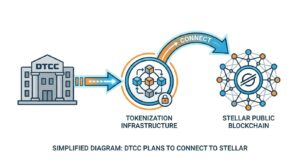
The Depository Trust & Clearing Corporation (DTCC), whose subsidiaries processed an extraordinary $4.7 quadrillion in securities transactions in 2025, has announced plans to bridge its tokenization service to the Stellar public blockchain. The deal, revealed Wednesday, marks a significant step in connecting traditional post-trade infrastructure with decentralized networks. Both organizations confirmed that DTC-tokenized assets will gain interoperability with Stellar’s open ledger, a move that could reshape how institutional-grade securities interact with public chain ecosystems.
What This Partnership Signals for Institutional Tokenization
Before unpacking the strategic implications, it’s worth framing why this particular pairing matters. DTCC sits at the center of the U.S. financial system’s plumbing. Stellar, meanwhile, has carved out a niche as a blockchain optimized for asset issuance and cross-border transfers. The convergence of these two entities suggests that tokenization is no longer a sandbox experiment for traditional finance; it is becoming operational infrastructure.
- Public chain validation: DTCC’s decision to connect with a public blockchain rather than a permissioned alternative signals growing institutional comfort with open network architectures (a distinction regulators have been slow to enforce).
- Scale meets speed: With $4.7 quadrillion in processed transactions backing DTCC’s credibility, Stellar gains a direct pipeline to the largest post-trade ecosystem in the world.
- The partnership could accelerate secondary market liquidity for tokenized assets, a persistent bottleneck that has limited real-world adoption of blockchain-based securities.
- Regulatory precedent: How U.S. regulators respond to this integration will arguably set the tone for future public-chain partnerships involving systemically important financial institutions.
- Competitive pressure: Other post-trade utilities and custodians now face a clear signal that public blockchain connectivity is moving from theoretical to production-grade.
Why Stellar, and Why Now?
Stellar’s selection is not accidental. The network has spent years positioning itself as a compliant-friendly blockchain with built-in features for asset issuance, including native support for regulatory controls like clawbacks and authorization flags. That architecture aligns with the kind of guardrails DTCC would require before exposing tokenized securities to a public ledger.
Timing matters here, too. The tokenization market has seen a surge of institutional interest throughout 2024 and into 2025, with major asset managers launching tokenized money market funds and treasury products. DTCC’s own Digital Securities Management platform has been expanding its capabilities, and connecting to Stellar’s public blockchain infrastructure represents a logical next step in that trajectory.
Still, questions linger about throughput demands. Stellar handles thousands of transactions per second in optimal conditions, but the sheer volume that DTCC’s ecosystem generates daily is orders of magnitude larger. Whether this integration begins with a narrow subset of asset types or scales broadly remains to be seen.
The Broader Tokenization Landscape Shifts
This announcement lands in a market where tokenization has become the most contested frontier in financial services. BlackRock’s BUIDL fund, Franklin Templeton’s on-chain money market fund, and JPMorgan’s Onyx platform have all demonstrated that tokenized assets can function within regulated frameworks. But interoperability between these siloed efforts has been largely absent.
DTCC’s move toward a public chain could change that calculus. By creating a bridge between its centralized post-trade infrastructure and an open network, the firm introduces the possibility of cross-platform settlement that doesn’t depend on bilateral agreements between individual institutions. That’s a structural shift, not just a product launch.
Consider the implications for collateral management alone. Tokenized securities that can move across both DTCC’s ecosystem and a public blockchain gain a kind of dual citizenship, usable in traditional clearing workflows and in decentralized finance protocols simultaneously. At least on paper, this unlocks capital efficiency gains that the industry has theorized about for years.
How Does This Affect Existing Market Participants?
Broker-dealers, custodians, and asset servicers connected to DTCC’s post-trade clearing and settlement services will need to evaluate how public blockchain connectivity changes their operational models. Compliance teams face new questions about transaction monitoring on open ledgers. And technology vendors serving these institutions will likely see demand for Stellar integration capabilities rise sharply.
Reframing Risk: What Institutional Blockchain Adoption Actually Requires
One underappreciated dimension of announcements like this involves the psychological framework institutions use when evaluating blockchain adoption. In practice, the decision to connect critical financial infrastructure to a public chain is not purely technical. It requires a fundamental reframing of risk perception.
For decades, the default assumption in post-trade services has been that security equals isolation. Closed networks, permissioned access, centralized oversight. Public blockchains invert that model, relying instead on transparency, cryptographic verification, and distributed consensus. The cognitive shift required to trust that model with trillions in assets is substantial.
What makes DTCC’s approach notable is that it doesn’t abandon the existing trust framework. Instead, it layers public chain access on top of established infrastructure, allowing institutions to engage with open networks while retaining the safety net of centralized clearing. This hybrid model addresses a core behavioral barrier: the fear that decentralization means loss of control. By maintaining DTCC’s role as the authoritative record-keeper while enabling Stellar-based distribution, the partnership offers institutions a graduated path toward broader blockchain engagement.
That graduated approach matters because adoption in financial services rarely happens through revolution. It happens through incremental comfort. Each successful transaction on a public chain, each audit that confirms data integrity, each settlement that completes without incident builds the institutional confidence necessary for the next step. DTCC and Stellar appear to understand this dynamic, designing an integration that meets risk-averse participants where they are rather than where blockchain advocates wish they would be.
Frequently Asked Questions
What is DTCC’s tokenization service?
DTCC’s Digital Securities Management platform enables the issuance, transfer, and management of tokenized securities within a regulated infrastructure framework. It serves as a bridge between traditional post-trade processes and digital asset workflows.
Why is a public blockchain connection significant?
Most institutional tokenization efforts have relied on private or permissioned blockchains. Connecting to a public network like Stellar opens the door to broader interoperability, potentially allowing tokenized assets to interact with a wider range of counterparties and protocols without bilateral agreements.
Does this mean DTCC is moving entirely to blockchain?
No. The integration with Stellar represents an extension of DTCC’s existing capabilities, not a replacement. Traditional clearing and settlement infrastructure remains the backbone of its operations.
What types of assets could be affected?
While specific asset classes covered by this integration have not been fully detailed, tokenized fixed-income instruments, money market funds, and equity securities are among the most likely candidates given current market trends and Stellar’s existing asset issuance capabilities.



