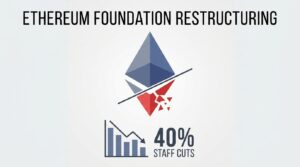
The Ethereum Foundation has announced a dramatic overhaul of its operations, reducing its annual budget by approximately 40% and eliminating roughly 20% of its workforce. According to a blog post published Tuesday, 54 employees are departing the nonprofit organization as it pivots toward a leaner, endowment-based model. The restructuring signals a fundamental shift in how the world’s most influential blockchain development organization intends to sustain itself and allocate capital going forward.
What the Budget Cuts and Layoffs Mean for Ethereum’s Ecosystem
A 40% reduction in annual spending is not a trim. It is a strategic repositioning. Before diving into the implications, here are the core takeaways from this restructuring:
- 54 employees are leaving the organization, representing about one-fifth of its total headcount
- The Foundation is transitioning to an endowment-based funding model, which suggests a longer time horizon for capital deployment but tighter annual disbursements
- Remaining resources will likely be concentrated on protocol-level research, security, and core infrastructure rather than broad ecosystem grants
- The move could pressure other Ethereum-aligned entities and grant recipients to find alternative funding sources
- Timing matters: this comes amid broader belt-tightening across the crypto sector, even as ETH’s market position remains strong relative to competitors
From Nonprofit Spending Machine to Endowment Steward
For years, the Ethereum Foundation’s approach to funding ecosystem development has drawn both praise and criticism. Praise for its willingness to fund public goods. Criticism for what some perceived as opaque allocation decisions and organizational bloat (a distinction the Foundation itself has rarely addressed head-on).
The shift to an endowment model changes the calculus entirely. Rather than spending down reserves at a pace dictated by annual grant cycles, the Foundation appears to be preserving principal and operating off returns or a controlled drawdown. That approach mirrors how university endowments and large philanthropic foundations manage longevity. Whether it works for a fast-moving technology ecosystem is another question.
Still, the logic is defensible. Ethereum’s treasury, denominated heavily in ETH, is subject to the same volatility that defines the broader crypto market. A 40% budget cut now could extend the Foundation’s operational runway by years, insulating it from a scenario where a prolonged bear market forces even deeper reductions under duress.
Who Bears the Impact?
The 54 departing employees represent real organizational knowledge walking out the door. And while the Foundation has not disclosed which teams or functions are most affected, restructurings of this scale rarely leave core research untouched.
Grant recipients and ecosystem projects that relied on Foundation funding face a more uncertain pipeline. Some will adapt. Others, particularly smaller teams working on public goods infrastructure, may struggle to secure alternative backing. The Ethereum ecosystem has matured enough that private venture capital, protocol treasuries, and DAOs can absorb some of this gap. But not all of it. Public goods funding has always been the hardest category to sustain without a centralized patron.
There is also a talent dimension worth watching. Crypto organizations compete fiercely for protocol engineers and researchers. If departing Foundation staff land at competing Layer 1 projects or move to the private sector entirely, the brain drain could compound over time.
Broader Context: Austerity Across the Sector
The Ethereum Foundation is not acting in isolation. Across the crypto industry, organizations have been recalibrating spending after the excesses of 2021 and early 2022. Consensys, a major Ethereum-focused software company, conducted its own layoffs in prior cycles. Several prominent DAOs have debated treasury management and spending discipline. Even well-capitalized protocols have pulled back on discretionary grants.
What sets this restructuring apart is scale and symbolism. The Foundation occupies a unique position: it is not a company, not a DAO, and not a government. It arguably holds more soft power over Ethereum’s direction than any other single entity, despite having no formal governance authority over the protocol. A leaner Foundation could, paradoxically, strengthen decentralization by reducing the ecosystem’s dependence on a single funding source.
Or it could create a vacuum that no one fills.
The Endowment Model: Sustainability or Constraint?
Endowment-based organizations typically target annual spending rates between 4% and 5% of total assets. Applied to the Foundation’s known ETH holdings, that formula would produce a meaningfully smaller annual budget than what the organization has historically deployed. The upside is perpetuity, at least on paper. The downside is reduced agility during periods when the ecosystem needs rapid investment in new tooling, standards, or security responses.
Arguably, the Foundation’s most critical function has always been funding work that no profit-motivated entity would touch: formal verification, cryptographic research, client diversity, and protocol upgrades that benefit the entire network without generating direct revenue. Constraining that budget forces harder prioritization. Whether that sharpens focus or starves essential work depends entirely on execution.
Frequently Asked Questions
Why is the Ethereum Foundation cutting its budget now?
The Foundation is transitioning to an endowment-based model designed to extend its operational lifespan. By reducing annual spending by 40%, it aims to preserve capital and avoid being forced into deeper cuts during potential future market downturns.
How many employees are affected?
Fifty-four employees are leaving, which represents approximately 20% of the Foundation’s workforce.
Will this affect Ethereum protocol development?
The full impact remains to be seen. Core protocol research and security are likely to retain priority, but ecosystem grants and broader funding initiatives could face significant reductions. Multiple client teams and independent contributors also work on Ethereum development outside the Foundation’s direct payroll, which provides some buffer.
What is an endowment-based model?
It means the organization manages its treasury as a long-term endowment, spending only a controlled percentage of assets annually rather than drawing down reserves at a faster rate. Universities and large foundations commonly use this structure to ensure indefinite operation.
Does this make Ethereum more decentralized?
In theory, reducing the Foundation’s financial footprint could encourage other entities to step into funding roles, distributing influence more broadly. In practice, public goods funding has historically been difficult to sustain without a dedicated patron, so the net effect is uncertain.



