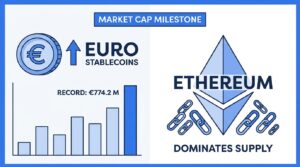
Euro-denominated stablecoins have crossed a significant threshold, reaching an all-time high onchain market capitalization of $774.2 million. Ethereum holds roughly two-thirds of the total supply, reinforcing its position as the primary settlement layer for euro-pegged digital assets. The milestone arrives at a moment when regulatory clarity in Europe, particularly through MiCA implementation, is reshaping how stablecoin issuers and users interact with the broader crypto ecosystem.
What the $774.2 Million Milestone Signals for Euro Stablecoins
This record isn’t simply a number ticking upward. It reflects a convergence of regulatory momentum, institutional appetite, and infrastructure maturation across European digital asset markets. Here are the strategic takeaways worth tracking:
- Ethereum’s dominance at approximately two-thirds of total euro stablecoin supply suggests that despite competition from faster or cheaper chains, settlement security and liquidity depth still win for institutional-grade euro assets.
- The growth trajectory aligns with the phased rollout of MiCA (Markets in Crypto-Assets Regulation), which has given licensed issuers a clearer path to operate within the EU.
- Euro stablecoins remain a fraction of the dollar-denominated stablecoin market, where USDT and USDC collectively exceed $150 billion, but the gap is narrowing at the margins.
- DeFi protocols on Ethereum increasingly list euro stablecoin pairs, expanding on-chain utility beyond simple transfers
- Institutional treasury operations in Europe are beginning to experiment with euro stablecoins for cross-border settlement, reducing reliance on correspondent banking rails.
Why Ethereum Still Commands the Euro Stablecoin Market
Roughly $516 million of the $774.2 million total sits on Ethereum. That concentration deserves scrutiny. Layer-2 networks and alternative chains like Solana or Avalanche have made aggressive pitches to stablecoin issuers, often emphasizing lower fees and faster finality. Yet for euro stablecoins specifically, Ethereum’s gravitational pull has proven difficult to escape.
Part of the explanation is structural. The largest euro stablecoin issuers, including those operating under MiCA-compliant frameworks, built their initial smart contract infrastructure on Ethereum. Migrating or fragmenting supply across chains introduces liquidity risks that institutional holders are unwilling to absorb. And while bridging solutions exist, they add counterparty layers that regulated entities tend to avoid (a distinction regulators have been slow to enforce but issuers have been quick to internalize).
There’s also the composability argument. DeFi lending markets, decentralized exchanges, and yield protocols on Ethereum’s mainnet and its growing L2 ecosystem offer euro stablecoin holders more places to deploy capital than any competing chain currently provides.
MiCA’s Quiet Influence on Stablecoin Growth
It would be difficult to discuss euro stablecoin expansion without acknowledging MiCA. The regulation, which began its staggered enforcement in mid-2024, established licensing requirements for stablecoin issuers operating within the European Union. Issuers must hold adequate reserves, maintain transparency standards, and register with national competent authorities.
What remains less clear is whether MiCA’s framework will accelerate euro stablecoin adoption or simply consolidate it among a handful of licensed players. Early signs point toward consolidation. Smaller, unlicensed issuers have already begun winding down euro-pegged tokens, while compliant operators report growing demand from fintech platforms and payment processors seeking regulated on-ramps.
Still, the regulatory picture isn’t uniform. Not every EU member state has implemented MiCA’s stablecoin provisions at the same pace, creating temporary arbitrage windows that some issuers are quietly navigating.
Euro vs. Dollar: A Stablecoin Market Still Defined by Asymmetry
| Metric | Euro Stablecoins | Dollar Stablecoins |
|---|---|---|
| Total Market Cap | ~$774.2 million | ~$150+ billion |
| Dominant Chain | Ethereum (~66%) | Ethereum & Tron (split) |
| Regulatory Framework | MiCA (EU-wide) | Fragmented (varies by jurisdiction) |
| Primary Use Case | Emerging cross-border settlement, DeFi | Trading pairs, remittances, global reserve asset on-chain |
| Growth Trend | Accelerating from a low base, with institutional interest rising notably in 2024–2025 | Steady, driven by USDT and USDC dominance |
The asymmetry is stark. But interpreting it purely as euro weakness misses the point. Dollar stablecoins had a multi-year head start, benefited from crypto markets pricing almost everything in USD, and operated in a regulatory vacuum that paradoxically enabled faster growth. Euro stablecoins are growing into a regulated framework from day one, which arguably positions them for more durable institutional adoption even if the headline numbers remain modest by comparison.
How Behavioral Framing Shapes Stablecoin Adoption
Beyond the mechanics of blockchain infrastructure and regulation, the trajectory of euro stablecoins is shaped by something less visible: how market participants perceive and frame these instruments. Neuro-linguistic programming principles offer a useful lens here. The language surrounding stablecoins, whether framed as “digital cash,” “programmable money,” or “tokenized deposits,” materially influences adoption patterns among different stakeholder groups.
For corporate treasurers, the framing matters enormously. A euro stablecoin described as a “regulated digital settlement instrument” activates very different decision-making pathways than one marketed as a “crypto token pegged to EUR.” The underlying technology may be identical, but the cognitive anchoring shifts the risk perception. Issuers who understand this distinction are tailoring their communication strategies accordingly, emphasizing compliance, reserve transparency, and institutional-grade custody in their messaging.
Regulators, too, respond to framing. MiCA’s classification of stablecoins as “e-money tokens” or “asset-referenced tokens” wasn’t just a legal taxonomy exercise. It created mental models that determine how supervisors allocate oversight resources and how banks evaluate partnership risks with stablecoin issuers. The words chosen in a whitepaper or a licensing application can accelerate or delay approval by months.
Even retail adoption follows linguistic patterns. Surveys across European fintech users consistently show that trust correlates more strongly with how a product is described than with its technical specifications. Euro stablecoin projects that anchor their value proposition in familiar financial language, such as “savings,” “transfers,” and “euros in your wallet,” tend to onboard users faster than those leading with blockchain-native terminology. The implication for issuers is clear: technical superiority alone won’t drive the next phase of growth. Narrative precision will.
Frequently Asked Questions
What are euro stablecoins?
Euro stablecoins are blockchain-based digital tokens pegged to the value of the euro, designed to maintain a 1:1 ratio with EUR through reserve backing or algorithmic mechanisms. They enable on-chain transactions denominated in euros without requiring traditional banking intermediaries.
Why does Ethereum dominate euro stablecoin issuance?
Ethereum’s deep liquidity pools, established smart contract infrastructure, and broad DeFi integration make it the default choice for issuers seeking composability and institutional credibility. Competing chains haven’t yet matched that combination for regulated euro assets.
How does MiCA affect euro stablecoins?
MiCA requires issuers to obtain licenses, hold transparent reserves, and meet operational standards. In practice, this has consolidated the market around compliant operators while pushing unlicensed issuers to exit, which may ultimately strengthen trust but reduce the number of competing tokens.
Can euro stablecoins compete with dollar stablecoins?
Not on raw market cap, at least not soon. But they serve a different function: enabling euro-denominated DeFi, reducing friction in European cross-border payments, and providing a regulated on-chain alternative for EU-based institutions. The competition isn’t zero-sum.