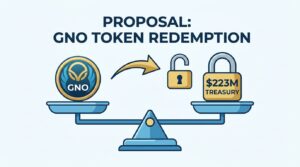
A governance vote that would allow GNO token holders to redeem their tokens for approximately $170 each from a $223 million treasury has swung back into favorable territory on Snapshot. The proposal, which effectively offers a direct claim on Gnosis DAO’s treasury reserves, had briefly trailed in polling before supporters rallied to retake the lead. The outcome carries significant implications for GNO holders, the broader Gnosis ecosystem, and how decentralized treasuries manage capital allocation under pressure from their communities.
What the Treasury Redemption Vote Means for GNO Holders
Before diving into the strategic details, it helps to frame what’s actually at stake. A $223 million treasury is not trivial, and a redemption mechanism at roughly $170 per token creates a hard floor that reshapes how the market prices GNO. Here are the key business implications:
- Price floor signal: If passed, the ~$170 redemption price establishes a tangible minimum value for GNO, anchored to real treasury assets rather than speculative demand.
- Treasury drawdown risk: A significant wave of redemptions could materially reduce the DAO’s operational runway and its capacity to fund future development.
- The vote’s back-and-forth trajectory on Snapshot suggests the community remains deeply split on whether capital return or long-term reinvestment better serves holders.
- Governance precedent: Approving a redemption mechanism of this scale would set a template that other DAOs with large treasuries will almost certainly study (and some may replicate).
- For traders and institutional participants, the redemption price creates an arbitrage-like dynamic whenever GNO trades below $170 on secondary markets.
Why the Vote Keeps Shifting
Snapshot votes in decentralized governance are not static events. They unfold over days, and large token holders can swing outcomes late. That’s precisely what appears to be happening here. The redemption proposal initially gained traction, lost momentum as opposing wallets cast their votes, and has now tipped back toward approval.
This pattern is familiar in DAO governance. Whales wait. Smaller holders vote early, creating an initial signal, and then concentrated holders respond strategically near the deadline. Whether this represents genuine community consensus or a handful of large wallets exercising outsized influence is a question the Gnosis community has not fully reckoned with.
Still, the mechanics matter less than the message. A majority of participating voters, at least on paper, want access to treasury capital.
The Tension Between Redemption and Reinvestment
At the heart of this vote sits an old argument dressed in new infrastructure. Should a project with a large cash reserve return capital to holders, or deploy it toward growth?
Gnosis has operated across multiple verticals, from its prediction market origins to the Gnosis Chain infrastructure that supports a growing ecosystem of decentralized applications. The DAO’s treasury, accumulated over years of operations and token sales, represents both a safety net and a war chest. Unlocking $223 million for redemptions would shrink that buffer considerably.
Proponents argue the treasury has been underutilized. They point to GNO trading below its per-token treasury value as evidence that the market has already discounted the DAO’s ability to deploy capital productively. In their view, redemption is not retreat; it is rational capital allocation.
Opponents counter that draining the treasury undermines long-term viability. Development, security audits, ecosystem grants, validator incentives: all of these require sustained funding. And once redeemed, that capital does not come back.
How $170 Per Token Stacks Up
| Metric | Detail |
|---|---|
| Proposed redemption price | ~$170 per GNO token |
| Total treasury value | $223 million |
| Voting platform | Snapshot (off-chain governance) |
| Current vote status | Redemption proposal leading |
| Key risk | Significant treasury depletion if redemption uptake is high |
Broader Implications for DAO Treasury Management
This vote does not exist in isolation. Across the decentralized governance landscape, treasury management has become one of the most contested topics. Projects like Arbitrum, Lido, and Uniswap have all faced debates about how to allocate reserves, though few have confronted a direct redemption mechanism of this magnitude.
What makes the Gnosis proposal distinctive is its simplicity. It is not a grant program, a buyback, or a staking incentive. It is a straight claim on underlying assets. That directness appeals to holders who have grown skeptical of elaborate treasury deployment strategies that produce unclear returns. But it also strips the DAO of optionality, arguably its most valuable asset in a volatile market.
The precedent here could ripple outward. If GNO holders successfully redeem at treasury value, every DAO sitting on a large reserve will face renewed pressure from its own community to justify why it should not do the same.
Reframing Value Perception in Decentralized Governance
Beyond the financial mechanics, this vote reflects something deeper about how token holders perceive value. When a token trades persistently below its treasury backing, a psychological gap opens. Holders begin to question whether governance itself is creating or destroying value. The redemption proposal is, in one reading, a vote of no confidence in the DAO’s ability to generate returns above its cash position.
Reframing this dynamic requires more than promises. It demands measurable outcomes: revenue growth, ecosystem adoption metrics, or clear deployment timelines that give holders a reason to stay invested rather than redeem. Without those anchors, the rational economic choice tilts toward taking the cash. And rationality, in governance votes, tends to win.
For GNO holders weighing their options, the calculation is deceptively simple on the surface but layered underneath. Redeeming locks in a known value. Holding bets on a future that the DAO’s leadership has yet to make fully legible.
Frequently Asked Questions
What happens if the GNO redemption proposal passes?
GNO token holders would gain the ability to redeem their tokens for approximately $170 each, drawn directly from the DAO’s $223 million treasury. The exact implementation timeline and any caps on total redemptions would depend on the proposal’s final terms.
Does this mean GNO’s price will drop to $170?
Not necessarily. The redemption price creates a floor, but market dynamics, speculation, and remaining treasury value post-redemption could all influence where GNO trades. It depends heavily on how many holders actually redeem.
Is this vote binding?
Snapshot votes are off-chain and technically signal-based rather than automatically executable on-chain. However, Gnosis DAO has historically treated Snapshot outcomes as binding governance decisions, so passage would carry significant weight with the core team and multisig signers responsible for execution.