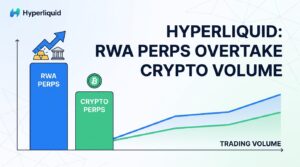
Real-world asset perpetual contracts surpassed crypto-native trading volume on Hyperliquid for the first time in the platform’s history, marking a structural shift in how decentralized exchanges attract capital. During the week of July 13–19, RWA perps generated $25.1 billion in volume, accounting for 52% of all trading activity on the platform. The milestone held for a second consecutive week, suggesting this wasn’t a one-off spike but the beginning of a durable pattern. Stocks, commodities, and indexes now compete directly with tokens for trader attention on a protocol originally built for crypto.
Why RWA Dominance on Hyperliquid Signals a Broader Market Shift
The fact that traditional asset classes outpaced crypto on a decentralized perpetuals exchange carries implications well beyond one protocol’s dashboard. For two straight weeks in July, traders on Hyperliquid allocated more capital to perps tied to equities, commodities, and indexes than to Bitcoin, Ethereum, or altcoin pairs. That’s not a marginal preference. It’s a majority.
- RWA perpetuals hit $25.1 billion in weekly volume, representing 52% of Hyperliquid’s total activity during July 13–19
- This marks the first time non-crypto assets have dominated trading on the platform across consecutive weeks
- The shift suggests DeFi infrastructure is becoming a viable venue for traditional asset exposure, not just token speculation
- Hyperliquid’s ability to support this volume without centralized order books challenges assumptions about where institutional-grade trading can happen
- Sustained RWA demand could reshape how other decentralized exchanges prioritize product development
What Actually Drove the Volume?
Several forces converged. Global equity markets were volatile through mid-July, with earnings season and macroeconomic data creating the kind of directional conviction that perpetual traders thrive on. Commodities, particularly oil and gold, saw renewed interest amid geopolitical uncertainty. And index-linked perps offered a way to express macro views without leaving the on-chain environment.
But the more interesting question isn’t why traders wanted RWA exposure. It’s why they chose Hyperliquid to get it.
The platform has built a reputation for low-latency execution and deep liquidity, two qualities that matter enormously when trading instruments pegged to real-time market prices. Unlike some DeFi venues where slippage on non-crypto pairs can be punishing, Hyperliquid’s perpetual contract infrastructure has matured to the point where it competes credibly with centralized alternatives. That maturation is what made the RWA crossover possible.
A Structural Pivot, Not a Novelty
One week of RWA dominance could be dismissed as noise. Two consecutive weeks cannot.
When more than half of a platform’s volume consistently comes from non-crypto assets, the platform’s identity starts to shift. Hyperliquid launched as a crypto-native perpetuals exchange. It may now be evolving into something closer to a general-purpose derivatives venue that happens to run on-chain. The distinction matters for how competitors, regulators, and liquidity providers evaluate the protocol going forward.
Still, there are limits to what this data tells us. Weekly volume doesn’t reveal how many unique traders participated, whether the activity was concentrated among a handful of large accounts, or how much of it was market-making flow versus directional bets. Those details would sharpen the picture considerably (and Hyperliquid has not, to date, published granular breakdowns of trader demographics).
How This Compares to Centralized Venues
| Metric | Hyperliquid (Week of July 13–19) | Context |
|---|---|---|
| Total Weekly Volume | ~$48.3 billion | Derived from RWA share at 52% |
| RWA Perps Volume | $25.1 billion | Stocks, commodities, indexes combined |
| RWA Share of Total | 52% | First-ever majority for non-crypto assets |
| Duration of Dominance | 2 consecutive weeks | Unprecedented on any major DEX |
What This Means for DeFi Product Strategy
Other decentralized exchanges have experimented with RWA-linked products, but none have seen this kind of organic crossover. The implication is straightforward: protocols that can offer reliable execution on traditional asset perps stand to capture a segment of traders who might otherwise default to centralized platforms. And that segment appears to be growing.
Yet the regulatory dimension remains unresolved. Perpetual contracts referencing equities and commodities occupy an ambiguous space in most jurisdictions. Whether regulators view these instruments as synthetic securities, derivatives, or something else entirely will shape how aggressively protocols can market and expand RWA offerings. At least on paper, the current environment allows experimentation. Whether that window stays open is another matter.
Frequently Asked Questions
What are RWA perps?
RWA perpetual contracts are derivative instruments on decentralized platforms that track the price of real-world assets like stocks, commodities, or indexes. They function similarly to crypto perps but reference off-chain markets instead.
Why does it matter that RWA volume exceeded crypto on Hyperliquid?
It signals that decentralized exchanges are no longer confined to crypto-native trading. When traditional assets dominate volume on a DeFi platform, it suggests the infrastructure has reached a level of reliability that attracts a different class of trader and a different kind of capital allocation strategy.
Is this trend likely to continue?
Two consecutive weeks of RWA dominance is notable but not yet definitive. Sustained dominance would depend on continued macro volatility, Hyperliquid’s ability to maintain execution quality at scale, and the regulatory environment remaining permissive toward synthetic asset trading on decentralized venues.
Does Hyperliquid face regulatory risk from offering stock and commodity perps?
Arguably, yes. Instruments that reference traditional securities and commodities could attract scrutiny from financial regulators in multiple jurisdictions, though enforcement actions against specific DeFi protocols for offering such products remain rare as of mid-2025.



