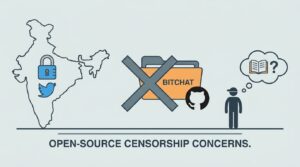
India’s Cyber Crime Coordination Centre (I4C), operating under the Ministry of Home Affairs, has directed GitHub to take down three code repositories belonging to Bitchat, a Bluetooth mesh messaging application that counts Block CEO Jack Dorsey among its backers. The directive gave Microsoft-owned GitHub just three hours to comply. Dorsey brought public attention to the takedown by publishing the order, reigniting a sharp debate over government overreach into open-source software and decentralised communication tools.
What India’s Bitchat Takedown Order Signals for Decentralised Tech
The speed and scope of the I4C’s demand deserve scrutiny. Ordering the removal of entire code repositories (not a specific release, not a flagged commit, but the foundational source code itself) represents a qualitatively different kind of enforcement action than blocking an app from a national app store. And the three-hour compliance window left almost no room for legal review or appeal.
- Sovereignty vs. open-source norms: India’s move targets code hosted on a global platform, testing the limits of jurisdictional authority over decentralised software development.
- Precedent for mesh networking apps: Bitchat uses Bluetooth mesh technology to enable peer-to-peer messaging without internet connectivity, a feature that makes it inherently resistant to conventional surveillance infrastructure.
- The involvement of Jack Dorsey, whose company Block has invested in decentralised and privacy-focused technologies, elevates this from a local regulatory skirmish to a global talking point.
- GitHub’s position: As the world’s largest code hosting platform, Microsoft’s GitHub faces increasing pressure from governments seeking to restrict access to specific repositories, putting it at the centre of a growing tension between compliance and platform neutrality.
- Whether the repositories were actually removed or remain accessible at the time of the directive’s publication has not been confirmed by GitHub.
Why Bluetooth Mesh Messaging Unsettles Regulators
Bitchat isn’t a typical messaging app. It operates over Bluetooth mesh networks that bypass traditional internet infrastructure, allowing users to communicate device-to-device without relying on cellular towers, Wi-Fi, or centralised servers. That architecture makes it functionally invisible to standard interception mechanisms.
For governments with lawful interception frameworks built around telecom providers and internet service providers, this is a blind spot. India’s IT Act and its intermediary guidelines assume a degree of platform-level control that simply doesn’t exist in mesh-based, peer-to-peer systems. The I4C’s response, targeting the source code rather than the network, reflects that structural mismatch.
Still, removing a GitHub repository doesn’t eliminate the code. Open-source projects are routinely forked, mirrored, and distributed across multiple platforms. The practical effect of a takedown order, at least on paper, may be more symbolic than operational.
Jack Dorsey’s Role and the Politics of Visibility
Dorsey’s decision to publicise the takedown order was deliberate. By surfacing the I4C’s directive, he transformed a quiet enforcement action into a public confrontation between state authority and the open-source community. This is consistent with his broader positioning since stepping down from Twitter’s leadership: Dorsey has increasingly aligned himself with decentralisation, Bitcoin-native protocols, and tools designed to resist institutional control.
Block, the financial technology company Dorsey leads, has funded multiple projects in the decentralised communications and payments space. His advocacy here isn’t incidental. It reflects a strategic commitment to technologies that operate outside traditional gatekeeping structures (a commitment not all industry observers view as purely ideological).
How This Fits India’s Broader Regulatory Posture
India has been tightening its grip on digital platforms for several years. The 2021 Information Technology (Intermediary Guidelines and Digital Media Ethics Code) Rules imposed significant compliance obligations on social media companies, including traceability requirements for encrypted messaging platforms. WhatsApp challenged those provisions in court, and the legal battle remains unresolved.
The Bitchat directive extends that trajectory into new territory. Consider the differences:
| Dimension | Traditional Platform Regulation | Bitchat Repository Takedown |
|---|---|---|
| Target | Operating companies with Indian presence | Open-source code hosted globally |
| Mechanism | Compliance notices, intermediary liability | Direct removal order to hosting platform |
| Enforcement leverage | Business operations, user base in India | Limited; code can be redistributed |
| Legal framework | IT Act, intermediary guidelines | Arguably less clearly defined for source code |
The gap in the rightmost column matters. Whether India’s existing legal instruments provide sufficient authority to order the removal of open-source repositories hosted outside its jurisdiction is a question that hasn’t been tested in court.
What Decentralised Communication Means for Digital Sovereignty
Governments worldwide are grappling with a fundamental asymmetry: the tools available for private, censorship-resistant communication are advancing faster than the regulatory frameworks designed to govern them. Mesh networking, end-to-end encryption, and decentralised protocols each present distinct challenges. Combined, they create communication channels that exist largely beyond institutional reach.
India is not alone in this struggle. The European Union’s ongoing debates around client-side scanning, Australia’s Assistance and Access Act, and the United States’ recurring encryption battles all stem from the same underlying tension. But India’s approach here, going after the source code itself rather than the application or its users, represents a notably aggressive posture.
For technology builders and investors operating in the decentralised space, the signal is clear: regulatory friction is no longer limited to deployment and distribution. It now reaches upstream, into the development layer itself. Whether that friction produces meaningful enforcement or merely drives development further underground remains the open question that neither regulators nor developers have fully answered.
Frequently Asked Questions
What is Bitchat?
Bitchat is a messaging application that uses Bluetooth mesh networking to enable device-to-device communication without requiring internet access or centralised servers. It has received backing from Jack Dorsey, CEO of Block.
Why did India order the removal of Bitchat’s repositories?
The I4C, India’s cybercrime coordination body under the Ministry of Home Affairs, issued the takedown order. The specific legal basis cited in the directive has not been fully detailed in public reporting, though the action aligns with India’s broader efforts to regulate encrypted and decentralised communication platforms.
Can removing a GitHub repository actually stop an open-source project?
In practice, not easily. Open-source code is routinely forked and mirrored across multiple platforms and personal servers. A single repository takedown may slow visibility and adoption but rarely eliminates the codebase entirely.
Has GitHub complied with the order?
Neither GitHub nor Microsoft has publicly confirmed whether the repositories were removed in response to the I4C’s three-hour deadline.



