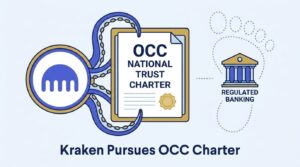
Payward, the parent company behind cryptocurrency exchange Kraken, has signalled its intent to obtain a national trust charter from the Office of the Comptroller of the Currency (OCC). The move would complement Kraken Financial, the firm’s existing Wyoming-chartered special purpose depository institution, by broadening its regulatory reach at the federal level. If granted, the charter would position Kraken among a small cohort of crypto-native firms operating under a nationally recognised banking framework. It also arrives at a moment when the OCC has shown increasing, if cautious, willingness to engage with digital asset companies seeking traditional banking credentials.
What Kraken’s Federal Charter Bid Means for Crypto Banking
The pursuit of an OCC national trust charter represents more than a licensing upgrade. For Kraken, it signals a deliberate pivot toward institutional credibility in a market where regulatory standing increasingly determines competitive advantage. Below are the strategic takeaways worth tracking:
- Federal-level trust authority would allow Kraken to offer custody and fiduciary services across all 50 states without navigating a patchwork of state-by-state licensing requirements.
- The charter complements rather than replaces Kraken Financial’s Wyoming SPDI licence, creating a dual-layer regulatory architecture that few crypto firms have attempted.
- Securing OCC approval would place Kraken alongside Anchorage Digital as one of the only crypto-native companies holding a federal banking charter (a distinction regulators have been slow to extend).
- Institutional clients, particularly asset managers and pension funds exploring digital asset custody, tend to favour counterparties with nationally recognised regulatory credentials.
- The timing aligns with broader shifts in Washington’s posture toward crypto regulation, where clarity at the federal level has become a recurring demand from both industry and lawmakers.
Why Wyoming Wasn’t Enough
Kraken Financial launched in 2020 as the first digital asset company to receive a state banking charter in Wyoming. That was a milestone. But state-level authority, however progressive Wyoming’s framework may be, carries inherent limitations. A Wyoming SPDI can custody digital assets and hold deposits, yet its operational reach remains tethered to the state’s regulatory perimeter.
A national trust charter changes the geometry entirely.
Under OCC supervision, Kraken would gain the ability to provide trust and custody services with federal preemption, meaning state-level restrictions on those activities would largely fall away. For a firm with global ambitions and a growing institutional client base, the difference between state and federal authority isn’t academic. It shapes which doors open and which stay closed. Pension funds, endowments, and registered investment advisers operate under fiduciary standards that often require their custodians to hold specific regulatory designations. An OCC-chartered trust company meets that threshold in ways a state SPDI, at least on paper, does not always satisfy.
The OCC’s Evolving Relationship with Digital Assets
The OCC has moved cautiously on crypto. In 2021, it granted a national trust charter to Anchorage Digital, marking the first time a crypto-focused firm received such approval. Since then, progress has been measured. Acting Comptrollers have alternated between encouraging innovation and tightening interpretive letters that initially gave banks broader latitude to engage with digital assets.
Still, the regulatory wind has shifted. Congressional pressure for a comprehensive digital asset framework, combined with growing institutional demand for regulated crypto custody, has nudged the OCC toward a more structured engagement model. Whether Kraken’s application advances smoothly will depend on several factors: its capital adequacy, anti-money laundering controls, and the robustness of its compliance infrastructure. The OCC’s review process for trust charters is neither fast nor forgiving.
What remains less clear is whether the current political environment accelerates or complicates the timeline. Regulatory appointments, shifting enforcement priorities, and the broader debate over stablecoin legislation all feed into the OCC’s decision-making calculus.
How This Reshapes Competitive Dynamics
Kraken’s charter pursuit doesn’t happen in isolation. Coinbase, BitGo, and several traditional custodians have been expanding their regulated offerings to capture institutional flows into digital assets. The competitive landscape increasingly rewards firms that can demonstrate regulatory depth rather than just technological capability.
| Company | Charter / Licence Type | Regulatory Authority | Scope |
|---|---|---|---|
| Kraken Financial | Special Purpose Depository Institution | Wyoming Division of Banking | State-level custody and deposits |
| Kraken (proposed) | National Trust Charter | OCC | Federal trust and custody services across all states |
| Anchorage Digital | National Trust Charter | OCC | Federal digital asset custody and lending |
| Paxos | Limited Purpose Trust Company | NYDFS | New York-regulated stablecoin issuance and custody |
And while technology stacks and fee structures matter, the real differentiator for institutional allocators is often the three-letter acronym on the licence. An OCC charter carries weight that no amount of marketing can replicate.
What Institutional Clients Actually Want
The institutional appetite for digital asset custody has grown substantially since 2020, driven by the approval of spot Bitcoin ETFs and increasing allocations from hedge funds and family offices. But appetite alone doesn’t translate into mandates. Fiduciary obligations require that custodians meet specific regulatory thresholds, and the gap between what crypto-native firms offer and what institutional compliance teams require has historically been wide.
Kraken’s dual-charter strategy arguably addresses this gap head-on. By layering federal trust authority on top of its existing state licence, the firm can present a compliance profile that mirrors traditional trust banks. That matters when the counterparty on the other side of the table is a pension fund with a $200 million allocation to explore, not a retail trader looking for lower fees.
The psychological dimension here is worth noting. Institutional decision-makers operate within frameworks shaped by precedent, peer behaviour, and perceived risk. A nationally chartered custodian triggers different cognitive anchors than a state-licensed one. The OCC imprimatur functions as a trust signal, reducing the perceived risk of engaging with a crypto-native counterparty. This framing effect, well documented in behavioural economics, means that the charter’s value extends beyond its legal utility. It reshapes how Kraken’s institutional crypto custody and trading platform is perceived by the very audience it needs to convert.
Reframing risk perception is arguably as important as the regulatory permissions themselves. When compliance officers evaluate custodians, they rely on heuristics: federal oversight signals rigour, national scope signals permanence. Kraken’s strategy appears designed to activate precisely those heuristics.
Frequently Asked Questions
What is an OCC national trust charter?
It is a federal banking charter issued by the Office of the Comptroller of the Currency that authorises an institution to provide trust and fiduciary services, including asset custody, under national regulatory supervision.
Does Kraken already have a banking licence?
Yes. Kraken Financial holds a Wyoming Special Purpose Depository Institution charter, which permits digital asset custody and deposit-taking at the state level. The proposed OCC charter would operate alongside it, not replace it.
How many crypto companies hold an OCC charter?
As of now, Anchorage Digital remains the only crypto-native firm to have received a full national trust charter from the OCC. Kraken’s application, if approved, would make it the second.
Why does a federal charter matter more than a state one?
Federal preemption allows the chartered entity to operate across all 50 states without obtaining separate state licences. For institutional clients subject to strict fiduciary requirements, federal oversight often meets compliance thresholds that state charters do not.