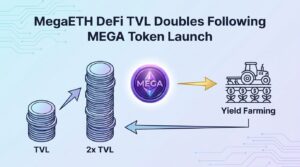
MegaETH, the Ethereum-scaling network that has attracted attention for its real-time transaction processing ambitions, saw its decentralised finance total value locked surge to roughly double its pre-launch levels within days of the MEGA token going live on Thursday. The rapid inflow appears driven largely by USDM stablecoin incentives and Terminal Points farming strategies, both of which have created compelling yield opportunities for DeFi participants. The speed of capital migration signals that liquidity-hungry protocols can still command attention in a crowded Layer 2 landscape, provided the tokenomics offer a clear short-term thesis.
What the MEGA Launch Actually Triggered
Before unpacking the numbers, it helps to frame why this matters beyond a single protocol’s metrics. Token launches in DeFi serve as liquidity magnets, but not all of them sustain momentum past the initial farming window. MegaETH’s ability to double TVL in under a week suggests the incentive architecture resonated with capital allocators, not just retail speculators chasing airdrops.
- TVL doubled since Thursday’s token launch, with the bulk of inflows tied to USDM stablecoin deposits and Terminal Points farming mechanisms
- MEGA token distribution created immediate yield pathways that attracted both existing MegaETH users and fresh capital from competing chains
- The stablecoin-centric strategy (a distinction from many Layer 2 launches that lean on volatile asset pairs) lowered the perceived risk for larger depositors
- Terminal Points farming introduced a gamified accumulation layer, giving participants a secondary reason to park liquidity beyond raw APY
- Whether this capital proves sticky once early farming rewards taper remains the open question for MegaETH’s longer-term DeFi positioning
USDM and the Stablecoin Flywheel
Stablecoin TVL has become the metric institutional observers watch most closely when evaluating chain health. Volatile-asset deposits can inflate headline numbers, but stablecoin inflows tend to reflect genuine usage intent. MegaETH’s decision to centre its launch incentives around USDM appears deliberate.
By channelling rewards through a stablecoin mechanism, the protocol effectively reduced impermanent loss risk for depositors. That matters. Large allocators, including treasury management operations and yield aggregator vaults, are far more likely to deploy capital when the downside is denominated in dollars rather than a freshly minted governance token with no price history.
Still, USDM itself carries its own set of assumptions. As a stablecoin native to the MegaETH real-time blockchain ecosystem, its peg stability and redemption mechanics will face scrutiny as TVL scales. Early confidence is not the same as battle-tested resilience.
Terminal Points: Gamification Meets Liquidity Mining
The Terminal Points system adds a layer that goes beyond conventional yield farming. Rather than simply distributing token rewards pro rata, the points framework introduces accumulation dynamics that incentivise longer deposit durations and specific protocol interactions. Think of it as a loyalty programme grafted onto DeFi primitives.
This approach borrows from the playbook popularised by protocols like EigenLayer and Blast, where points-based systems generated billions in speculative TVL ahead of token launches. MegaETH is applying the same logic post-launch, which is a subtly different bet. Pre-launch points farming benefits from uncertainty about token value; post-launch points farming requires the token to hold enough perceived upside to justify the opportunity cost of locking capital.
Whether Terminal Points can sustain engagement beyond the initial excitement phase depends on conversion mechanics that have not yet been fully detailed.
How MegaETH’s TVL Growth Compares
| Metric | Pre-Launch (Approx.) | Post-Launch (Approx.) |
|---|---|---|
| DeFi TVL | Baseline level | ~2x baseline |
| Primary inflow driver | Organic usage | USDM farming + Terminal Points |
| Capital profile | Early adopters, testnet participants | Broader DeFi allocators seeking yield |
| Risk perception | Higher (pre-token uncertainty) | Lower for stablecoin depositors, elevated for MEGA holders |
The Psychology Behind Rapid TVL Surges
Rapid capital inflows in DeFi are rarely just about numbers on a dashboard. They reflect a convergence of behavioural triggers that NLP frameworks would recognise as anchoring, social proof, and scarcity signalling working in concert.
Anchoring plays a role because the MEGA token launch created a reference point. Participants who saw early depositors earning outsized yields anchored their expectations to those initial returns, even though such rates are structurally unsustainable at scale. The result is a rush to participate before dilution erodes the opportunity.
Social proof compounds the effect. When DeFi dashboards show TVL climbing in real time, each new data point validates the decision to deposit. Crypto-native communities amplify this through social channels, where screenshots of yield figures circulate as implicit endorsements. And while experienced allocators discount this noise, the aggregate behaviour it produces is measurable in on-chain flows.
Scarcity signalling operates through the Terminal Points mechanism specifically. Points that accumulate based on early participation create a fear-of-missing-out dynamic, arguably the most powerful motivator in speculative markets. The implicit message: deposit now, or accept a permanently smaller share of future rewards.
Understanding these psychological levers does not diminish the legitimacy of MegaETH’s growth. But it does suggest that protocols designing token launches are increasingly sophisticated in how they structure incentive timing, reward visibility, and community narrative. The line between organic adoption and engineered liquidity events has never been thinner.
Frequently Asked Questions
What is MegaETH?
MegaETH is an Ethereum-scaling network focused on real-time transaction processing, positioning itself as a high-performance Layer 2 solution for decentralised applications.
Why did TVL double so quickly after the MEGA launch?
The combination of USDM stablecoin farming incentives and the Terminal Points accumulation system created strong short-term yield opportunities that attracted significant capital inflows. Stablecoin-denominated rewards lowered the barrier for risk-conscious depositors, which broadened the pool of participants beyond typical airdrop farmers.
Is this TVL growth sustainable?
That depends on several factors, including how long farming incentives remain attractive relative to competing protocols, whether USDM maintains its peg under higher volumes, and how MegaETH converts short-term depositors into long-term ecosystem participants. Early TVL surges driven by token launches often experience partial retracement once initial reward rates normalise.
What are Terminal Points?
A points-based incentive layer that rewards users for specific on-chain interactions and deposit durations within the MegaETH ecosystem, functioning as a secondary reward mechanism alongside direct token yields.



