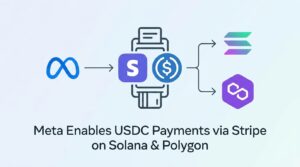
Meta has begun rolling out cryptocurrency-based payouts for creators and sellers across its platforms, integrating USDC stablecoin payments powered by Stripe’s infrastructure. The payments run on two blockchain networks: Solana and Polygon. This marks a tangible step by the social media conglomerate toward embedding digital asset rails into its existing commerce ecosystem, affecting creators who monetize through Facebook and Instagram.
What Meta’s Stablecoin Integration Signals for Platform Commerce
The decision to adopt USDC rather than a proprietary token (a distinction worth noting given Meta’s abandoned Diem project) reflects a pragmatic shift. Rather than building its own blockchain payment layer, Meta is leveraging established third-party infrastructure. Here’s what matters most for stakeholders watching this move:
- Stripe handles the payment plumbing, meaning Meta avoids the regulatory burden of directly processing crypto transactions while still offering blockchain-speed payouts to eligible users.
- Solana and Polygon were chosen for their low transaction fees and high throughput, which makes micropayments to creators economically viable at scale.
- USDC, issued by Circle, maintains a 1:1 peg with the U.S. dollar, reducing volatility risk that has historically deterred mainstream businesses from crypto adoption.
- The integration positions Meta to compete with platforms like YouTube and TikTok, which have explored but not yet operationalized stablecoin-based creator payouts
- Cross-border friction drops significantly. Creators in markets with limited banking access or high remittance fees stand to benefit most from near-instant, low-cost settlements.
Why Solana and Polygon, and Why Now?
Both networks have spent the past two years aggressively courting enterprise clients. Solana’s transaction finality sits around 400 milliseconds, with fees often below a fraction of a cent. Polygon, operating as an Ethereum Layer 2 solution, offers similar cost advantages while maintaining compatibility with the broader Ethereum ecosystem. For a platform processing potentially millions of small creator payouts monthly, these economics matter enormously.
The timing is not accidental either.
Stripe announced its support for USDC stablecoin payments earlier this year, rebuilding crypto capabilities it had shelved back in 2018 when it dropped Bitcoin support. That reversal gave Meta a ready-made partner with regulatory compliance infrastructure already in place across dozens of jurisdictions. And while Meta hasn’t disclosed the exact number of creators eligible for USDC payouts at launch, the company’s creator monetization programs span over 100 countries.
The Diem Shadow and a Different Playbook
It’s impossible to discuss Meta and crypto without acknowledging Diem, the company’s ill-fated stablecoin project that drew intense regulatory scrutiny before being wound down and its assets sold in early 2022. That experience, arguably, taught Meta a hard lesson: building proprietary financial infrastructure invites political opposition that can stall even well-resourced initiatives.
This time, Meta is a customer, not an issuer. Circle mints the USDC. Stripe moves the money. Solana and Polygon validate the transactions. Meta simply offers the payout option. That separation of roles insulates the company from the kind of regulatory confrontation that killed Diem, at least on paper.
Still, questions linger about how far Meta intends to push this. Will USDC become an option for advertisers paying for campaigns? Could marketplace transactions between buyers and sellers eventually settle on-chain? The company hasn’t said. But the infrastructure now exists to support those use cases if demand materializes.
How Stablecoin Payouts Reshape Creator Economics
Traditional creator payouts through platforms like Meta involve bank transfers that can take days to settle, carry fees that eat into small earnings, and exclude individuals without access to conventional banking. Stablecoin payouts compress that timeline to minutes. For a creator in Nigeria or the Philippines earning $50 from a Reels bonus, the difference between receiving $46 after fees in five business days versus $49.90 in under a minute is not trivial.
| Factor | Traditional Bank Payout | USDC via Solana/Polygon |
|---|---|---|
| Settlement Time | 2–5 business days | Seconds to minutes |
| Transaction Fees | $1–$5+ per transfer | Fractions of a cent |
| Banking Requirement | Full bank account needed | Crypto wallet sufficient |
| Cross-Border Complexity | Intermediary banks, FX conversion | Direct settlement in USD-pegged token |
| Availability | Limited in some regions | Accessible wherever internet connectivity and a compatible wallet exist |
Broader Market Implications Worth Tracking
Meta’s move validates a thesis that enterprise stablecoin adoption would arrive not through speculative trading but through mundane, high-volume payment flows. When a company with 3.98 billion monthly active users across its family of apps begins routing real money through blockchain rails, it normalizes the technology in ways that a thousand DeFi protocols cannot.
Competitors will feel pressure. YouTube’s parent company, Alphabet, has explored blockchain integrations without committing to stablecoin payouts. TikTok’s parent ByteDance faces its own geopolitical constraints. Snap and X (formerly Twitter) have both flirted with crypto features. None have matched the specificity of what Meta just deployed.
For Stripe, this partnership reinforces its ambition to become the default payments layer for internet commerce, crypto included. The company processes hundreds of billions of dollars annually; adding stablecoin disbursement to that stack gives it a competitive edge over legacy payment processors still hesitant about digital assets.
Frequently Asked Questions
Which creators are eligible for USDC payouts on Meta’s platforms?
Meta has not published a complete eligibility list, but the option appears tied to existing creator monetization programs on Facebook and Instagram. Availability likely varies by region and account standing.
Do creators need a crypto wallet to receive USDC?
Yes. Recipients need a wallet compatible with either the Solana or Polygon network. Several mainstream wallets, including Phantom and MetaMask, support these chains.
Is USDC the same as USD?
Not exactly. USDC is a stablecoin pegged 1:1 to the U.S. dollar and backed by cash and short-term Treasury reserves held by Circle. It can be redeemed for dollars, but it exists as a digital token on blockchain networks rather than in a traditional bank account.
Could Meta expand this to advertiser payments or marketplace purchases?
The company hasn’t confirmed any expansion plans. But the technical groundwork laid by this Stripe integration would make such extensions feasible without major additional infrastructure investment.



