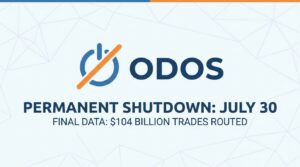
Odos, the decentralized exchange aggregator that facilitated over $104 billion in trade volume across its four-year lifespan, announced Thursday that it will permanently cease all operations on July 30. The operating company behind the protocol cited internal deliberations but offered limited detail on the precise reasons driving the shutdown. The closure marks the end of one of DeFi’s more quietly significant routing engines, one that carved out a niche by optimizing multi-token swaps across fragmented liquidity pools.
What the Odos Shutdown Signals for DEX Aggregation
The decision to wind down did not arrive in a vacuum. DEX aggregators occupy a peculiar position in decentralized finance: essential infrastructure, yet perpetually squeezed between razor-thin margins and the protocols they route through. Before unpacking the broader implications, here are the critical takeaways from this development:
- $104 billion in cumulative volume underscores that Odos was not a fringe player; it handled serious institutional and retail flow over four years
- The shutdown removes a competitive routing option from the aggregator landscape, potentially concentrating more volume through 1inch, Paraswap, and Jupiter
- No acquisition, merger, or protocol migration was announced, suggesting this is a clean exit rather than a strategic pivot
- Users should withdraw any remaining funds or open positions before the July 30 deadline
- The closure raises fresh questions about the sustainability of aggregator business models in DeFi, where fee capture remains structurally difficult
A Quiet Giant in DeFi Routing
Odos distinguished itself through its smart order routing algorithm, which could split trades across multiple decentralized exchanges simultaneously to minimize slippage and maximize output for users. That capability mattered most during periods of high volatility, when liquidity fragmentation across AMMs like Uniswap, SushiSwap, and Curve made single-venue execution costly. The Odos smart order routing platform supported multi-token input swaps, a feature that let users consolidate several assets into a single output token in one transaction.
$104 billion is not a trivial number. For context, that figure rivals the annual volume of several mid-tier centralized exchanges. Yet volume alone never guaranteed viability. Aggregators typically earn through positive slippage capture or small convenience fees, and in a market where users can bypass them entirely by going direct to a DEX, the value proposition depends on consistent execution advantage.
Whether Odos struggled with revenue generation, regulatory pressure, or simply operational fatigue remains unclear (a distinction the team’s brief announcement did little to clarify).
Competitive Landscape Shifts
The aggregator market has been consolidating for some time. 1inch dominates Ethereum-based routing. Jupiter has locked down Solana. And newer entrants like CowSwap have introduced intent-based models that arguably threaten the traditional aggregator architecture altogether.
Odos operated across multiple EVM-compatible chains, but it never achieved the brand recognition or token-driven community gravity of its larger competitors. Still, its exit tightens the field. Fewer aggregators means fewer routing paths, which could marginally increase slippage for large trades during volatile windows.
| DEX Aggregator | Primary Chain Focus | Key Differentiator | Status |
|---|---|---|---|
| Odos | Multi-chain EVM | Multi-token input swaps | Shutting down July 30 |
| 1inch | Ethereum, multi-chain | Pathfinder algorithm, Fusion mode | Active |
| Jupiter | Solana | Limit orders, DCA, perps integration | Active |
| CowSwap | Ethereum | Intent-based batch auctions for MEV protection | Active |
| Paraswap | Multi-chain EVM | Augustus router, gas optimization | Active |
The Aggregator Business Model Problem
This shutdown, arguably, tells a broader story about infrastructure economics in DeFi. Aggregators sit at the application layer but behave like utilities. Users expect them to work seamlessly, route optimally, and charge almost nothing. Building and maintaining sophisticated routing algorithms across dozens of DEXs and multiple chains requires significant engineering resources. The revenue to support that work? Often negligible.
Token launches have served as a workaround for some aggregators, creating community incentives and treasury reserves that subsidize operations. Odos did launch its ODOS token, but token-based sustainability depends on sustained demand and trading activity around the token itself. When broader market sentiment cools, so does that lifeline.
And while protocols like Uniswap have begun exploring their own aggregation features, the squeeze on standalone aggregators grows tighter from both directions: DEXs moving upstream, and wallets embedding swap functionality natively.
How DeFi Users Should Respond to the Odos Closure
Framing this purely as a market event misses the practical dimension. Users who relied on Odos for portfolio rebalancing or multi-token consolidation need to act before July 30. The transition is not just about finding an alternative aggregator; it requires reassessing workflow habits built around a specific tool’s capabilities.
Behavioral patterns in DeFi tend to be sticky. Users who found Odos through a particular wallet integration or dApp may not even realize their routing layer is disappearing until transactions start failing. Proactive migration, rather than reactive scrambling, separates prepared participants from those caught off guard. This is where intentional decision-making matters: evaluate which remaining aggregator best fits your chain preferences, typical trade sizes, and MEV protection needs before the deadline forces a rushed choice.
Consider mapping out your most frequent transaction types. If you regularly executed multi-token input swaps, your replacement options narrow considerably, since few competitors replicate that feature with the same efficiency. Anchoring your next choice in actual usage data rather than brand familiarity will yield better outcomes.
Frequently Asked Questions
When exactly does Odos stop operating?
All Odos services will permanently shut down on July 30, 2025. Users should complete any pending activity and withdraw funds well before that date to avoid disruption.
What happens to the ODOS token after the shutdown?
The announcement did not specify plans for the ODOS token post-closure. Token holders should monitor official channels for any further communication from the team, though no buyback or migration program has been disclosed.
Which DEX aggregator should Odos users switch to?
That depends heavily on chain preference and trade complexity. 1inch and Paraswap cover broad EVM ecosystems. Jupiter dominates Solana. CowSwap offers strong MEV protection on Ethereum. No single replacement perfectly mirrors Odos’s multi-token input functionality.
Is this part of a larger trend in DeFi?
Arguably, yes. Aggregator margins have been under pressure for years, and the integration of swap features directly into wallets and DEX frontends has eroded the standalone aggregator’s value proposition. Odos is unlikely to be the last closure in this segment.



