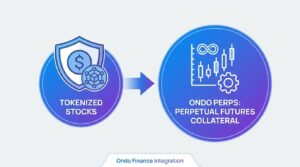
Ondo Finance has taken a concrete step toward bridging traditional equities and decentralized derivatives by deploying its tokenized stocks as collateral on OndoPerps, a perpetual futures trading venue. The initial rollout covers SPYon and QQQon, tokenized representations of the S&P 500 and Nasdaq-100 ETFs respectively. Announced Monday via X, the integration allows traders to use these tokenized equity products to back perpetual futures positions. It’s a move that collapses the gap between on-chain derivatives and real-world asset exposure in a way few protocols have attempted at this scale.
What Tokenized Stock Collateral Means for DeFi Traders
Before unpacking the strategic implications, it’s worth grounding what actually changed. Here’s what matters most for market participants and observers:
- SPYon and QQQon are now live as collateral on OndoPerps, giving traders a new category of margin backing beyond stablecoins or native crypto assets
- This creates a pathway for capital efficiency: users holding tokenized equities no longer need to liquidate those positions to trade perpetual futures
- The integration signals a broader thesis that real-world asset (RWA) tokens can serve functional roles in DeFi infrastructure, not just sit as passive yield instruments
- Perpetual futures venues have historically relied on USDC, USDT, or volatile crypto collateral, making equity-backed margin a notable departure
- Ondo’s approach positions tokenized stocks as composable building blocks rather than standalone products
Why Collateral Composition Matters More Than It Sounds
Collateral is the unglamorous backbone of every derivatives market. And yet the type of collateral a platform accepts shapes everything from liquidation dynamics to user behavior. By introducing tokenized equities into the mix, OndoPerps is effectively letting traders maintain exposure to broad market indices while simultaneously deploying that capital in leveraged positions.
That’s not a trivial shift.
In traditional finance, prime brokerages have long allowed equity holdings to serve as margin collateral. But in DeFi, the collateral menu has remained stubbornly narrow: stablecoins, ETH, BTC, and a rotating cast of governance tokens with questionable liquidity profiles. Ondo’s integration brings a flavor of TradFi capital efficiency into on-chain markets (a distinction regulators have been slow to enforce). Whether this model attracts meaningful volume depends on how traders perceive the reliability and liquidity of the underlying tokenized assets.
Ondo’s Expanding Footprint in Real-World Asset Tokenization
Ondo Finance has been building aggressively in the RWA tokenization space. The protocol already offers tokenized exposure to U.S. Treasuries through its OUSG product and short-term bonds via USDY. Adding tokenized stock indices like SPYon and QQQon extends the product line into equities, a market with far larger retail and institutional appeal.
The decision to route these products into a perpetual futures venue rather than simply listing them as passive holdings reveals something about Ondo’s strategy. Passive tokenization, where a token merely tracks an asset’s price, has limited utility in DeFi ecosystems hungry for composability. By making these tokens functional as collateral, Ondo Finance’s tokenized equity products gain a use case that extends well beyond price tracking.
Still, questions linger about the custodial and regulatory architecture underpinning these tokenized stocks. Who holds the underlying equities? What redemption mechanisms exist? How are corporate actions like dividends handled on-chain? Ondo has addressed some of these in prior documentation, but the perpetual futures integration adds new layers of counterparty and smart contract risk that haven’t been stress-tested in volatile markets.
Perpetual Futures and the Collateral Arms Race
Perpetual futures platforms have been locked in an intensifying competition for liquidity and user acquisition. Venues like dYdX, GMX, and Hyperliquid have differentiated largely on execution speed, fee structures, and supported trading pairs. Collateral flexibility represents a newer competitive axis.
OndoPerps entering this arena with equity-backed collateral could attract a different user profile entirely: traders who hold diversified portfolios and want to deploy that capital without converting to crypto-native assets first. The following table illustrates how collateral options compare across major perpetual futures venues:
| Platform | Primary Collateral Types | Equity-Backed Collateral |
|---|---|---|
| OndoPerps | Stablecoins, SPYon, QQQon | Yes (tokenized ETFs) |
| dYdX | USDC | No |
| GMX | ETH, BTC, USDC, USDT, DAI | No |
| Hyperliquid | USDC, select crypto assets | No |
The contrast is stark. Whether OndoPerps can convert this structural novelty into sustained trading volume remains an open question, but the differentiation is real.
Reframing Risk: What Traders Should Consider
Using tokenized equities as collateral introduces a layered risk profile that differs meaningfully from stablecoin-backed positions. Equity prices fluctuate. A trader using SPYon as margin faces the possibility that both their perpetual futures position and their collateral move against them simultaneously during a broad market selloff. This correlation risk doesn’t exist when collateral is denominated in stablecoins.
There’s also the matter of oracle reliability. Perpetual futures platforms depend on accurate, real-time price feeds to manage liquidations. Tokenized stocks require oracles that track not just crypto markets but traditional equity markets, which operate on different hours and settlement cycles. A weekend gap in equity pricing, for instance, could create collateral valuation ambiguities that smart contracts aren’t designed to handle gracefully.
Arguably, these risks are manageable with proper engineering. But they demand a level of infrastructure maturity that most DeFi protocols are still building toward.
Frequently Asked Questions
What are SPYon and QQQon?
They are tokenized representations of the S&P 500 ETF (SPY) and Nasdaq-100 ETF (QQQ), issued by Ondo Finance for use in decentralized finance applications.
How does using tokenized stocks as collateral differ from using stablecoins?
Stablecoins maintain a relatively fixed value, which simplifies liquidation math. Tokenized stocks fluctuate with equity markets, introducing correlation risk where both a trader’s position and collateral can decline at the same time. The tradeoff is capital efficiency: holders don’t need to sell equity exposure to access leverage.
Is OndoPerps available to all users?
According to Ondo’s announcement, tokenized stock collateral is available for all users on the platform, though jurisdictional restrictions may apply depending on regulatory frameworks in specific regions.
What risks should traders watch for?
Key risks include oracle accuracy for equity price feeds during off-hours, smart contract vulnerabilities in the collateral management layer, and the potential for correlated drawdowns during broad market stress events.



