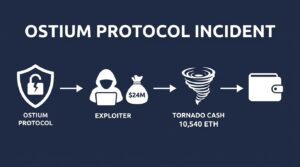
The attacker behind the $24 million exploit of Ostium, a real-world-asset perpetuals protocol built on Arbitrum, has funneled 10,540 ETH into Tornado Cash, according to blockchain security firm PeckShield. The firm confirmed that Ostium’s public OLP vault was drained of approximately $24 million in USDC. This laundering move signals a calculated effort to obscure the stolen funds’ trail, raising fresh questions about DeFi protocol security and the effectiveness of on-chain asset recovery efforts.
What the $24M Ostium Exploit Means for DeFi Security
Before diving into the specifics, it’s worth framing the broader stakes. A $24 million drain from a single vault, followed by rapid movement into a mixing service, compresses the window for any meaningful recovery. And it exposes structural vulnerabilities in how perpetuals protocols manage liquidity pools tied to real-world assets.
- The exploiter moved 10,540 ETH into Tornado Cash, the Ethereum-based mixing protocol frequently used to anonymize stolen crypto funds
- Ostium’s OLP vault lost roughly $24 million in USDC, a significant blow to a protocol operating at the intersection of RWA and on-chain derivatives
- Speed of laundering: The rapid transfer into Tornado Cash suggests the attacker had a pre-planned exit strategy, limiting the chances of fund freezing by centralized stablecoin issuers
- PeckShield flagged the transaction publicly, but by the time the alert circulated, the mixing process was already underway
- The incident adds to a growing list of DeFi exploits in 2025 that have collectively drained hundreds of millions from protocols across multiple chains
How the Attack Unfolded
PeckShield’s on-chain analysis revealed that the Ostium OLP vault, a public liquidity pool designed to support the protocol’s perpetual trading infrastructure, was the sole target. The attacker extracted approximately $24 million in USDC before converting a substantial portion into ETH. That conversion happened quickly enough to avoid any potential blacklisting by Circle, the USDC issuer (a distinction that matters, since Circle has frozen addresses in past exploits when alerted in time).
The 10,540 ETH then entered Tornado Cash in batches. Mixing services like Tornado Cash break the on-chain link between sender and receiver, making it extraordinarily difficult for investigators to trace funds beyond the deposit point. The U.S. Treasury’s Office of Foreign Assets Control sanctioned Tornado Cash in August 2022, yet the protocol’s smart contracts remain operational and accessible.
Whether additional funds from the exploit remain unmixed or were routed through alternative channels has not been confirmed.
Arbitrum’s Growing Exposure to Protocol-Level Risk
Ostium operates on Arbitrum, the leading Ethereum Layer 2 scaling network, which has attracted a dense ecosystem of DeFi protocols due to its lower transaction costs and faster settlement. But that density brings concentrated risk. When a protocol on Arbitrum suffers a major exploit, it reverberates across the chain’s liquidity landscape.
This isn’t the first significant security incident on Arbitrum in recent months. The chain’s rapid growth has outpaced the security auditing capacity available to newer protocols, and projects experimenting with novel asset classes like RWA-backed perpetuals face attack surfaces that traditional DeFi audits may not fully cover. Still, Arbitrum itself was not compromised; the vulnerability resided within Ostium’s own smart contract logic or operational security.
The Tornado Cash Problem Persists
Every major DeFi exploit in the past three years has, at some point, intersected with Tornado Cash. The protocol remains the default laundering tool for on-chain attackers despite sanctions, legal action against its developers, and ongoing regulatory scrutiny. Its continued operation illustrates a fundamental tension in decentralized systems: code deployed to an immutable blockchain doesn’t stop running because a government says it should.
For Ostium’s affected depositors, the practical implication is bleak. Once funds enter a mixer at this scale, recovery through on-chain tracing alone becomes nearly impossible. Any realistic path to restitution would likely depend on Ostium’s own treasury reserves, insurance mechanisms (if any exist), or a negotiated bounty with the attacker.
Real-World Asset Protocols Under Scrutiny
Ostium sits in a category of DeFi protocols that blend traditional financial instruments with on-chain infrastructure. RWA perpetuals allow traders to take leveraged positions on assets like commodities, forex pairs, or indices without leaving the blockchain environment. The appeal is clear: global access, 24/7 markets, reduced counterparty friction. The risk, as this exploit demonstrates, is that the smart contracts underpinning these products can become single points of catastrophic failure.
Protocols handling RWA derivatives arguably need to meet a higher security bar than standard DeFi applications, given the broader market exposure they facilitate. Whether the industry internalizes that lesson or treats this as another isolated incident will shape how institutional capital evaluates on-chain RWA products going forward.
Frequently Asked Questions
What is Ostium?
Ostium is a decentralized perpetuals trading protocol on Arbitrum that enables leveraged trading on real-world assets using on-chain infrastructure. Its OLP vault pools user-deposited USDC to provide liquidity for these trades.
Can the stolen funds be recovered?
Once assets pass through Tornado Cash, tracing becomes extremely difficult. Recovery would likely require either cooperation from the attacker, intervention by centralized exchanges if funds are eventually off-ramped, or an internal compensation mechanism from the protocol itself.
Was Arbitrum itself compromised?
No. The exploit targeted Ostium’s protocol-level contracts or operational security, not the Arbitrum network. The Layer 2 chain continued to operate normally throughout the incident.
Why is Tornado Cash still operational despite U.S. sanctions?
Tornado Cash runs on immutable smart contracts deployed to Ethereum. While its front-end interfaces have been taken down and its developers faced legal consequences, the underlying contracts remain accessible to anyone interacting directly with the blockchain. Enforcement, at least on paper, has not extended to making the contracts themselves inoperable.



