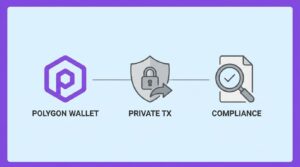
Polygon’s native wallet has rolled out a “Privately Send” feature that shields sender addresses, receiver addresses, and transaction amounts from public view on the blockchain. What sets this apart from earlier privacy tools in crypto is the integration of Know Your Transaction (KYT) screening into every single transfer. The move positions Polygon at a tricky intersection: user privacy and regulatory compliance, two forces that have historically pulled in opposite directions across the digital asset landscape.
What Polygon’s Privacy Feature Signals for the Industry
Privacy in blockchain transactions has long been a polarising topic. Regulators worry about illicit finance; users demand confidentiality that mirrors traditional banking. Polygon’s approach attempts to thread that needle, and the implications ripple well beyond a single wallet update.
- By embedding KYT compliance directly into the privacy layer, Polygon avoids the regulatory landmines that sank or sidelined earlier privacy-focused protocols
- The feature could accelerate institutional interest in Polygon-based applications, where data confidentiality has been a persistent barrier to adoption
- Competing Layer 2 networks now face pressure to offer equivalent privacy tooling or risk losing users who treat transaction confidentiality as non-negotiable
- This is arguably the clearest signal yet that privacy and compliance are converging into a single product requirement, not a trade-off
How the “Privately Send” Feature Actually Works
At its core, the feature obscures three data points that are typically visible on any public blockchain: who sent the transaction, who received it, and how much was transferred. These details remain hidden from onchain observers while still being processed through KYT screening mechanisms before execution.
KYT, for those outside the compliance world, functions as a real-time transaction monitoring layer. It flags transfers that match patterns associated with sanctioned entities, known illicit wallets, or suspicious activity. Every “Privately Send” transaction passes through this filter. If a transfer triggers a compliance flag, it doesn’t go through. That’s the deal.
The technical architecture behind this hasn’t been fully detailed by the Polygon development team, though the wallet-level integration suggests the screening occurs client-side or through a trusted intermediary before the privacy-preserving transaction hits the network. Whether that intermediary layer introduces latency or centralisation risks remains an open question the team has not yet addressed publicly.
Why Privacy and Compliance Are Merging Now
For years, privacy coins and mixing services operated in a grey zone. Tornado Cash’s sanctioning by the U.S. Treasury’s OFAC in August 2022 changed the calculus dramatically. Developers and protocols learned a hard lesson: privacy without compliance guardrails invites enforcement action, regardless of the underlying technology’s legitimacy.
Polygon’s timing here is deliberate. The EU’s Markets in Crypto-Assets (MiCA) regulation is now in effect, and the U.S. continues to tighten its stance on transaction transparency through proposed rulemaking at FinCEN. Building privacy features that satisfy both user demand and regulatory expectations is no longer a nice-to-have. It’s a survival strategy for any protocol seeking mainstream relevance.
Still, not everyone in the ecosystem views this as progress.
Privacy maximalists argue that any compliance layer, no matter how well-intentioned, introduces a gatekeeping function that undermines the censorship-resistant ethos of blockchain technology. And they have a point (at least philosophically). The question is whether that ethos can coexist with a regulatory environment that shows no signs of relaxing its grip on digital asset flows.
Competitive Landscape and Strategic Positioning
Polygon isn’t operating in a vacuum. Several projects have explored privacy-preserving transactions with varying degrees of compliance integration:
| Project | Privacy Approach | Compliance Integration |
|---|---|---|
| Polygon Wallet | Hides sender, receiver, amount | KYT screening on every transaction |
| Aztec Network | Zero-knowledge rollup with encrypted transactions | Selective disclosure mechanisms under development |
| Railgun | Shielded transfers on Ethereum | Built-in proof-of-innocence system |
| Zcash | Shielded pool with optional transparency | No native compliance layer; relies on exchange-level controls |
What distinguishes Polygon’s implementation is the wallet-native integration. Users don’t need a separate tool, a third-party mixer, or additional steps. The privacy option sits alongside standard send functionality. That kind of seamless UX lowers the friction barrier considerably, which in practice matters more than technical elegance when it comes to adoption.
Reframing Privacy as a Product Feature, Not an Ideology
There’s a broader shift happening here that deserves attention. For much of crypto’s history, privacy was treated as an ideological position. You were either for it or against it, and the tools reflected that binary. Polygon’s move reframes privacy as a product feature with configurable compliance parameters.
This reframing matters because it changes who the audience is. Enterprise treasury teams, institutional DeFi participants, and regulated financial entities have all cited transaction privacy as a prerequisite for deeper blockchain engagement. But they need that privacy to come with audit trails and compliance assurances their legal teams can defend. By packaging both into a single wallet action, Polygon is speaking directly to that constituency.
The psychological dimension is worth noting too. When users feel their financial data is protected by default rather than exposed by default, trust in the platform deepens. Behavioural research consistently shows that perceived control over personal information drives engagement and retention. Polygon’s design choice taps into that dynamic, making privacy feel like a right rather than a workaround.
Frequently Asked Questions
Does the Privately Send feature work for all tokens on Polygon?
Details on supported token types have not been fully disclosed. Wallet-level privacy features typically begin with native tokens and major stablecoins before expanding to broader asset support.
Can regulators still access transaction data if needed?
The KYT screening layer suggests that compliance data exists somewhere in the pipeline, though Polygon has not publicly outlined how or whether law enforcement requests would be handled. This is one of the harder questions the feature raises.
Is this similar to using a privacy coin like Monero?
Not exactly. Privacy coins bake confidentiality into the protocol layer itself. Polygon’s approach applies privacy at the wallet application level while maintaining a compliance checkpoint, a fundamentally different architecture with different trade-offs.
Will other wallets on Polygon support this feature?
That depends on whether the privacy mechanism is exposed as a network-level primitive or remains exclusive to Polygon’s own wallet. Third-party wallet integration would require developer tooling that hasn’t been announced yet.