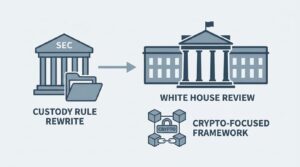
The Securities and Exchange Commission has sent a proposed overhaul of custody rules for investment advisers and investment companies to the White House for review, a procedural step that signals the rulemaking is approaching its next public phase. Submitted on Aug. 25, the proposal introduces a crypto-specific regulatory framework after the agency pulled back a separate 2023 safeguarding proposal that had drawn sharp criticism from industry participants. The move places digital asset custody squarely within the broader regulatory architecture governing traditional finance, and it arrives at a moment when institutional appetite for crypto exposure continues to grow.
What the SEC’s Custody Rule Rewrite Means for Digital Asset Markets
Before diving into the specifics, it helps to understand why this matters beyond the regulatory mechanics. Custody rules determine who can hold client assets, under what conditions, and with what protections. For crypto, where self-custody and decentralized protocols blur the lines of traditional safekeeping, these rules carry outsized weight. The framework the SEC advances here will likely shape how registered investment advisers interact with digital assets for years.
- The SEC’s decision to withdraw its 2023 safeguarding proposal and replace it with a new custody-focused rule suggests the agency is recalibrating its approach to digital asset regulation rather than simply layering new requirements onto existing ones.
- White House review through the Office of Information and Regulatory Affairs (OIRA) typically precedes a formal notice-and-comment period, meaning market participants could see a proposed rule text within weeks or months.
- Investment advisers managing crypto allocations face potential compliance overhauls depending on how the rule defines qualified custodians for digital assets.
- The timing aligns with broader Washington momentum around crypto legislation, including stablecoin bills and market structure proposals moving through Congress.
- A clearer custody framework could reduce one of the key barriers institutional allocators cite when explaining their hesitance toward digital asset exposure.
Why the 2023 Safeguarding Proposal Was Pulled
The SEC’s earlier attempt at modernizing custody requirements, proposed in February 2023, drew extensive pushback. Critics argued the rule was overly broad, extending custody obligations to asset classes and arrangements that didn’t fit neatly into the traditional custodial model. Crypto industry groups were particularly vocal, contending that the proposal failed to account for the technical realities of blockchain-based asset storage.
And the concerns weren’t limited to crypto firms. Traditional asset managers questioned whether the rule would impose disproportionate costs on smaller advisory shops. The comment period generated hundreds of responses, many of them detailed and adversarial. Rather than finalize a rule that faced near-certain legal challenge, the SEC opted to start fresh.
That decision, arguably, reflects a more pragmatic posture from the commission under its current leadership.
How OIRA Review Shapes the Timeline
Once a proposed rule reaches the Office of Information and Regulatory Affairs, the review process can take anywhere from 30 to 90 days, though extensions are common. OIRA examines the rule’s economic impact, its alignment with executive priorities, and whether the cost-benefit analysis holds up under scrutiny. For a rule touching crypto custody, expect particular attention to how the SEC quantifies compliance costs for digital asset custodians.
What remains less clear is whether the White House will push for modifications that soften or sharpen the crypto-specific provisions. The current administration has signaled a more accommodating stance toward digital assets than its predecessor (a distinction that has already influenced SEC staffing and enforcement priorities), but accommodation doesn’t guarantee the industry will get the framework it wants.
Key Variables to Watch During Review
| Variable | Potential Impact |
|---|---|
| Definition of qualified custodian for digital assets | Determines which entities can legally hold crypto on behalf of advisory clients; could include or exclude crypto-native custodians |
| Treatment of self-custody and smart contract-based arrangements | May create new compliance categories or exclude DeFi-adjacent strategies entirely |
| Cost-benefit analysis methodology | OIRA scrutiny here could delay or reshape the final proposal |
| Alignment with pending Congressional crypto legislation | Overlap or conflict with stablecoin or market structure bills could force revisions |
Institutional Custody and the Broader Regulatory Puzzle
For institutional investors, custody has long been the unglamorous but essential plumbing of portfolio management. In traditional markets, the rules are well-established: banks, broker-dealers, and trust companies serve as qualified custodians under SEC oversight. Crypto disrupts that model. Digital assets can be held in hot wallets, cold storage, multi-signature arrangements, or through decentralized protocols that have no central operator. The SEC’s evolving custody framework must somehow accommodate these realities without abandoning the investor protections that custody rules exist to provide.
Still, the gap between what regulators want and what technology permits is narrowing. Several crypto-native custodians have pursued state trust charters or federal banking licenses precisely to position themselves as qualified custodians under whatever framework emerges. Firms like Anchorage Digital, which holds a federal bank charter, and Coinbase Custody, operating under a New York trust charter, have spent years building the compliance infrastructure that a stricter custody rule would demand.
Whether the SEC’s new proposal recognizes these efforts or imposes additional requirements remains the central tension.
Frequently Asked Questions
What is the SEC custody rule?
The custody rule governs how investment advisers must safeguard client assets. It specifies which entities qualify as custodians and what protections must be in place. The proposed rewrite would update these requirements to address digital assets specifically.
Why did the SEC withdraw its 2023 safeguarding proposal?
The earlier proposal faced broad criticism for being overly expansive and poorly tailored to non-traditional asset classes, particularly crypto. The SEC chose to replace it with a more targeted approach rather than finalize a rule likely to face legal challenges.
When could the new custody rule take effect?
The rule is currently under White House review, which typically lasts 30 to 90 days. After that, the SEC would publish a proposed rule for public comment, review responses, and then issue a final rule. Realistically, a final rule is unlikely before late 2026 at the earliest.
How does this affect crypto investors?
Directly, the rule targets investment advisers and investment companies, not retail investors. But indirectly, the framework will determine how easily advisers can offer crypto exposure to their clients, which shapes access and product availability across the market.



