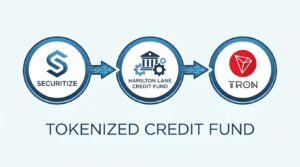
Securitize has issued a tokenized version of Hamilton Lane’s Senior Credit Opportunities Fund (HLSCOPE) on the TRON blockchain, marking the first time the tokenization platform has deployed an asset on the stablecoin-dominant network. The joint announcement, made Tuesday, signals a deliberate push by both firms to tap into TRON’s deep liquidity pool and its massive stablecoin user base. For Hamilton Lane, a firm managing over $900 billion in assets under management and supervision, the move extends its reach into a blockchain ecosystem that has historically been associated more with retail-scale USDT transfers than institutional credit products.
Why the TRON Deployment Reshapes Tokenization Strategy
Before unpacking the specifics, it’s worth framing what this launch actually represents in the broader tokenized real-world assets (RWA) landscape. Securitize has built its reputation issuing tokenized funds on Ethereum and, more recently, other EVM-compatible chains. Choosing TRON breaks that pattern in a meaningful way. Here’s what matters most from a strategic standpoint:
- First-ever TRON issuance for Securitize — the platform’s expansion beyond Ethereum-aligned ecosystems suggests a multi-chain distribution thesis is now operational, not theoretical
- TRON processes more stablecoin volume than any other blockchain, giving HLSCOPE immediate proximity to capital that’s already on-chain and liquid
- Hamilton Lane’s institutional credibility lends weight to TRON’s bid for legitimacy among asset managers who have historically dismissed the network
- The fund itself targets senior credit opportunities, a relatively conservative asset class that could appeal to stablecoin holders seeking yield without moving off-chain
- This deployment may pressure competing tokenization platforms to evaluate TRON as a viable distribution layer
What HLSCOPE Actually Offers On-Chain Investors
Hamilton Lane’s Senior Credit Opportunities Fund focuses on senior secured lending, a segment of private credit that sits higher in the capital structure and, at least on paper, carries lower default risk than subordinated debt. Tokenizing this fund through Securitize allows qualified investors to access the strategy with blockchain-native settlement and custody infrastructure.
The mechanics matter here. Securitize acts as the transfer agent and technology layer, handling compliance checks, investor onboarding, and token issuance. TRON provides the settlement rail. And Hamilton Lane manages the underlying portfolio. That three-party architecture is becoming standard in institutional tokenization, but deploying it on TRON introduces a variable that few institutional players have tested at this scale.
Still, the choice isn’t random. TRON’s network handles roughly $53 billion in daily USDT transfer volume on peak days (a distinction that often surprises those who associate the chain primarily with Justin Sun’s public persona). For a product denominated in dollars and targeting yield-seeking capital, that pipeline is hard to ignore.
TRON’s Institutional Pivot: More Than Stablecoins?
TRON has long occupied an unusual position in crypto. It dominates stablecoin transfers globally, particularly in emerging markets where USDT on TRON serves as a de facto dollar rail. But institutional asset issuance? That’s new territory.
Securitize’s decision to launch on TRON suggests the network’s transaction throughput and low fees have crossed a threshold that institutional infrastructure providers now consider acceptable. Whether other tokenization firms follow depends partly on how smoothly this deployment performs and partly on whether TRON’s governance and validator structure satisfy the due diligence requirements of regulated fund administrators.
And while Ethereum remains the default chain for tokenized treasuries and credit products from firms like BlackRock and Franklin Templeton, the competitive dynamics are shifting. Avalanche, Polygon, Stellar, and now TRON are all vying for a share of what Boston Consulting Group has projected could become a $16 trillion tokenized asset market by 2030. Each chain offers a different value proposition. TRON’s is volume and reach, particularly in Asia and Latin America.
How This Fits the Broader RWA Tokenization Wave
The tokenized real-world asset sector has grown rapidly through 2024 and into 2025, with on-chain treasuries alone surpassing $2 billion in total value locked across multiple protocols. Private credit tokenization, though smaller in aggregate, is arguably where the more consequential institutional experimentation is happening. Funds like HLSCOPE represent a bridge between traditional allocators and DeFi-native capital pools.
Securitize’s tokenization infrastructure for private market funds has already facilitated issuances for major asset managers, including its work with BlackRock’s BUIDL fund on Ethereum. Adding TRON to its supported chains expands the addressable investor base without requiring Hamilton Lane to modify the fund’s underlying strategy or compliance framework.
One question lingers beneath the surface: does issuing on TRON change the investor profile that these products attract? Senior credit is a conservative allocation. TRON’s user base skews toward stablecoin utility. The overlap between those two populations isn’t obvious, and neither firm has publicly addressed how they expect demand to materialize.
Frequently Asked Questions
What is HLSCOPE?
HLSCOPE is Hamilton Lane’s Senior Credit Opportunities Fund, which invests in senior secured lending. The tokenized version issued by Securitize allows blockchain-based access to this institutional credit strategy.
Why was TRON selected for this launch?
TRON processes more stablecoin volume than any other blockchain, offering immediate access to on-chain dollar liquidity. Its low transaction fees and high throughput also make it operationally attractive for fund settlement.
Is this the first tokenized fund on TRON?
It is the first asset Securitize has ever issued on TRON. The deployment represents a significant expansion of both Securitize’s multi-chain strategy and TRON’s role in institutional finance. Whether other tokenized funds already exist on TRON through different issuers is less well-documented.
Who can invest in the tokenized HLSCOPE fund?
Securitize handles investor onboarding and compliance, meaning participants must meet applicable regulatory and accreditation requirements. This isn’t a permissionless DeFi product.
What Comes After the First Issuance
Launching a single fund on a new chain is a proof of concept, not a migration. But proofs of concept in institutional finance tend to carry outsized signaling value. If HLSCOPE on TRON attracts meaningful inflows, expect Securitize to expand its TRON-based offerings and expect competing platforms to accelerate their own multi-chain roadmaps. The tokenized asset space is no longer debating whether to go multi-chain. The debate now centers on which chains earn the right to host institutional-grade products, and TRON just entered that conversation with a credible first entry.



